
Peel-and-reveal labels are multi-layer constructions built from two or more bonded plies that a consumer lifts and peels back to expose hidden panels underneath. Brands turn to them for one core reason: they let you print pages of regulatory copy, translations, or promotional content without adding a single millimeter to the container itself. The tradeoff is production complexity, and getting that right is where most projects succeed or stall.
**TL;DR:** Recyclability of peel-and-reveal labels depends on matching the face stock, adhesive, and inks with the container’s recycling stream, requiring supplier test data. Accurate production relies on locking down material specifications, adhesive types, and registration capabilities before finalizing artwork and design. Short runs with variable content are best produced using digital printing, while high-volume jobs with embellishments favor flexo printing. Proper die-cutting and peel-force testing across environmental conditions are critical to ensure labels peel cleanly without tearing or misregistering. Choosing the right construction, materials, and supplier expertise can reduce production errors and improve sustainability outcomes.
Table of Contents
- What Are Peel-and-Reveal Labels and How Do the Constructions Differ?
- Why Do Brands Use Peel-and-Reveal Labels?
- How Do You Choose Materials That Meet Recyclability Goals?
- What Should You Know About Manufacturing and Printing Peel-and-Reveal Labels?
- What Design Rules Keep Peel-and-Reveal Labels Functional?
- What Should a Peel-and-Reveal Label Spec Sheet Include?
- What Makes Yuan Packaging Suited to Complex Label Projects?
- The Real Bottleneck Isn’t Design. It’s Production Discipline
- Get a Sample or Quote for Your Next Label Project
- Sources
- FAQ
What Are Peel-and-Reveal Labels and How Do the Constructions Differ?
You’ll see this format called several things depending on who you’re talking to: peel-and-reveal, peel-back, piggyback, or extended-content labels. All of them describe the same idea, layers of pre-printed material laminated together at a hinge, so the reader peels one ply away from another to access more content than a single-panel label could ever hold.
The construction you pick determines how much content you can fit and how the label behaves in a consumer’s hands.
- *2-ply (booklet or piggyback):** A top ply hinges open over a base ply, roughly doubling printable area. Common on wine and cosmetics for tasting notes or ingredient lists.
- *3-ply and multi-page booklet:** Several plies stack and fold, often used in pharmaceuticals where dosage information runs in a dozen languages.
- *Butterfly labels:** Two wings fold inward over a center panel, frequently used on ampoules and small vials where space is extremely tight.
- *Resealable hinge labels:** A deadened (non-adhesive) corner or edge lets the consumer peel back and reclose repeatedly without tearing the face stock.
Release liners and a controlled hinge width keep the peel action smooth. Brands with heavy compliance text tend to choose booklet formats; those chasing shelf appeal with a promotional reveal often stick to a simple 2-ply.
Why Do Brands Use Peel-and-Reveal Labels?
The business case for extended-content labels rests on three pillars: regulatory necessity, promotional creativity, and operational simplification.
Pharmaceutical brands lean on multi-layer labels most heavily, since regulated products routinely require dosage instructions, side effects, and multilingual directions that no single-panel label could accommodate. Cosmetics and spirits brands use the same construction for a different reason: it lets them turn compliance space into a storytelling opportunity.
- *Regulatory and multilingual compliance.** One SKU can satisfy label requirements across a dozen markets by hiding country-specific language under the top ply instead of running separate print jobs.
- *Promotional mechanics.** Coupons, unique codes, and loyalty offers print on inner panels, turning a bottle or jar into an interactive touchpoint rather than a static wrapper.
- *Brand storytelling.** Origin stories, sourcing details, or usage rituals fit on the reveal panel without crowding the primary artwork that sells the product at first glance.
- *Operational consolidation.** A single multi-layer label often replaces a folded insert, an outer sleeve, or a secondary carton, cutting material cost and simplifying the supply chain.
- *Traceability.** Serialized codes tucked under the peel layer support anti-counterfeit programs and batch tracking without cluttering the visible face.
How Do You Choose Materials That Meet Recyclability Goals?
Material choice on a multi-layer label is a balancing act between shelf durability and recycling compatibility, and procurement teams need to weigh both from the start.
Paper face stocks recycle more easily in most municipal streams but perform poorly in humid or refrigerated environments. Synthetic films like PP and PET hold up better against moisture and handling, but only recycle cleanly when they match the resin of the container they’re applied to or use an adhesive designed to separate during the wash stage.
- *Paper face stock:** Best recyclability profile, weaker moisture and durability performance.
- *PP or PET films:** Strong durability, recyclable when matched to a compatible container stream.
- *Synthetic paper:** A middle ground offering film-like durability with better print handling than raw paper.
Recyclability ultimately hinges on how the material, adhesive, and inks interact with the recycling stream the container enters, not on the face stock alone, according to guidance on sustainable packaging materials. Wash-off adhesive systems are the clearest lever brands have here. UPM’s wash-off label portfolio is built specifically to separate cleanly from PET and HDPE flakes during the recycling wash stage, which keeps label residue out of the recycled resin.
Before finalizing a spec, ask your supplier for wash-off test data on the exact adhesive and container combination you’re using, and check How2Recycle or your local recycler’s requirements, since recyclability claims are stream-specific rather than universal.
What Should You Know About Manufacturing and Printing Peel-and-Reveal Labels?
Production choice starts with run length. Digital printing suits short runs and variable data like serialized codes or region-specific text, while flexo remains the more cost-effective route for high-volume orders and can inline a wider range of embellishments in a single pass.
The production flow itself involves several tightly sequenced steps:
- Unwinding and delaminating the base web so each ply can be printed separately
- Printing registration marks and artwork on multiple faces
- Relaminating the plies at the hinge with precise alignment
- Die-cutting to the finished label shape and kiss-cutting the peel line
- Slitting and rewinding into finished rolls for application
Multi-layer production is unforgiving of small errors. It requires exact registration between multiple webs, disciplined tension control, and specialized delamination and relamination equipment, since even minor drift causes warping or misregistered panels, according to FlexoTech’s reporting on multi-layer label production. Many converters now run inline crossover units or parallel web translators that print and laminate in a single pass, which improves both registration accuracy and throughput.
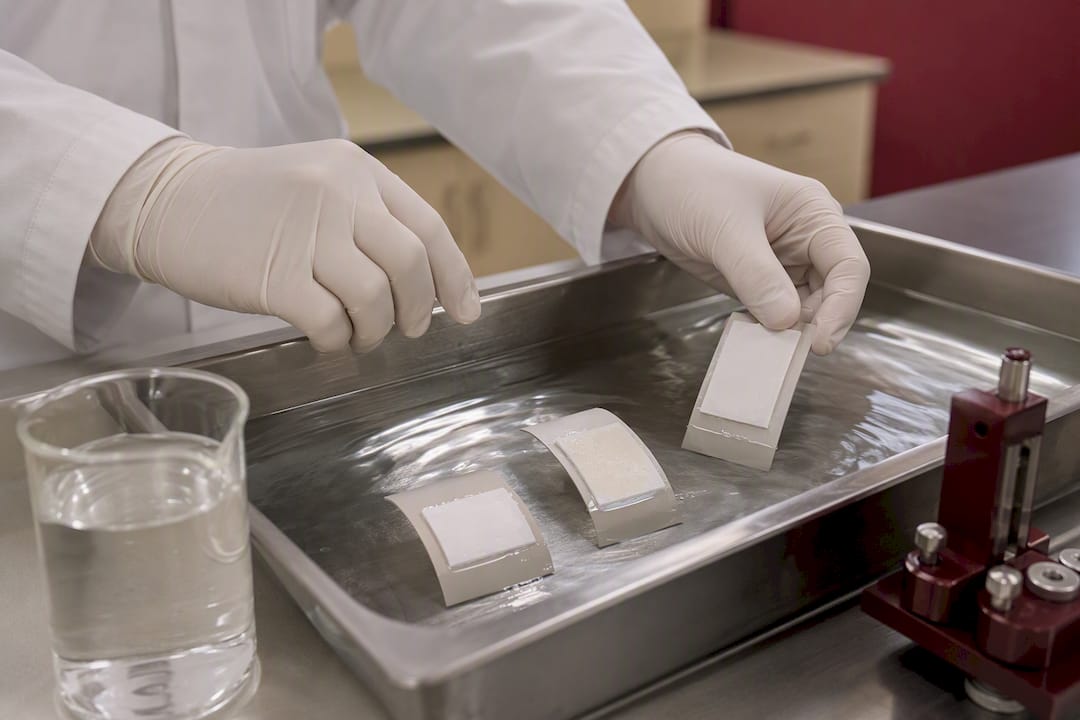
Die-cut depth deserves particular attention. Cut too deep and the top ply tears prematurely; cut too shallow and consumers can’t get a clean peel start. Reputable converters test peel-force ranges before committing to a production die.
**Pro Tip:** _Ask your printer for peel-force test results across a range of environmental conditions, not just room temperature. A label that peels cleanly at 70°F can behave very differently after a cold supply chain or a humid retail floor._
What Design Rules Keep Peel-and-Reveal Labels Functional?
Artwork for multi-layer labels needs to account for mechanics that a single-panel design never has to consider. Get these wrong and you’ll be reprinting plates after the first press proof.
- *Build separate artboards per ply.** Each layer needs its own file with precise die-lines marking the cut path, hinge location, and bleed area, so your printer isn’t guessing where one panel ends and the next begins.
- *Respect minimum type sizes on inner panels.** Compliance text often gets crammed onto the smallest available space; keep body copy no smaller than 6 points and never run critical information across a peel seam, where it can distort or tear.
- *Specify the hinge and deadened corner explicitly.** State hinge width and which edge stays adhesive-free so the label reseals without curling.
- *Request a physical proof before production.** A flat digital proof can’t show you how the peel actually feels. Ask for die-cut samples on the real substrate before signing off on a full run.
What Should a Peel-and-Reveal Label Spec Sheet Include?
A tight spec sheet is the fastest way to get comparable quotes instead of vague estimates that fall apart at production.
- Face material and ply count (paper, PP, PET, or synthetic paper)
- Adhesive type, including whether wash-off or repositionable adhesive is required
- Finished label size and hinge/deadened corner dimensions
- Target peel-force range and reseal cycle expectations
- Embellishments needed (foil, tactile varnish, holographic elements)
- Press type available (digital, flexo, or hybrid) and delam/relam capability
- Inspection method, sample process, minimum order quantity, and lead time
Ask suppliers directly whether they run inline delamination and relamination, since that capability affects both registration accuracy and turnaround time. Reputable partners will also offer inspection data, such as 4K camera inspection, and peel-and-reseal cycle testing before committing to full production, particularly for regulated or premium-market jobs, per FlexoTech’s production guidance.
| What to Request | Why It Matters |
|---|---|
| Peel-force test data | Confirms the label opens and reseals consistently across conditions |
| Wash-off adhesive documentation | Verifies recyclability claims for your specific container stream |
| Press samples on final substrate | Reveals hinge feel and print registration before committing to a die |
| Delam/relam capability confirmation | Determines whether the supplier can handle true multi-web registration |
Cost drivers to expect in any quote include ply count, embellishment complexity, and run length. A short-run digital job with variable codes will price differently per unit than a high-volume flexo run with foil accents, so compare quotes against matched specs, not just a bottom-line number.
What Makes Yuan Packaging Suited to Complex Label Projects?
Producing a reliable multi-layer label takes more than a press. It takes a converter with real registration discipline and material flexibility. Yuan Packaging brings over 25 years of experience manufacturing premium labels and packaging for beauty, spirits, and lifestyle brands, with more than 100 million units delivered across 5,000 brands globally.
That track record includes pressure-sensitive label production, anti-counterfeit and serialized security finishes, and prototyping support that lets brand teams test peel mechanics before committing to a full run. Sustainable material options are built into the sampling process rather than bolted on afterward. When you first reach out to a converter for a peel-and-reveal project, ask specifically about their delam/relam equipment, wash-off adhesive documentation, and sample turnaround time.
The Real Bottleneck Isn’t Design. It’s Production Discipline
Most of the advice circulating on extended-content labels focuses on the creative upside: more room for storytelling, cleverer promotions, a richer unboxing moment. That’s not wrong, but it undersells where these projects actually go sideways. The failure point is almost always production, not concept, a misregistered ply, an adhesive that fights the recycling stream, a die-cut depth that tears on the shelf.
Brand teams who treat multi-layer labels as a design exercise first and a manufacturing spec second tend to get expensive surprises at proof stage. The teams who succeed do the opposite: they lock down peel-force ranges, hinge width, and adhesive compatibility before a single artboard gets built. Sustainability adds another layer of discipline here, since a beautiful reveal panel means nothing if the wash-off adhesive doesn’t actually separate cleanly in the recycling stream you’re targeting; for more on choosing eco-friendly materials, see our guide to ambalaje sustenabile premium pentru branduri.
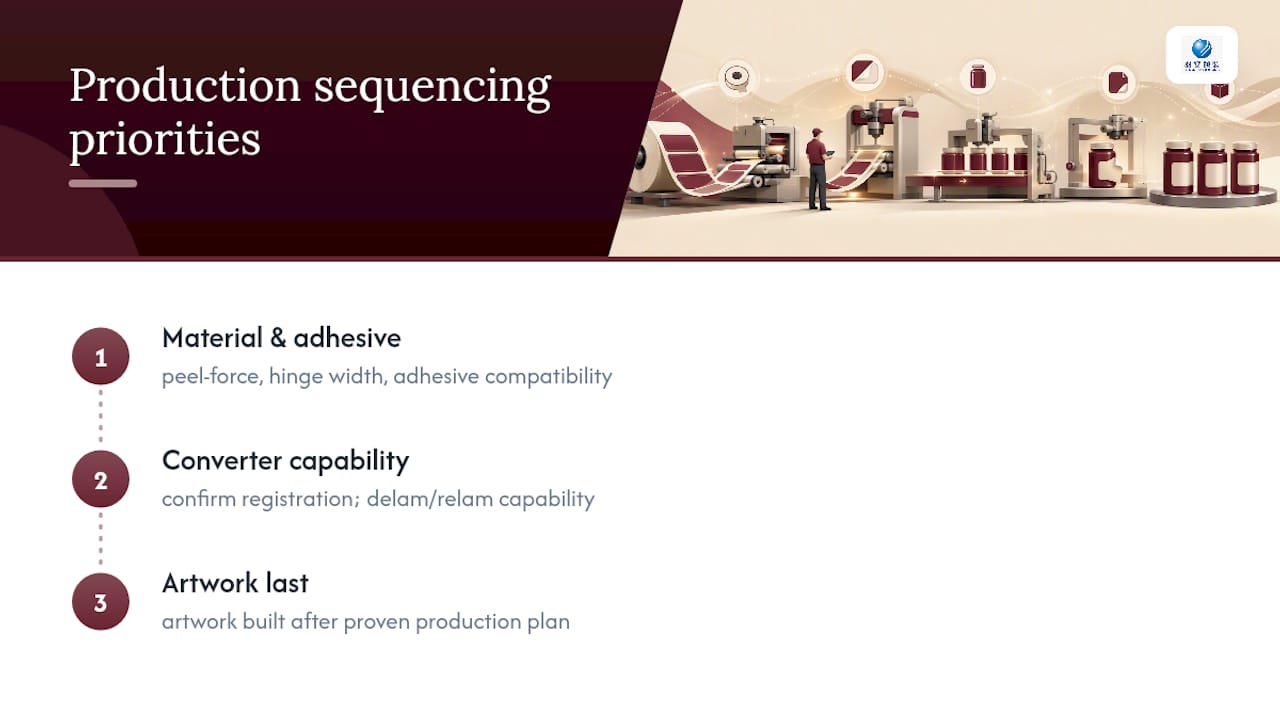
If there’s one priority to take from all this, it’s sequencing. Nail the material and adhesive spec first, confirm your converter’s registration and delam/relam capability second, and treat the artwork as the final layer built on top of a proven production plan, not the other way around.
_— Anthony_
Get a Sample or Quote for Your Next Label Project
Yuan Packaging is built for exactly the kind of complexity peel-and-reveal labels demand: multi-web registration, adhesive selection tied to real recyclability targets, and finishing that holds up on a premium shelf. Rather than guessing whether a converter can handle delamination and relamination reliably, you get a partner who already runs that process for beauty, spirits, and lifestyle brands at scale.
Our team supports the full project arc:
- Design consultation on hinge mechanics, ply layout, and die-line setup
- Prototyping and physical press samples before full production commitment
- Scalable runs from short digital jobs to high-volume flexo production
- Sustainable material options, including wash-off adhesive systems suited to your recycling stream
If your next launch needs multilingual compliance copy, a promotional reveal, or serialized anti-counterfeit protection, request a quote on custom label production and get sample-ready specs back with real turnaround estimates.
Sources
- Peeling and revealing: finding success in multi-layer labels - FlexoTech
- Recyclable Product Labels: A Guide to Sustainable Packaging - The Label Printers (blog)
- Wash-off labels for PET package recycling | UPM Adhesive Materials
FAQ
What Is the Difference Between Peel-and-Reveal and Standard Labels?
A standard label prints on one visible surface, while a peel-and-reveal label bonds two or more plies together so a consumer can peel back the top layer to access hidden panels underneath.
Are Peel-and-Reveal Labels Recyclable?
Recyclability depends on the specific face material, adhesive, and ink combination used, and how well those match the container’s recycling stream, so ask your supplier for wash-off test data rather than assuming a material is universally recyclable.
Should I Choose Digital or Flexo Printing for My Multi-Layer Label?
Digital printing works best for short runs and variable data, while flexo is more cost-effective at high volume and can inline more embellishments in a single pass.
What Information Belongs on the Hidden Panel?
Regulatory text, multilingual instructions, promotional codes, and brand storytelling content typically go on inner panels, while the primary selling message stays on the visible face.
How Do I Get an Accurate Quote for a Peel-and-Reveal Label Run?
Provide your material, adhesive, ply count, finished size, hinge specification, and peel-force expectations upfront, and request press samples before committing to full production. Yuan Packaging supports this process directly through its custom label services, from prototyping through scaled production.