Custom Serialised & Variable-Data Labels
One label design with a different serial number, QR code or batch record on every piece, printed digitally from the data you send or the code structure you set.
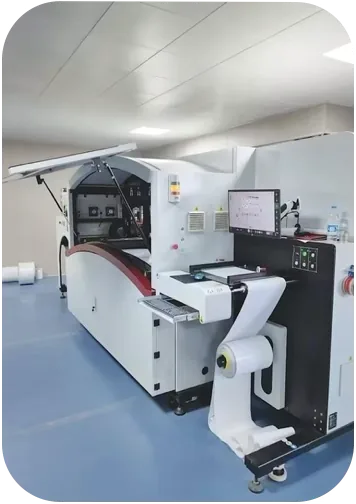
At a glance
- Minimum order quantity
- From 1,000 labels, digital runs included; 10,000 or more is the better-value run
- Sampling
- Presentation-quality sample in 5–7 working days. The sample cost is credited against your first approved production order.
- Production lead time
- 15–20 working days after artwork approval
- Delivery to Europe
- DDP or DAP to the EU and the UK, DDP to Switzerland; your customs broker confirms duty and VAT rates
- Production
- Made to order (OEM/ODM)
- Country of origin
- Huai'an, Jiangsu, China
- Unit-Level Codes
Overview
A variable-data label keeps one design across the whole run while one or more fields change from label to label: a serial number, a QR or Data Matrix code, a batch and date line, a name or a campaign code. Those fields are printed digitally, driven by a data file instead of a printing plate, so the last label on a roll can carry different data from the first without anything being changed at the press.
Buyers choose it for three kinds of work. Regulated and pharmaceutical packs need a record of which unit went where, so each label carries an identity of its own. Spirits and other high-value goods use a scannable code that a consumer or distributor checks against the brand's database. Promotions, limited editions and personalised runs print individual names, numbers or entry codes without setting up a separate print job or SKU for every version.
On the label itself, the variable fields sit in fixed windows drawn on the dieline beside the static artwork. Each window has a size, a position and a background chosen so the code scans: a dark code on a light, flat ground with a clear margin round it, away from the label edge and from the tightest curve of the container. Foil, embossing and varnish belong to the static part of the design and stay out of those windows. On the roll every label is different, so the order of the data matters as much as the artwork: the file states which code goes on which label, and the roll sequence is agreed before printing so the applied labels can be reconciled with the file afterwards.
What to decide for this format
Per-label data or one print for the batch
If every unit needs an identity of its own — a serial, a scan link that leads to that unit, a personal name — the fields have to be printed label by label from data. If every label in a production batch shares the same lot and date, that line can be part of the batch's artwork instead. The deciding question is whether anyone will need to tell one unit from the next.
QR, Data Matrix or a printed number
A QR code is the familiar choice when consumers are meant to scan with a phone. Data Matrix packs the same data into a smaller square and suits trade and regulatory scanning. A human-readable number printed next to either gives a fallback when a code is scuffed or no scanner is to hand.
On the main label or on a separate seal
Printing the code into the main label keeps one label per pack. Putting it on a seal across the closure ties the code to the moment of opening, which matters when the code is part of an authentication or refill-prevention programme, usually alongside holographic and tamper-evident features.
Anti-counterfeit label options
Who generates the data, and how it comes back
Either your system issues the codes and you send a file for each order, or you set the structure — prefix, length and range — and the codes are generated from it and returned to you as a file for each production run. Agree the file format and the numbering range before artwork approval: the data cannot change once printing has started.
Across the Custom Labels range
This page covers what is particular to this product. The full lists for the whole range are set out once, on the Custom Labels page:
- Materials and finishes
- What you can customise
- Applications
- How it is made
- What drives the cost
- Why work with us
What applies to this product
- Materials
- Coated & Uncoated Papers; PP & PET Films
- Printing & Finishes
- Hot & Cold Foil Stamping; Lamination & Overvarnish; Precision Die Cutting
- Applications
- Spirits, Wine & Baijiu; Pharmaceutical; Daily Chemical & Agrochemical; Beauty & Personal Care
- How it is made
- Container & condition review; Die & artwork preparation; Process selection; Sampling; Production & in-line finishing; Inspection, winding & delivery
Specifications
| Minimum order quantity | From 1,000 labels, digital runs included; 10,000 or more is the better-value run |
|---|---|
| Production lead time | 15–20 working days after artwork approval |
| Print processes | Offset, Manroland 6+1 intermittent letterpress, six-colour flexo and digital (installed 2022) |
| In-line capability | Printing, embossing, hot stamping and holographic positioning combined in the same pass on the letterpress line |
| Sectors served | Liquor and spirits, pharmaceutical, agricultural chemical, daily chemical, beauty and food |
Terms for this specification
- Sampling
- Presentation-quality sample in 5–7 working days. The sample cost is credited against your first approved production order.
- Colour matching
- Pantone references and physical samples are used where the selected print process supports them. The approval method follows the substrate, artwork and process.
- Certifications
- ISO 9001, ISO 14001:2015, ISO 45001 and China Environmental Labelling (Ten-Ring). ISO 22000 applies to eligible food-contact work.
- Materials and inks
- FSC®-certified paper and board (FSC® C232946) on request, plus recycled-content stock, water-based inks and adhesives, and fibre-based fitments, where the selected construction supports them. Only products sold with an FSC claim on our invoice are FSC certified. FSC Chain of Custody certification means our forest supply chain is unbroken for our FSC-certified products. www.fsc.org How to order FSC-certified packaging
Design & artwork
From an artwork check, through a dimensioned dieline and print-ready files, to a full concept package across a range — done by the factory that will make it.
Frequently asked questions
Should the code be printed on the label or added on our filling line?
Print it on the label when the code must sit in a designed position, carry the brand's colours or be protected by the same finish as the rest of the label, or when your line has no coder. Add it on the line when the data only exists at filling, such as a fill date or a line number. In that case the label is printed with a clear, unvarnished panel for the coder to print into, so the two methods can share one label.
Can a serialised label also carry foil, embossing or holographic features?
Yes. Foil, emboss and holographic elements are applied as part of the static design, and the serial data is printed digitally into the windows left for it. Keep the finishes out of the code window and its margin, and judge the scan on the printed sample, not on screen: reflective foil right next to a code can confuse a phone camera.
How do samples and lead times work for variable-data labels?
Samples take 5–7 working days. Judge the code windows on the printed sample, not on screen, and have your team scan them with the phones and scanners they will really use. Production then takes 15–20 working days after artwork approval, with the data file and numbering range fixed before printing starts.
What do you need from us to quote a variable-data label?
The label size and shape, the container it goes on, the quantity per order (from 1,000 labels) and how many versions or data sets that quantity is split into. Then which fields change, the code type and what each code should contain, and whether you will supply the data or the code structure. For the rolls, give the core size, unwind direction and number of labels on each roll that your applicator expects. Add the finishes you have in mind and the delivery country.
From the Journal
Related products
Request a custom packaging quote
What to send for a quote
- The product it is for, and the format you have in mind
- Size as length × width × height, and whether those are inside or outside dimensions
- Quantity, or two or three quantities if you want to compare unit prices
- Material and finish preferences, or the look you are after
- Artwork status: print-ready files, a draft, or nothing yet
- The date you need the goods by
- The destination country
Missing some of these? Send what you have, and we will ask about the rest.