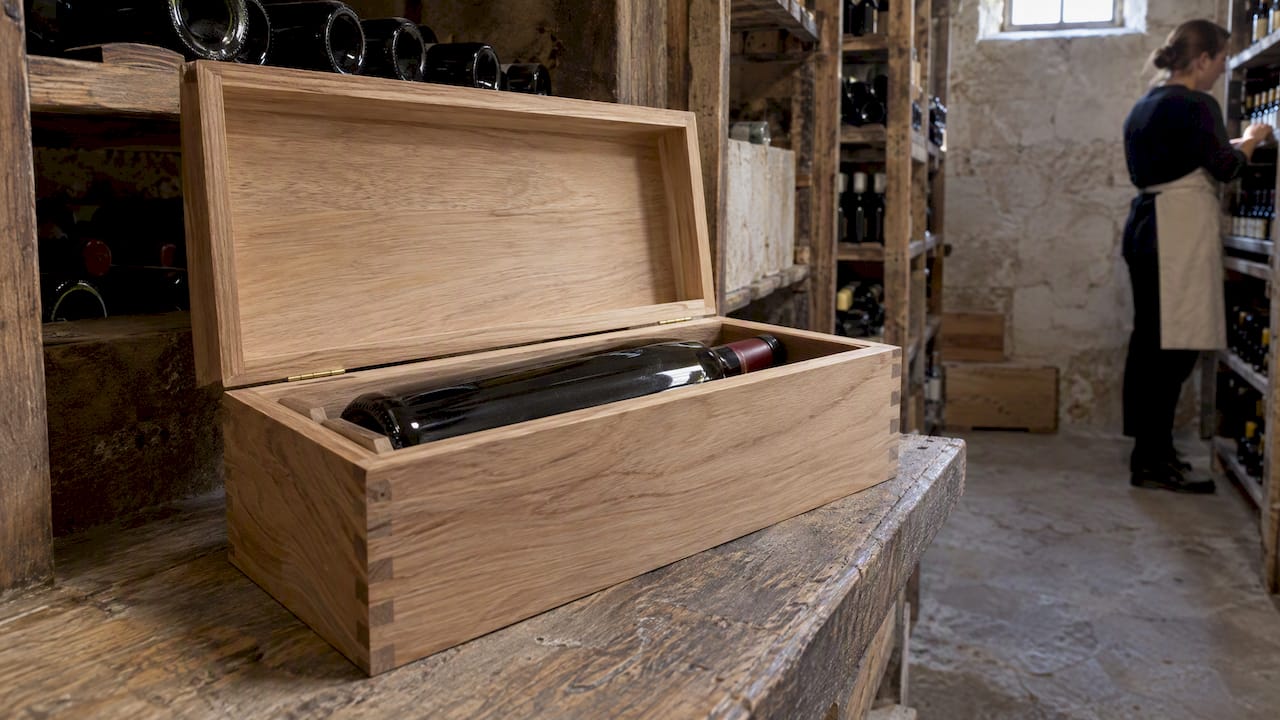
A wooden wine box is a presentation case, usually holding one to six bottles, that turns a bottle into a gift, a collector's piece or a point-of-sale display. The best ones are decided by five choices: how many bottles, which wood or wood-based board, how the lid closes, how the brand is marked, and whether the box needs to cross a border. This guide walks through each, so you can brief a manufacturer with confidence or judge a stock box on its merits.
TL;DR
- Choose the format first (single, double, three or six bottles, magnum), because it drives structure, weight and freight cost.
- Solid wood gives the heaviest, most tactile feel. Plywood and other processed wood give cleaner finishes and often simpler export paperwork.
- Most wine gift boxes made of processed wood fall outside the ISPM 15 stamp requirement, but raw-wood crates and pallets do not.
- Anything touching the food side of the product, including coatings and adhesives, needs a compliance check in the market where you sell.
- If wood is too heavy or costly for your run, a rigid box with a wrap and insert can give a similar premium result.
Table of Contents
- What a wooden wine box is actually for
- Choosing the wood: solid, plywood or wrapped board
- Structure and closure options
- Branding the wood: marking and finishing methods
- Export, phytosanitary and food-contact rules
- Sustainability: what holds up and what does not
- A note on boxed wine
- Our perspective: where wood works and where a rigid box wins
- Rigid box or wooden box: a quick comparison
- Brief your manufacturer: a checklist
- Work with us on your wine packaging
- FAQ
- Sources
What a wooden wine box is actually for
Before choosing materials, decide the job. Three uses dominate, and each pulls the design in a different direction.
| Use | What matters most | Typical design lean |
|---|---|---|
| Gifting and seasonal sets | Unboxing, branding, reusability | Hinged or sliding lid, laser or hot-brand logo, liner or straw fill |
| Collector and en primeur cases | Protection, stackability, provenance | Thicker walls, secure closure, branded end panels |
| Retail and trade display | Shelf visibility, speed of opening | Open slat or window front, light weight |
Stock wine boxes in the US market are plentiful. Some retailers publish catalogs with standard and premium grades, with the premium grade built from thicker wood, which shows how much wall thickness shapes perceived quality. A custom project becomes worthwhile when you need your own dimensions, a specific bottle shape, a printed or wrapped finish, or consistent output across thousands of units.
Choosing the wood: solid, plywood or wrapped board
The material shapes weight, finish, cost and regulatory treatment, so settle it early.
Solid wood
Pine, fir and similar softwoods are common for crates and rustic cases. Hardwoods and darker stains read as more formal. Solid wood shows grain and knots, which is part of the appeal and also a quality-control variable: you should agree on an acceptable grade, a sanding standard and a tolerance for color variation before production begins.
Plywood and veneered panels
Plywood and veneered board are dimensionally stable, take stain and lacquer evenly, and resist the warping that solid planks can show in humid shipping conditions. They are also the usual route to a very clean, modern look with crisp edges and a laser-engraved logo.
Wood-effect and wrapped constructions
Some brands want the warmth of wood without the weight. A rigid board box wrapped in a printed wood-grain paper, or paired with a wooden lid detail, can lower freight cost. We cover how these structures compare below.
Pro tip: ask for a physical sample in the actual finish, not a render. Stain, lacquer and wax change both color and hand-feel, and the difference is rarely visible on screen.
Structure and closure options
The closure sets the tone of the opening moment, which is the part of the experience a customer remembers.
- Sliding lid: a lid that moves along grooves. It feels precise and is simple to make, but the groove tolerance must be tight enough to avoid rattling.
- Hinged lid with a clasp: the classic gift format. It adds hardware, so specify hinge and latch material and test them for repeated opening.
- Lift-off lid: the simplest and most economical. Open slat styles often pair with an optional lift-off lid.
- Drawer or tray: the base slides out of a sleeve. This is easier to achieve in rigid board, and our drawer boxes are one example of the structure.
- Book-style: a hinged cover that opens like a book, well suited to two-bottle or bottle-and-glass sets. See our book-style hinged boxes.
Interior protection
A bottle sits safely only if it cannot move. Common solutions are wood wool or paper shred, cut foam, molded pulp, and die-cut board dividers. For multi-bottle cases, dividers also stop glass-on-glass contact. Always test the finished pack with the actual filled bottle, because a 750 ml bottle's weight and shoulder shape vary between producers.

Branding the wood: marking and finishing methods
The marking method should match your volume and your visual identity.
- Laser engraving: precise, permanent and suited to names, dates or monograms.
- Hot branding (wood burning): a rustic, tactile mark, strong for craft and heritage positioning.
- Screen or pad printing: allows color, but needs good surface preparation on raw grain.
- Foil stamping and blind embossing: more typical on paper-wrapped and rigid constructions, where the crisp relief of metallic foil is easiest to control.
- Applied labels: a printed label on the lid or end panel lets you change vintage or SKU details without retooling. Our wine and spirits labels are produced for that purpose.
Export, phytosanitary and food-contact rules
This is the section brands skip until a shipment stalls.
Does your wooden wine box need an ISPM 15 stamp?
ISPM 15 is the international standard governing wood packaging material made from raw wood in international trade. The standard exempts wood packaging made wholly of processed wood. According to an ISPM 15 FAQ, plywood, particle board, oriented strand board or veneer made with glue, heat or pressure is considered low risk and exempt. A box built from solid raw planks is a different matter and may need to be treated and marked.
In practice, the box format and the shipping carton are separate questions. The retail gift box inside may be exempt, while a wooden crate or pallet used to move the cartons is not. Check the rules of your destination country before you finalize materials, for example the UK's guidance on wood packaging material for import and export. This article is not customs advice: confirm the treatment of your specific box with your freight forwarder or the plant-health authority of the importing country.
Food-contact considerations
A wooden case rarely touches the wine itself, since the glass bottle sits between them. Still, sealed bottles, straw fill, liners and any coating that contacts a food or drink product deserve a compliance check. In the EU and, in retained form, Great Britain, the framework is Regulation (EC) No 1935/2004, which governs materials intended to come into contact with food. US brands selling only domestically follow US rules, so confirm which regime applies to each market. Ask any supplier for written declarations covering coatings, adhesives and inks before launch, not after.
Sustainability: what holds up and what does not
Wood reads as natural, but the footprint depends on how the box is built. Research on eco-design for wood wine boxes, published in the International Journal of Life Cycle Assessment, treats the box as a system to be analyzed, which is the right mindset: material, finishing, transport and end of life all count.
Practical choices that help:
- Reduce wall thickness and box weight where protection allows, since freight emissions follow weight.
- Avoid mixing materials that cannot be separated, such as wood glued to foam and plastic windows.
- Choose inks, coatings and finishes compatible with the recycling or reuse path you intend.
- Design the box to be kept and reused, for instance as a storage or display case, which extends its useful life.
The WineGB packaging toolkit is aimed at wine producers and is a useful checklist for pallet optimization and material choices, even if you are outside the UK. Ask your manufacturer for documentation on responsibly sourced material rather than accepting a general claim.
A note on boxed wine
Searchers sometimes land on this topic while looking for bag-in-box wine, which is a different product. It is a flexible bag inside a cardboard carton, and its image has improved: Wine Spectator's 2025 sommelier picks describe producers adopting the format for convenience, value and environmental benefits. For choosing one, Master Sommelier Gillian Ballance advises evaluating the winery first, as you would with a bottle. If you are a producer, a wooden presentation case and a bag-in-box carton serve different customers, and they rarely compete for the same shelf.
Our perspective: where wood works and where a rigid box wins
We make rigid gift boxes, folding cartons, labels, bags and wooden boxes under one roof, so we do not push wood for its own sake. For a flagship vintage, a collector's release or a limited gift set, wood communicates permanence, and a well-built case is kept long after the wine is gone. That is the situation where we recommend our wooden wine boxes.

For wider launches, e-commerce shipping or seasonal sets in the tens of thousands, we often steer clients to a rigid structure: lower weight, more finish options and a greater range of printed effects. Soft-touch lamination, foil stamping and embossing are our daily work, and they let a brand reach a premium feel with less freight burden. Our comparison of rigid boxes and folding cartons explains where the line sits for different budgets.
The more important advice is about sequence. Decide the bottle, the closure and the destination market before you pick the finish. Then request samples, test the filled pack through a drop and vibration check, and only then approve production. Most failures we see in wine packaging are not about beauty. They come from a mismatch between bottle tolerance and insert, or from a finish that scuffs in transit.
— Anthony
Rigid box or wooden box: a quick comparison
| Criterion | Wooden wine box | Rigid wine box |
|---|---|---|
| Weight | Heavier, raises freight cost | Lighter at the same size |
| Hand-feel | Natural grain, solid | Soft-touch, textured or wrapped papers |
| Branding | Engraving, hot brand, print | Foil, emboss, spot UV, full-color print |
| Reuse value | High, often kept as storage | Moderate, depends on structure |
| Customization of shape | Good, tooling dependent | Wide range of structures |
| Export paperwork | Depends on raw or processed wood | Generally simpler, since it is paper-based |
The last row is a general point, not a rule: always verify the specifics for your destination.
Brief your manufacturer: a checklist
- State the bottle: diameter, height, weight when filled, and shoulder shape.
- State the quantity per run and the number of SKUs.
- Choose the closure and the interior fitment.
- Name the destination markets, so material and compliance can be planned together.
- Provide your logo as vector artwork and a dieline or dimensions. Our guide to rigid box dielines and production rules explains what files production teams need.
- Request a pre-production sample and a written compliance statement.
- Plan the outer carton and shipping method early. A bottle and gift set carrier bag can complete the retail experience.
Work with us on your wine packaging
If you are planning a wine or spirits launch, we can handle the box, the label and the carrier bag in one facility, which keeps colors and finishes consistent across pieces. Start with our wine and spirits packaging page or send us your brief through the products overview. We do not publish prices, as each project depends on structure, material and quantity.
FAQ
How many bottles should a wooden wine box hold?
That depends on the use. Single and double boxes suit gifting and retail, while three, six or larger cases suit collectors, hospitality and trade. Larger formats raise weight and shipping cost quickly, so test the filled case before you commit to volume.
Can I put my logo on a wooden wine box?
Yes. Common methods are laser engraving, hot branding, printing and applied labels. Engraving and hot branding are permanent, while labels give you flexibility to change details between releases.
Is a wooden box better than a rigid box for wine?
Neither wins everywhere. Wood offers weight, grain and long-term reuse. A rigid box offers lower weight and a wider range of printed finishes. Choose by use case, run size and shipping route.
Sources
- Regulation of wood packaging material in international trade (ISPM 15), IPPC
- ISPM15 frequently asked questions
- Wood packaging material for import and export, GOV.UK
- Regulation (EC) No 1935/2004
- Combined application of LCA and eco-design for wood boxes for wine bottles
- WineGB Packaging Toolkit
- The Best Boxed Wines for 2025, Wine Spectator
- How To Choose The Best Quality Boxed Wine, Tasting Table
Recommended
- Wooden Wine Box Manufacturer in China
- Wine & Spirits Packaging: Labels, Boxes & Carriers Guide
- Custom Wine & Spirits Labels
- Wine & Spirits Packaging Manufacturer
How many bottles should a wooden wine box hold?
That depends on the use. Single and double boxes suit gifting and retail, while three, six or larger cases suit collectors, hospitality and trade. Larger formats raise weight and shipping cost quickly, so test the filled case before you commit to volume.
Can I put my logo on a wooden wine box?
Yes. Common methods are laser engraving, hot branding, printing and applied labels. Engraving and hot branding are permanent, while labels give you flexibility to change details between releases.
Is a wooden box better than a rigid box for wine?
Neither wins everywhere. Wood offers weight, grain and long-term reuse. A rigid box offers lower weight and a wider range of printed finishes. Choose by use case, run size and shipping route.