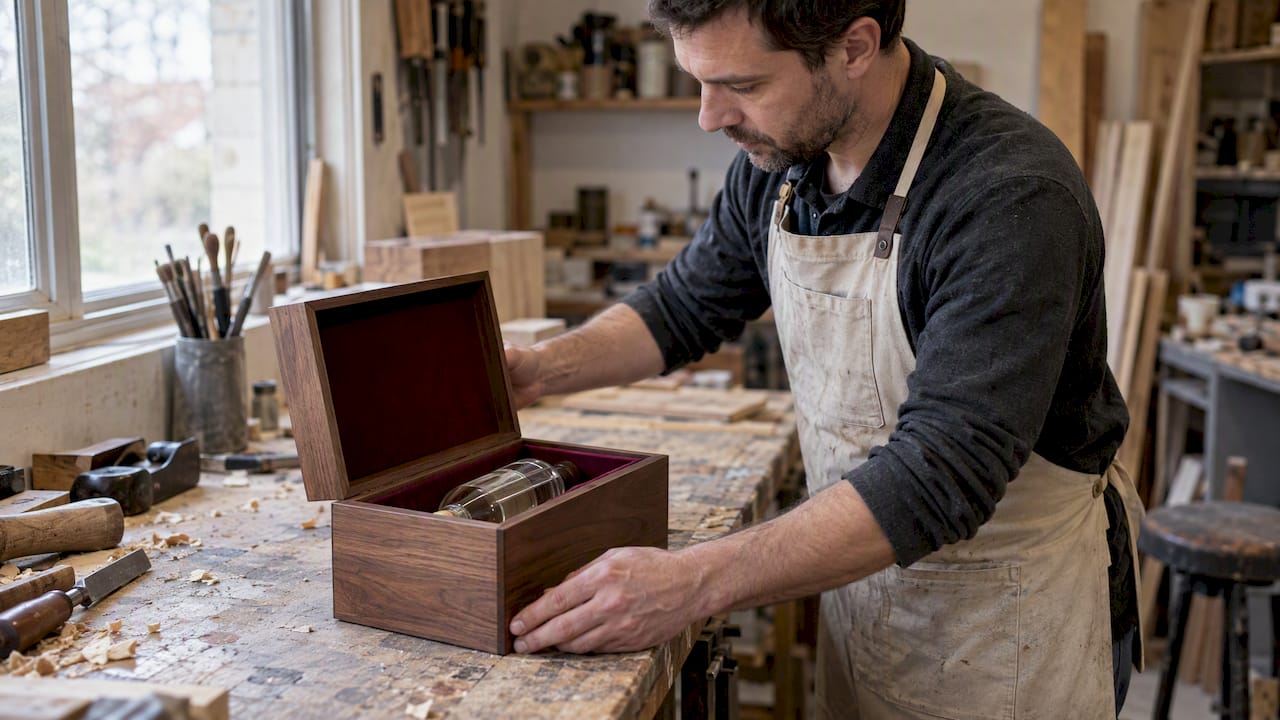
Wooden box packaging covers two quite different products. One is the retail or gift box, a hinged, sliding-lid or drawer box that presents a bottle, a fragrance or a gift set. The other is the shipping crate, built to protect heavy goods in transit. This guide is mainly about the first, because that is where premium brands make decisions about species, finish, closures and compliance. It also explains where the second kind, and its phytosanitary rules, can catch you out.
TL;DR
- Choose the wood for the job: pine and paulownia for light, economical boxes, oak, walnut or beech where grain and weight signal luxury, bamboo where a renewable story matters.
- Wood that touches food or spirits needs more thought than wood that only presents them. Coatings, waxes and glues change the safety picture, not just the timber.
- ISPM 15 applies to raw wood packaging used in international shipping, such as crates and pallets. Processed wood such as plywood is generally outside its scope.
- Liners, inserts and closures decide whether a wooden box performs, particularly with alcohol vapor and humidity.
- A wooden box is often best as part of a system: a wood presentation piece inside a printed carton or carrier bag, with security features on the label.
Table of Contents
- Two products under one name: presentation boxes and shipping crates
- Why brands choose wood
- Choosing the wood species
- Structure: the box styles that work in wood
- Finishes that change how a wooden box feels
- Food, spirits and cosmetics: what the rules say
- Engineering for alcohol vapor and humidity
- Sustainability and certification
- Shipping rules: when ISPM 15 applies
- Brand protection: wood plus security labels
- Our perspective
- How to brief a wooden box project
- Where our team can help
- FAQ
- Sources
Two products under one name: presentation boxes and shipping crates
Search results for this keyword mix UN-certified wooden crates for dangerous goods, generic box catalogs and craft inspiration. That is a sign the term is ambiguous, so decide which you need before you brief anyone.
| Presentation or gift box | Shipping crate | |
|---|---|---|
| Purpose | Shelf presence, unboxing, keepsake value | Protecting heavy or fragile goods in transit |
| Typical wood | Pine, beech, oak, walnut, paulownia, bamboo | Softwood boards, plywood, OSB |
| Finish | Stain, lacquer, laser engraving, foil, hot stamp | Usually untreated or marked |
| Key rules | Food contact, coatings, import of the finished article | ISPM 15 marking, UN certification where relevant |
| Buyer | Brand manager, creative director | Logistics or supply chain lead |
The rest of this article is written for the left-hand column, with a clear note wherever the right-hand column's rules reach you anyway.
Why brands choose wood
Wood is heavy in the hand, warm to the touch and smells faintly of itself. Those three sensory facts do work that printing cannot. A bottle of aged spirit in a solid wood box suggests the cask. A fragrance in a wood-collared presentation piece suggests craft and slow making. The unboxing becomes a narrative moment rather than a transaction.
Beauty is a good example of how mainstream this has become. One cosmetics packaging supplier describes wood as having moved from an experimental material to a mainstream choice for cosmetics packaging, used by some of the world's largest beauty brands, and it notes FSC and PEFC certified production. Whatever you think of any single supplier's claims, the direction is clear: buyers now expect wood to be technically engineered, not rustic.
There are also practical reasons to pick it:
- Reuse. A wooden box is far more likely to be kept than a folding carton, which extends the brand's presence in the customer's home.
- Protection. Solid walls resist crushing better than paperboard, which matters for glass.
- Price signaling. For limited editions, gift sets and collector releases, wood supports a premium price point.
The trade-offs are equally real: weight (and so freight cost), higher unit cost, slower production and more variation from piece to piece. Wood is a natural material, and no two grain patterns match.
Choosing the wood species
Species shapes color, weight, machining behavior and cost. Specialist makers of custom wood retail boxes typically offer a short list; one Canadian manufacturer, for example, works with pine, black walnut, beech, bamboo, paulownia and oak. A practical way to read that list:
- Pine: pale, light and economical. It takes stains well, which suits tinted finishes and branded colors. Knots and resin pockets need grading rules.
- Paulownia: very light for its size, which helps when freight is a concern. A good choice for large boxes that must not feel punishing to ship.
- Beech: fine, even grain, a dense feel, and clean engraving. Strong for cosmetics and gift sets.
- Oak: pronounced grain and weight, with strong associations to cooperage, which is why it appeals to whisky, bourbon and wine brands.
- Black walnut: dark and rich, with a clear luxury cue. It is among the more expensive options, so it suits small, high-value runs.
- Bamboo: technically a grass, fast-growing and hard. It supports a renewable story, though you should still ask about the adhesives used in laminated bamboo panels.
Pro tip: ask for a sample in your exact species and finish, not a catalog photo. Stain on pine and stain on beech never look the same.
Structure: the box styles that work in wood
Wood allows a narrower set of structures than paperboard, but each has a clear use.
- Hinged lid. The classic presentation box for a single bottle or a gift set. Brass or concealed hinges and a magnetic or clasp closure raise the perceived value.
- Sliding lid. Simple and elegant, with fewer parts to fail. Common for wine, spirits and cigars.
- Drawer. A tray that slides out of a sleeve, good for sets of small items such as skincare or jewelry. If you like this format, our guide to drawer box packaging that meets premium and ECMA standards shows how the same logic works in rigid board.
- Lid and base. Two parts that nest. Tolerances matter, because wood swells and shrinks with humidity and a lid that fits in a dry factory can bind in a humid port.
- Wood collar or component. Rather than a full box, only the cap, lid or collar is wood. This is common in fragrance, where CNC-machined wooden caps, collars and boxes are paired with other materials.
The insert is as important as the shell. Foam, die-cut paperboard, molded pulp or fabric-wrapped trays hold the product still and carry the interior color. A wood exterior with a poorly fitted insert reads as cheap the moment the lid opens.
Finishes that change how a wooden box feels
Finish is where a plain wooden box becomes a branded one.
- Laser engraving. Permanent, precise, and good for logos, serial numbers and limited-edition numbering. No ink, so nothing to wear off.
- Hot foil stamping. Metallic logos on a stained or lacquered surface. It needs a smooth, sealed surface to look crisp.
- Screen printing. Allows solid brand colors. Use it on lacquered or sanded surfaces.
- Stain and lacquer. Control color and protection. Matte lacquer keeps a natural look, gloss adds depth.
- Blind embossing or debossing. More often used on the paper wrap, label or sleeve that accompanies the wood.
- Printed labels or plaques. A pressure-sensitive label on a wooden lid gives full-color artwork without printing on the grain. See our overview of custom label printing.
Every finish adds a chemical layer. Keep that in mind in the next section.
Food, spirits and cosmetics: what the rules say
This is the part many guides skip. If your wooden box holds a sealed bottle, the box is secondary packaging and the rules are lighter. If wood touches food, the picture changes.
In the EU, wood is one of the materials listed in the food contact framework. There is no harmonized EU regulation specific to wooden food contact articles; the general Regulation (EC) No 1935/2004 applies, and manufacturers must be able to justify compliance. Member states fill the gap with national rules, and Dutch and French requirements are frequent references for wood processing, gluing and coating.
Species versus processing. The Finnish Food Authority notes that common wood species are generally considered chemically safe for food contact, but waxes or lacquers change that. In other words, the timber is rarely the problem. The finish, glue and any liner are.
Hygiene. A common worry is that porous wood harbors bacteria. A comprehensive review of the microbial safety of wood argues that porous surfaces often create unfavorable conditions for microorganisms and that wood can produce natural antimicrobial compounds. That does not remove the need for testing, but it should not rule wood out.
Migration. For spirits and fatty foods, the concern is what moves from packaging into product. A recent study in the journal Foods found that migration depends strongly on conditions and material quality, with toasted oak casks showing minimal harmful migration while improper plastic components can introduce phthalates. The practical lesson: test the complete assembly, including adhesives and plastic parts, under realistic shelf-life conditions.

For the US market, if you plan direct food contact, ask your maker for documentation on every coating and adhesive, and confirm requirements with a regulatory specialist or the FDA before launch. This article is not a compliance opinion.
Engineering for alcohol vapor and humidity
Spirits are demanding. Alcohol vapor and humidity can warp or discolor wood, and they can attack finishes. Specialists in wood components for spirits describe controlled-drying processes and barrier treatments, with plastic, silicone or metal liners built into the wood to give an airtight seal while keeping the tactile feel.
When you write your brief, specify:
- the target moisture content of the finished wood and how it will be checked;
- whether the box will ever be in direct contact with a leaking or sweating bottle;
- the climate range from factory to final shelf, including sea freight;
- the liner or sealing system, if any part touches the closure.
Sustainability and certification
A wooden box is renewable only if the wood is responsibly sourced. FSC says forest-based packaging can be renewable, recyclable and biodegradable, but only when responsibly sourced. Ask for chain-of-custody certification and for the certificate number to be checked against the supplier's name.
If you sell in the EU, the new Packaging and Packaging Waste Regulation, Regulation (EU) 2025/40, applies from 12 August 2026. Lightweight wood packaging is exempt from the mandatory recyclability requirements because it makes up under 1% of packaging placed on the Union market, but general waste prevention duties still apply. Check the exact scope with a compliance adviser, because adhesives, plastic liners and mixed-material designs can change the analysis.
Shipping rules: when ISPM 15 applies
Here the crate side of the keyword returns. ISPM 15 regulates raw wood packaging in international trade. It requires debarking and an approved treatment, such as heat treatment to a core temperature of 56°C for 30 minutes, to control quarantine pests. Processed wood products such as plywood are generally outside the scope.
What this means for you:
- A finished retail gift box made of processed wood is generally not the target of the standard, but confirm with the destination country's plant health authority, since classification of a given article can be debated.
- Pallets, crates and cases made of raw wood used to ship your goods must carry the ISPM 15 mark. In the US, APHIS requires importers to ensure wood packaging is pest-free, debarked, heat-treated or fumigated and marked.
- Non-compliant shipments can be destroyed, re-exported or treated at the importer's expense. Canada's authority publishes its own questions and answers on wood packaging if you ship north.
A simple way to avoid trouble is to ship wooden presentation boxes inside corrugated cartons on compliant pallets, and to ask your forwarder to confirm the marking on every pallet.
Brand protection: wood plus security labels
A wooden box for premium spirits or high-value cosmetics is an obvious target for counterfeiters, because the box is often worth stealing. Security increasingly lives in the label and seal rather than in a visible hologram alone. AlpVision describes invisible digital features embedded in packaging or labels at the time of production, which consumers can verify with a smartphone and no special hardware.
For a wooden box, that suggests a practical stack:
- A serialized or QR label, applied to the box or the bottle, linked to a verification page. Look at our variable data and serialized labels.
- A tamper-evident seal across the lid opening.
- An anti-counterfeit label on the bottle itself, so a swapped box does not defeat protection. Our guide to security features and costs explains the options.
Our perspective
We make rigid boxes, folding cartons, labels, carrier bags and other premium packaging for beauty, spirits and lifestyle brands, and we offer wooden boxes alongside them. That vantage point shapes how we advise on wood.
First, wood is rarely the whole answer. The strongest launches we see treat the wooden piece as the hero and surround it with systems that do the quiet work: a printed shipper, a carrier bag that suits the bottle, a label that carries compliance and security data. Planning these together, from one facility, keeps colors, tolerances and timelines aligned.

Second, ask whether you need solid wood at all. A premium rigid box with a soft-touch finish, foil stamping and a well-made insert can deliver much of the same ceremony at lower weight. Our comparison of rigid boxes and folding cartons and our rigid box design rules are a useful check before you commit to timber. When the answer is yes, wood earns its cost: for limited editions, collector releases and gifts meant to be kept.
Third, specify early. Dielines, tolerances, finish and documentation are far cheaper to settle in the brief than on the production floor. Send us the product dimensions, the destination markets and the finish you imagine, and we will tell you plainly what is and is not sensible.
— Anthony
How to brief a wooden box project
Use this checklist when you approach any manufacturer, including us.
- Product and fit. Exact dimensions and weight of the item, including closures, plus the insert concept.
- Use case. Retail shelf, gift, e-commerce or trade shipment. This determines strength and the shipper.
- Species and finish. Preferred wood, color, texture, and decorative processes such as engraving or foil.
- Compliance. Destination markets, whether there is any food contact, and which documents you need.
- Sustainability. Required certifications and any recyclability goals in your markets.
- Security. Serialization, tamper evidence, label and seal requirements.
- Volume and timeline. Build in sampling rounds for the wood and finishing.
- Logistics. Pallet type, carton packing, ISPM 15 marking and incoterms.
Where our team can help
If you are planning a wooden presentation box, we can quote it together with the rest of your packaging: wooden boxes, rigid gift boxes, paper carrier bags and custom labels. Browse the full range on our products page and send us a brief using the checklist above. Pricing is project-based, so we quote against your specification rather than publishing a rate card.
FAQ
Is wooden packaging safe for food and drink?
Often yes, but it depends on the finish and the assembly, not only the wood. Common species are generally regarded as chemically safe, while waxes, lacquers, glues and plastic parts change the assessment. Ask for documentation on every component and have the finished assembly tested for your product.
Does a wooden gift box need an ISPM 15 stamp?
ISPM 15 targets raw wood packaging such as pallets and crates, and processed wood like plywood is generally excluded. A finished retail box is therefore usually treated differently, but rules and customs interpretation vary. Check with the plant health authority of the destination, such as APHIS in the US, before shipping.
Which wood is best for a premium spirits box?
Oak is the natural association for whisky and wine, while walnut and beech suit a darker or finer look. Choose by grain, weight and budget, then ask for a finished sample. Make sure the box is engineered for humidity and alcohol vapor.
Is wooden packaging sustainable?
It can be, when the wood is certified and the design avoids unnecessary mixed materials. Ask for FSC or equivalent chain-of-custody proof. In the EU, lightweight wood packaging is exempt from mandatory recyclability requirements under Regulation (EU) 2025/40, but waste prevention duties still apply.
Sources
- ISPM 15: Regulation of wood packaging material in international trade (FAO)
- Import ISPM 15-compliant wood packaging material into the U.S. (APHIS)
- Wood packaging questions and answers (Canadian Food Inspection Agency)
- Food contact materials (European Commission)
- Wooden FCMs: Dutch and French regulations (Productipedia)
- Wood, paper and board (Finnish Food Authority)
- Microbial safety of wood in contact with food (review, 2016)
- Migration study (Foods, MDPI)
- Regulation (EU) 2025/40 on packaging and packaging waste (EUR-Lex)
- Paper packaging booklet (FSC)
- Packaging and label protection (AlpVision)
Recommended
- Wooden Wine Box Manufacturer in China
- Drawer Box Packaging That Looks Premium and Meets 4evergreen and ECMA
Is wooden packaging safe for food and drink?
Often yes, but it depends on the finish and the assembly, not only the wood. Common species are generally regarded as chemically safe, while waxes, lacquers, glues and plastic parts change the assessment. Ask for documentation on every component and have the finished assembly tested for your product.
Does a wooden gift box need an ISPM 15 stamp?
ISPM 15 targets raw wood packaging such as pallets and crates, and processed wood like plywood is generally excluded. A finished retail box is therefore usually treated differently, but rules and customs interpretation vary. Check with the plant health authority of the destination, such as APHIS in the US, before shipping.
Which wood is best for a premium spirits box?
Oak is the natural association for whisky and wine, while walnut and beech suit a darker or finer look. Choose by grain, weight and budget, then ask for a finished sample. Make sure the box is engineered for humidity and alcohol vapor.
Is wooden packaging sustainable?
It can be, when the wood is certified and the design avoids unnecessary mixed materials. Ask for FSC or equivalent chain-of-custody proof. In the EU, lightweight wood packaging is exempt from mandatory recyclability requirements under Regulation (EU) 2025/40, but waste prevention duties still apply.