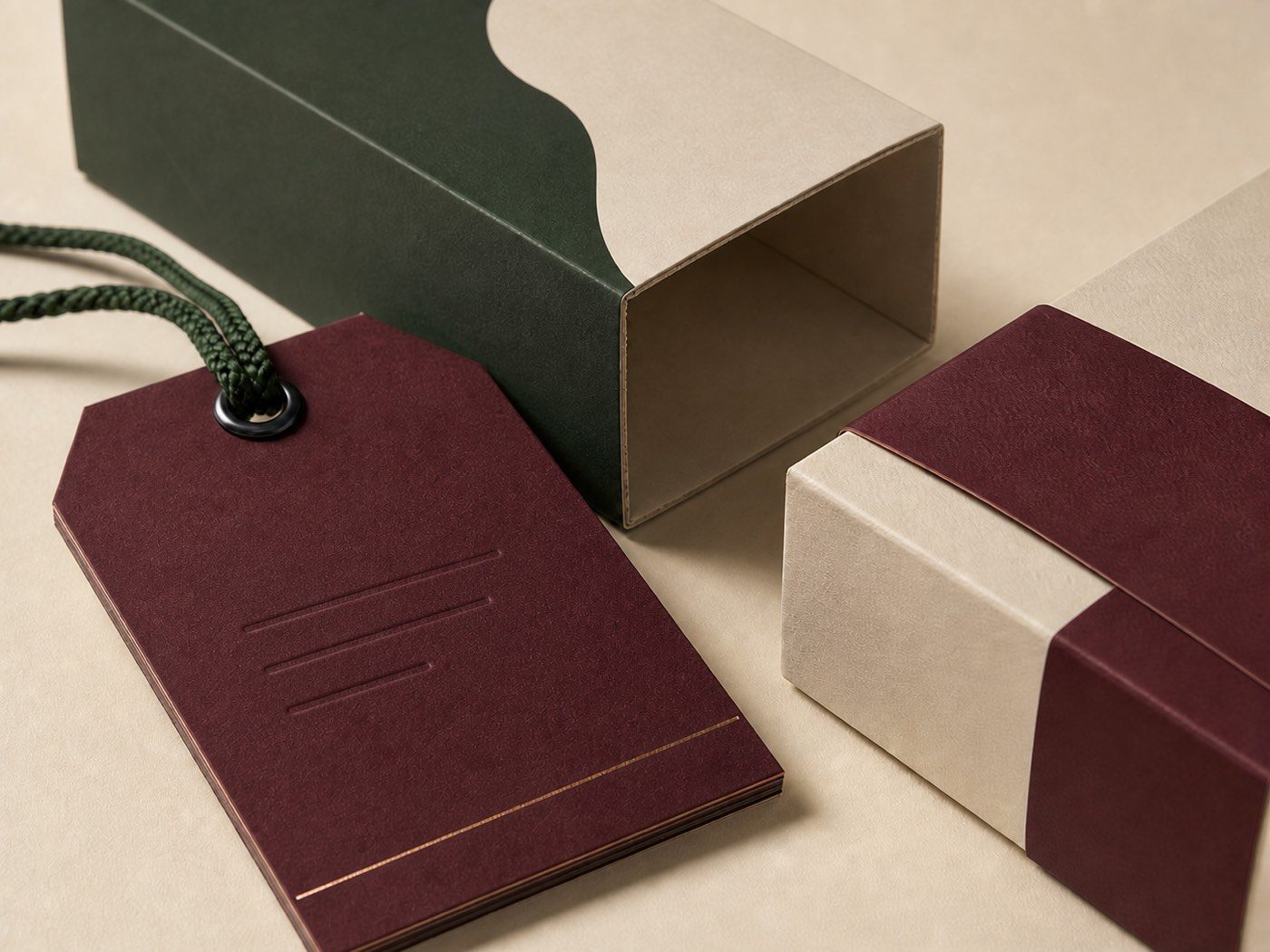
A belly band is a narrow printed strip of paper or board that wraps around the middle of a box, jar or bundle to add branding or an edition name without reprinting the pack. Four decisions matter: the closure, the length, the stock and dieline setup, and whether a band, a sleeve or a printed box fits best.
Key takeaways: Measure the packed, closed product at the band position, then add the ease and closure allowances. Choose the closure by how the band is delivered, fitted and removed. Keep single-item barcodes and mandatory label text visible; a band that bundles items sold as one unit carries its own barcode and hides the inner ones. Approve an unprinted fit sample, then a printed sample on the real pack.
Table of Contents
- What Is a Belly Band?
- Belly Band Closures: Glued Loop, Tab-and-Slot, Adhesive
- How to Size a Belly Band
- Stock, Print and Dieline Setup
- Barcodes and Labelling
- Sleeve, Belly Band or Printed Box?
- What to Send for a Quote
- How Yuan Packaging Can Help
- FAQ
- Sources
What Is a Belly Band?
A belly band circles a pack and joins at one point, covering only part of it, so the box stays visible above and below. Some suppliers, and our sleeve packaging design guide, use sleeve and belly band for the same thing; in this guide a sleeve covers four sides.
A band can help hold a lid closed or keep a set together, but it does not replace the box structure; confirm any closure role on an assembled sample.
Belly Band Closures: Glued Loop, Tab-and-Slot, Adhesive
The closure sets how the band is fitted, how tightly it sits and how it is removed.
| Closure | Delivered and fitted | Sensitivity to size error | Opening | Best for | Main risk |
|---|---|---|---|---|---|
| Glued loop | A ring, folded flat, that slides on; or a flat strip glued around the pack | High for a ring: its length is fixed | A ring slides off and can be reused; a glued-on band is torn | Rigid boxes, straight-sided cartons | Measure on a packed sample |
| Tab-and-slot | Flat, locked by hand | Medium: the slot is fixed | Unlocks; reusable | Reopenable packs | A band that is too tight pulls the tab out |
| Adhesive | Flat, closed with adhesive, tape or a seal label | Lower: the overlap absorbs small errors | Torn or peeled; single use | Soft or irregular products | Bond on coated or laminated stock |
A thumb notch, tear strip or perforation makes removal easier. If the band must show that a pack has been opened, design it as a tamper-evident feature; see our tamper-evident packaging guide.
How to Size a Belly Band
Lids, tissue and contents change the circumference, so measure the packed, closed product, not an empty box or a drawing.
- Mark the band position on a packed sample and set the band width (the short side of the strip) to clear any barcode or label text.
- Measure the circumference there with a paper strip: 2 × (W + D) for a square-cornered pack of width W and depth D, or π × the diameter for a round pack.
- Add the ease allowance, the extra length that lets the band slide on without scuffing but not slip off.
- Add the closure allowance: the glue overlap, the tab or the adhesive overlap.
- Crease at the measured corners, test an unprinted mock-up, then approve a printed sample.
Four cases need extra care:
- Lid-and-base boxes. A lid’s circumference is about 8 × (lid wall thickness + clearance per side) larger than the base’s, so decide whether the band sits on the lid wall or crosses the lid edge.
- Rounded corners make the true circumference shorter than 2 × (W + D), so measure with a strip.
- Tapered jars need the circumference at both band edges, and the flat band becomes a curved strip; see our guide to labels for curved surfaces.
- Thick stock adds about π × its thickness to the length at the band’s mid-line.
Worked example: a square-cornered box 120 mm wide and 60 mm deep has a circumference of 2 × (120 + 60) = 360 mm, so its flat length is L = 360 mm + E + A, with the ease allowance E and the closure allowance A agreed on a mock-up.
Stock, Print and Dieline Setup
Bands are printed flat and die-cut, so artwork must work flat and wrapped. Ask for a dieline drawn to your measured size; our artwork preparation guide covers bleed and colour. Points specific to bands:
- Keep the glue area free of varnish and laminate unless the adhesive is confirmed to bond to them.
- Put the join on the back or a side, away from logos, and keep type off creases, where ink and coatings can crack.
- Thicker stock gives crisper edges but cracks more easily at corners, so creasing must suit its thickness.
- Paper folds best along the grain and changes size most across it as humidity changes, so agree the grain direction and check the fit after samples settle at your site.
- Colours shift on the brown base of kraft, and band and box are often different stocks, so proof on the actual stock and check colours against the real box.

Diagram key: 1 cut line, 2 creases at the measured corners, 3 glue area, 4 bleed, 5 safe area for text, 6 front panel; L = C + E + A, where C is the circumference.
Laminates, metallised foils and adhesives are non-fibre components; the 4evergreen recyclability evaluation protocol is one industry method for assessing their effect. For an FSC label, ask for the supplier’s chain-of-custody certificate code and check it on FSC’s public certificate search; see also our FSC vs PEFC guide.
Barcodes and Labelling
On a single item, keep the barcode visible and scannable, with its quiet zones clear.
A band that bundles items sold as one unit is different. GS1 guidance lists banded items among multipacks: the band carries the multipack’s own barcode, and the inner barcodes must be totally obscured so checkout scanners cannot read them. The brand owner allocates that GTIN.
On food packs, Article 13 of Regulation (EU) No 1169/2011, also kept in UK law, requires mandatory food information to be easily visible and not obscured by other material, so a band must not hide it. If a band must cross a labelled panel, have your labelling team check the layout, including the Article 13(5) same-field-of-vision rule.
For cosmetics, Article 19 of Regulation (EC) No 1223/2009 requires the labelling particulars on the container and packaging in indelible, easily legible and visible lettering. Do not rely on a removable band for mandatory information; confirm any exception with your regulatory adviser. Our cosmetic label requirements guide covers US rules.
Sleeve, Belly Band or Printed Box?
| Factor | Belly band | Full sleeve | Printed box |
|---|---|---|---|
| Coverage | Part of the pack | Four sides, open at the ends | The whole outer surface |
| Extra component | A band | A sleeve | None |
| New versions | Change the band | Change the sleeve | Reprint the box |
| Sensitivity to size error | Depends on the closure | High: must slide on and stay on | None |
| Main risk | Barcodes: clear on single items, inner codes hidden on bundles | Fit as it slides on and off | Cost of artwork changes |
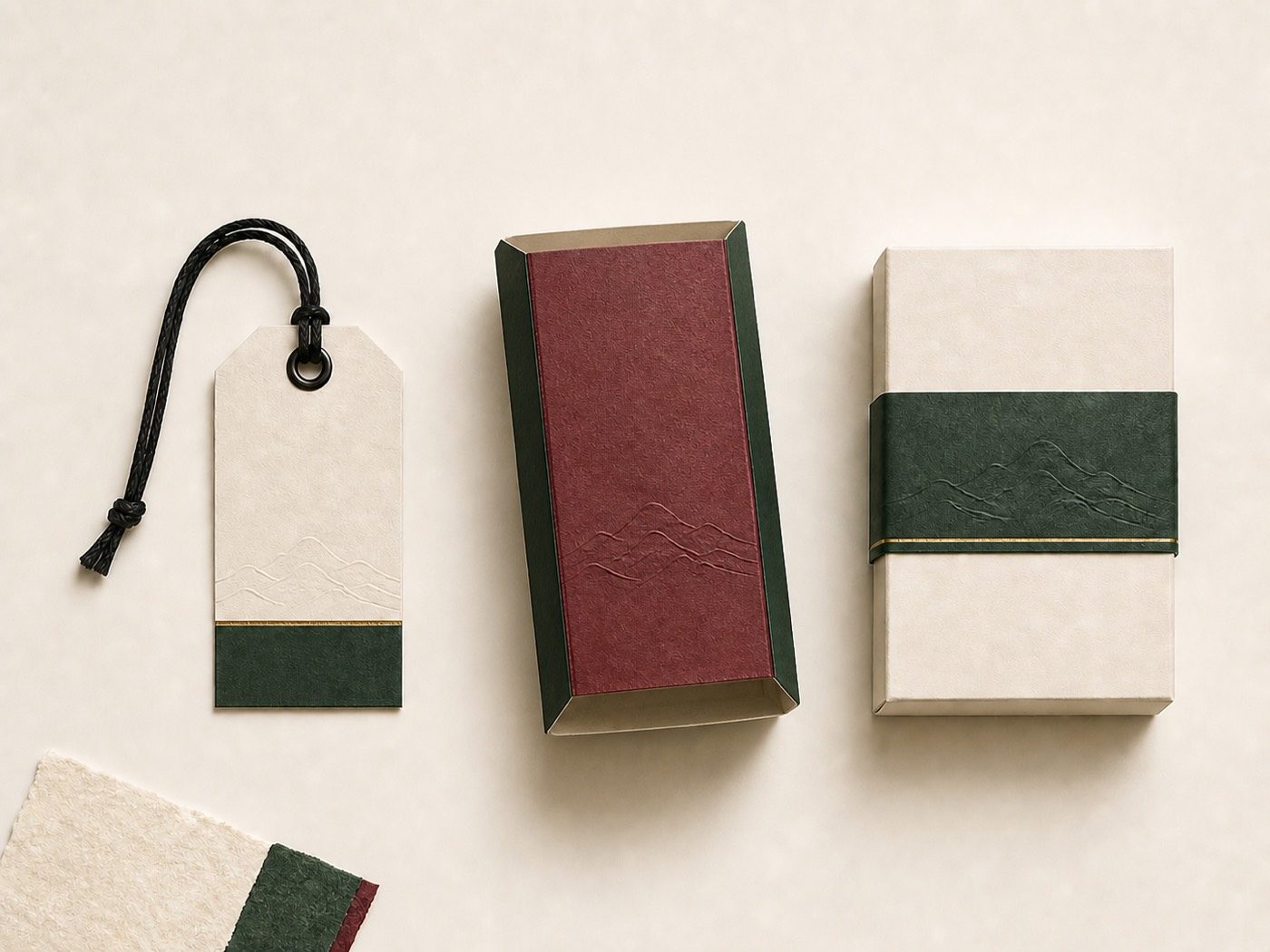
Choose a band when the base pack stays the same and only the message changes, a full sleeve when the whole outer look must change, and a printed box when the design is settled.
Regulation (EU) 2025/40 has applied since 12 August 2026; its Article 10 requires packaging weight and volume to be reduced to the minimum necessary for function by 1 January 2030 (see our EU PPWR 2026 guide). In our reading, a band that replaces a label, ribbon or reprinted box is easier to justify than one that repeats the box.
What to Send for a Quote
Price depends mainly on the number of versions and whether they can be printed on one sheet, the finishes, pre-gluing or adhesive application, and whether a new cutting die is needed. Pre-glued rings travel folded flat, so ask for counted bundles packed so printed faces do not rub. Send:
- Pack type (lid-and-base, one-piece, tapered or round), dimensions at the band position and, ideally, a packed sample
- Band width and position, measured from the base
- Closure, delivery format (flat or pre-glued) and where the bands will be fitted
- Barcode plan: single item or multipack
- Stock and any certification label required
- Colour references, sides printed, finishes and number of versions
- Quantity per version, packing count per bundle and delivery date
- Whether you need an unprinted fit sample first
- Dieline needed or supplied, with vector PDF artwork including bleed
- Destination and Incoterm, such as DDP or DAP (see our DDP vs DAP guide)
How Yuan Packaging Can Help
Yuan Packaging, established in 2000, makes custom printed belly bands as part of its hang tags, sleeves and belly bands range.
- A presentation-quality sample takes 5–7 working days.
- Production takes 15–20 working days after artwork approval.
- Samples reach Europe in 1–2 weeks.
- We deliver DDP or DAP to the EU and the UK, and DDP to Switzerland.
- The minimum order is 1,000 pieces for both offset and digital printing; see our MOQ guide.
Send the checklist above through our quote form and we will reply with a quote.
FAQ
What is the difference between a belly band and a sleeve?
A belly band covers a strip around the middle of a pack; a sleeve wraps four sides and is open at the ends. Some suppliers use both terms for the same product, so confirm the coverage in your quote request.
How do you measure a belly band?
Measure the circumference of the packed, closed product where the band will sit, add the ease and closure allowances, then confirm the length on an unprinted mock-up.
Which closure is best for a belly band?
A glued loop looks cleanest on straight-sided boxes, a tab-and-slot closure can be reopened, and an adhesive closure suits soft or irregular products and tolerates small size errors best.
Can a belly band cover the barcode or label information?
On a single item, no: keep the barcode scannable and label text visible; on food packs, Regulation (EU) No 1169/2011 requires mandatory food information to stay easily visible and not obscured. The exception is a band that bundles items sold as one unit: under GS1 guidance it carries its own barcode and hides the inner ones.
Sources
- Food information to consumers legislation, European Commission
- Regulation (EU) No 1169/2011, Article 13, legislation.gov.uk
- Regulation (EC) No 1223/2009, Article 19, legislation.gov.uk
- Barcode location for retail point-of-sale (February 2025), GS1 New Zealand
- Packaging waste and Regulation (EU) 2025/40, European Commission
- Recyclability evaluation protocol, updated edition (June 2026), 4evergreen
- FSC certificate search, Forest Stewardship Council
— Anthony
What is the difference between a belly band and a sleeve?
A belly band covers a strip around the middle of a pack; a sleeve wraps four sides and is open at the ends. Some suppliers use both terms for the same product, so confirm the coverage in your quote request.
How do you measure a belly band?
Measure the circumference of the packed, closed product where the band will sit, add the ease and closure allowances, then confirm the length on an unprinted mock-up.
Which closure is best for a belly band?
A glued loop looks cleanest on straight-sided boxes, a tab-and-slot closure can be reopened, and an adhesive closure suits soft or irregular products and tolerates small size errors best.
Can a belly band cover the barcode or label information?
On a single item, no: keep the barcode scannable and label text visible; on food packs, Regulation (EU) No 1169/2011 requires mandatory food information to stay easily visible and not obscured. The exception is a band that bundles items sold as one unit: under GS1 guidance it carries its own barcode and hides the inner ones.