
There is no single best LCA software, but there is a best fit for each team. For packaging and consumer products, SimaPro and Sphera LCA for Experts suit specialists, openLCA and Brightway suit academic and technical users on a budget, and platforms such as One Click LCA and Makersite suit teams that need to assess many products quickly. Below we compare nine tools on what matters when you commission packaging: users, data, reporting, integration and cost model.
TL;DR
- A 2025 systematic review of 41 studies found SimaPro, GaBi, openLCA, Umberto and Athena to be the most frequently applied tools, each with a distinct sector focus (MDPI, 2025).
- Choose by use case, user expertise, database compatibility and reporting duties, not by brand name.
- Expert desktop tools give the most control. Cloud platforms give speed across large portfolios.
- Open-source tools are free to run, but commercial databases such as ecoinvent still need a separate license.
- Whichever tool you pick, the result is only as good as the material, weight and finish data you feed it. Your packaging supplier is a key data source.
Table of Contents
- What LCA software actually does
- How to choose: six criteria that decide it
- The tools at a glance
- Expert desktop tools
- Open-source options
- Cloud platforms for portfolios
- Matching the tool to your situation
- Perspective
- Getting packaging data ready for any LCA tool
- Start from a packaging spec that is easy to model
- FAQ
- Sources
What LCA software actually does
LCA software models the environmental impacts of a product or service from raw material extraction to disposal. Teams use it to find hotspots, improve product design, meet reporting requirements such as CSRD and create environmental product declarations (Carbon Maps, 2026).
For a premium packaging program, that means answering questions like these: how much of a rigid box's footprint comes from the paperboard versus the soft-touch lamination, what changes if you switch a carton to recycled board, and how a carrier bag compares with a reusable non-woven alternative. The software links your bill of materials to a database of process data, then applies an impact method to produce results such as global warming potential.
How to choose: six criteria that decide it
Organizations should pick LCA software based on project context and objectives, available expertise, database compatibility, and the methods and settings needed for reliable results (MDPI, 2025). In practice we would turn that into six questions:
- Who will run it? A trained LCA practitioner can handle an expert tool. A packaging or procurement manager usually cannot, and needs guided workflows.
- How many products? Five hero SKUs and 500 SKUs call for different tools. Portfolio scale decides whether you need automation (Carbon Maps, 2026).
- Which reporting is required? EPDs, CSRD disclosures, retailer scorecards and EPR fee modeling each lean on different outputs.
- Which databases and methods? Check that the tool opens the database and impact method your reviewers expect.
- How will it connect? Look at supplier-data collection, compatibility with existing systems, and export in open formats (Earthster, 2024).
- Can you leave? Vendor lock-in and data portability are real strategic risks. Prefer tools that follow open standards and let you extract your own data for long-term audit readiness (Earthster, 2024).
Pro tip: run the same simple packaging model, say a folding carton with one foil stamp, in your two shortlisted tools before you buy. Software choice can change packaging decisions: a comparison of several packaging systems in COMPASS, SimaPro, GaBi and Package Modeling found significant discrepancies between the results (ResearchGate). Agree the method and database up front so comparisons stay fair.
The tools at a glance
| Tool | Best for | Type | Standout feature |
|---|---|---|---|
| SimaPro | Practitioners, consultants, academia | Expert desktop | Scenario and uncertainty analysis, ecoinvent access |
| Sphera LCA for Experts (formerly GaBi) | Industrial and manufacturing LCAs, EPDs | Expert desktop plus data | 20,000+ verified datasets reported |
| openLCA | Research, budget-limited technical teams | Free, open source | Developed by GreenDelta since 2006 |
| Brightway | Python-capable researchers and data teams | Open-source framework | High performance on large datasets |
| One Click LCA | Construction and manufacturing, EPDs | Cloud platform | Automated assessments in 170+ countries |
| Makersite | Manufacturers weighing cost, risk and footprint | Cloud platform | Sustainability, cost and risk trade-offs |
| Minviro XYCLE | Batteries, critical minerals | Software plus consultancy | ISO-compliant LCA for advanced supply chains |
| Umberto | Energy and process modeling | Expert desktop | Process-flow modeling |
| Athena | Construction and BIM | Specialist | BIM integration |
Expert desktop tools
SimaPro
SimaPro describes itself as an expert-developed tool used in industry and academia for 35 years, with scenario and uncertainty analysis, transparent results and access to ecoinvent (SimaPro). The systematic review singles it out for flexibility and robustness (MDPI, 2025).
For packaging it is a strong fit when an in-house or consultant LCA specialist needs to build custom models, for example comparing a rigid box with a magnetic closure against a folding carton with a printed sleeve. The trade-off is the learning curve and the manual data work, so budget practitioner time.
Sphera LCA for Experts (GaBi)
Sphera is the successor to GaBi. It is described as an expert-focused tool with 20,000+ DEKRA-verified datasets, suited to chemicals, energy and manufacturing (Manglai, 2026). The academic review notes GaBi's strength in industrial applications and EPD support (MDPI, 2025). Sphera also offers a lighter path for small assessments of up to 25 LCAs, plus large-scale automated analysis (Sphera).
SimaPro vs GaBi: how to decide
Both are mature, expert-grade and licensed commercially, and commercial tools carry high licensing costs (MDPI, 2025). A workable rule of thumb:
- Pick SimaPro when flexibility, transparency and an academic or consulting workflow matter most.
- Pick Sphera (GaBi) when your work is industrial, you need strong EPD support, or you value its bundled, verified datasets.
- Test both on your own packaging model. Neither publishes a price list we can quote, so request a quote and ask what the database access includes.
Umberto and Athena
Umberto is the choice for energy and process modeling, and Athena for BIM-integrated construction work (MDPI, 2025). Neither is a natural first choice for a beauty or spirits packaging team, but both matter if your project spans factory energy flows or building materials.
Open-source options
openLCA
openLCA is free, professional, open-source LCA and footprint software developed by GreenDelta since 2006 (openLCA). It gives academic and technical users flexibility, though commercial databases such as ecoinvent require separate licensing (MDPI, 2025). Configuring it requires LCA knowledge (Manglai, 2026). It suits a sustainability lead with some LCA training and a limited budget.
Brightway
Brightway is a Python-based framework built for high performance, flexibility and large datasets, widely used in academia and increasingly in industry (Brightway docs). It is the right tool when you want to automate hundreds of packaging variants in code. It is the wrong tool for a brand manager who wants a dashboard.
Cloud platforms for portfolios
One Click LCA
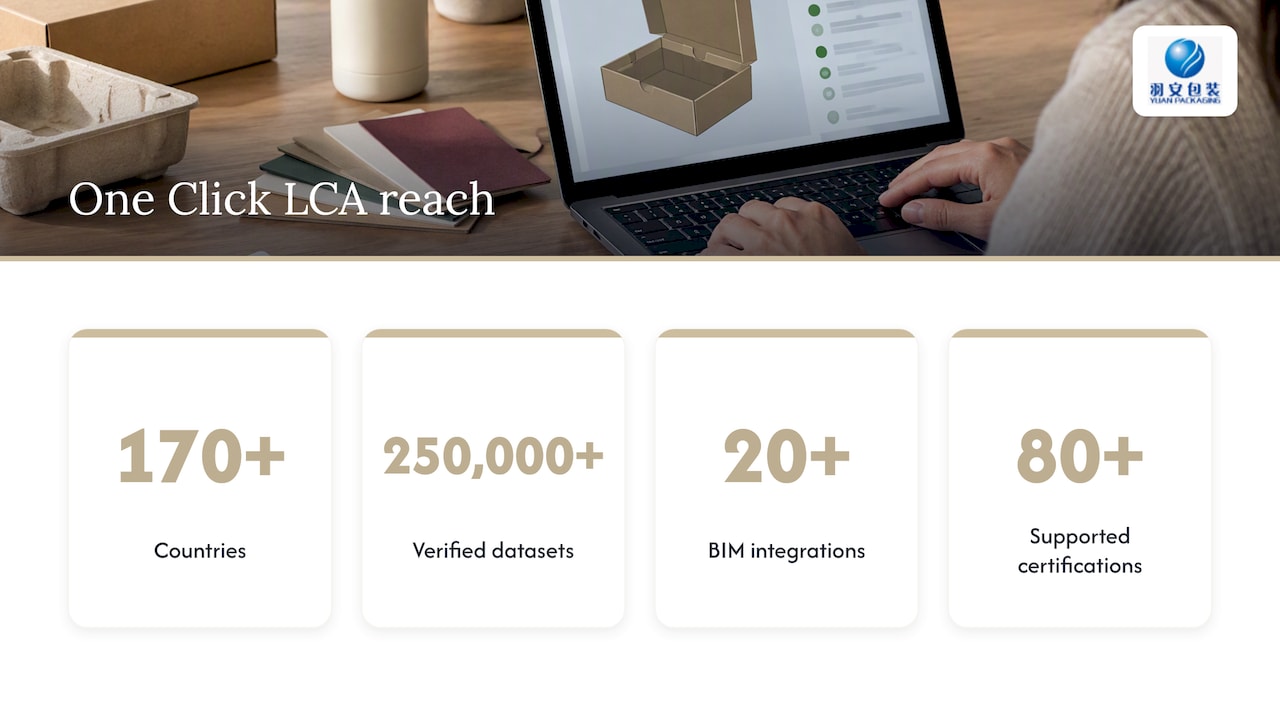
One Click LCA is AI-powered software for construction and manufacturing, used in 170+ countries to automate environmental assessments (One Click LCA). The company reports more than 250,000 verified datasets, 20+ BIM integrations, automated EPD creation and support for 80+ certifications (One Click LCA, 2025). Its strength is speed and standardized outputs, which helps when many SKUs need the same treatment.
Makersite
Makersite offers a platform for sustainability, cost and risk trade-offs, with Pro, Teams and Enterprise plans (Makersite pricing). That cost-and-footprint view appeals to procurement teams that compare materials on more than carbon alone.
Minviro XYCLE
Minviro provides LCA consultancy and XYCLE software for critical minerals, batteries and advanced technology supply chains, for ISO-compliant LCA and product carbon footprint models (Minviro). It is specialist, so it is relevant mainly if your packaging sits inside a battery or electronics product.
Manglai and other SaaS options
Manglai positions itself as a SaaS tool with AI-assisted data capture (Manglai, 2026). Tools of this kind trade some modeling depth for ease of use, which can suit a non-specialist team.
Matching the tool to your situation
| Your situation | Likely shortlist |
|---|---|
| One LCA specialist, bespoke models, audit-grade results | SimaPro, Sphera LCA for Experts |
| Researcher or student, limited budget | openLCA, Brightway |
| Hundreds of SKUs, need speed and EPDs | One Click LCA, Makersite |
| Non-specialist team, first footprint | Cloud SaaS with guided data capture |
| Battery or critical-mineral supply chain | Minviro XYCLE |
Check integration before you commit. One vendor comparison describes SimaPro and GaBi as manual and slower to connect than platforms with API and PLM or ERP connectors (Dawn). That is a vendor's view, so test it against your own systems in a trial.
Perspective
We make rigid gift boxes, folding cartons, labels, carrier bags and pharmaceutical cartons for beauty, spirits, lifestyle, health and food brands, so we see LCA from the supply side. The software question is rarely where a footprint goes wrong. It goes wrong when the inputs are guesses: a board grade assumed, a lamination forgotten, a foil weight left out.
That is why we run material, finish and structure decisions in one facility, with consistent specifications from the dieline to the finished unit. A brand that arrives with a clear bill of materials can model its packaging in any of the tools above in a fraction of the time.
Our advice: pick the tool your team will actually use, agree one impact method, and ask your packaging partner for specifications early. We are designed to make that handover simple, whether the target is a lighter rigid box, a recycled-content carton or a reusable bag.
Anthony
Getting packaging data ready for any LCA tool
Whichever software you choose, collect the same inputs for each packaging item:
- Dimensions, board grade and caliper, and unit weight.
- Every component: inserts, ribbons, magnets, window films, adhesives.
- Print and finishing: inks, foil stamping, embossing, soft-touch lamination.
- Recycled content and sourcing claims, ideally documented. Our guide on proving post-consumer recycled content shows what procurement teams should request.
- Transport mode and distance from factory to filler.
The same data supports compliance work. Our 30/60/90 day plan for U.S. packaging EPR rules uses much of it, and why leading brands are rethinking packaging sustainability explains where the pressure is coming from. For design choices that change the numbers, see our notes on rigid box dielines, materials and production rules.
Start from a packaging spec that is easy to model
Yuan Packaging manufactures custom rigid gift boxes, folding cartons, labels, paper carrier bags, non-woven bags, corrugated boxes, paper tubes, pharmaceutical cartons and hang tags, with options for structure, material and finishing, including responsibly sourced materials. If you are preparing an LCA for a new or redesigned pack, a defined specification makes the model faster to build and easier to defend.
Browse the full product range, or contact us through our site with your target materials and volumes.
FAQ
Is there a free LCA software?
Yes. openLCA is free and open source, developed by GreenDelta since 2006 (openLCA), and Brightway is a free Python framework (Brightway docs). Be aware that commercial databases such as ecoinvent require separate licensing (MDPI, 2025).
What is the most widely used LCA software?
A 2025 systematic review of 41 studies identified SimaPro, GaBi, openLCA, Umberto and Athena as the most frequently applied tools in sustainability science (MDPI, 2025). Frequency of use in research does not always match what suits a brand team, so apply the six criteria above.
Can LCA software create EPDs?
Some can. One Click LCA states that it automates EPD creation (One Click LCA, 2025), and the academic review credits GaBi with EPD support (MDPI, 2025). Confirm with the vendor which program operators and product categories are covered for packaging.
How much does LCA software cost?
Most vendors publish plan names but not full prices. Makersite lists Pro, Teams and Enterprise plans (Makersite pricing), and commercial expert tools carry high licensing costs (MDPI, 2025). Request current quotes and ask whether database access is included.
Does the software choice change the result?
It can. A packaging study comparing four tools found significant discrepancies between their results (ResearchGate). Fix the database, method and system boundary before you compare packaging options.
Sources
- No One-Size-Fits-All: A Systematic Review of LCA Software (MDPI, 2025)
- LCA Software 2026: Compare Top Tools (Carbon Maps)
- 8 best software tools to measure product carbon footprint (Manglai)
- Choosing the right Life Cycle Assessment software (Earthster)
- Choice of LCA Software Can Impact Packaging System Decisions (ResearchGate)
- SimaPro desktop
- Sphera life cycle assessment software and data
- openLCA
- Brightway documentation
- One Click LCA
- Best LCA software (One Click LCA)
- Makersite pricing
- Minviro
- LCA Tools Comparison (Dawn)
Recommended
- Packaging Quality Control for QA & Procurement: ISO 2859, AQL, 3 Tests
- Reduce Lab Retests: ISTA Transit Testing Workflow for Packaging Teams
- Save on Packaging Runs: Offset vs Digital Printing for 500–5,000+
- REACH vs RoHS: Packaging Decisions to Make in 90 Days
Is there a free LCA software?
Yes. openLCA is free and open source, developed by GreenDelta since 2006 (openLCA), and Brightway is a free Python framework (Brightway docs). Be aware that commercial databases such as ecoinvent require separate licensing (MDPI, 2025).
What is the most widely used LCA software?
A 2025 systematic review of 41 studies identified SimaPro, GaBi, openLCA, Umberto and Athena as the most frequently applied tools in sustainability science (MDPI, 2025). Frequency of use in research does not always match what suits a brand team, so apply the six criteria above.
Can LCA software create EPDs?
Some can. One Click LCA states that it automates EPD creation (One Click LCA, 2025), and the academic review credits GaBi with EPD support (MDPI, 2025). Confirm with the vendor which program operators and product categories are covered for packaging.
How much does LCA software cost?
Most vendors publish plan names but not full prices. Makersite lists Pro, Teams and Enterprise plans (Makersite pricing), and commercial expert tools carry high licensing costs (MDPI, 2025). Request current quotes and ask whether database access is included.
Does the software choice change the result?
It can. A packaging study comparing four tools found significant discrepancies between their results (ResearchGate). Fix the database, method and system boundary before you compare packaging options.