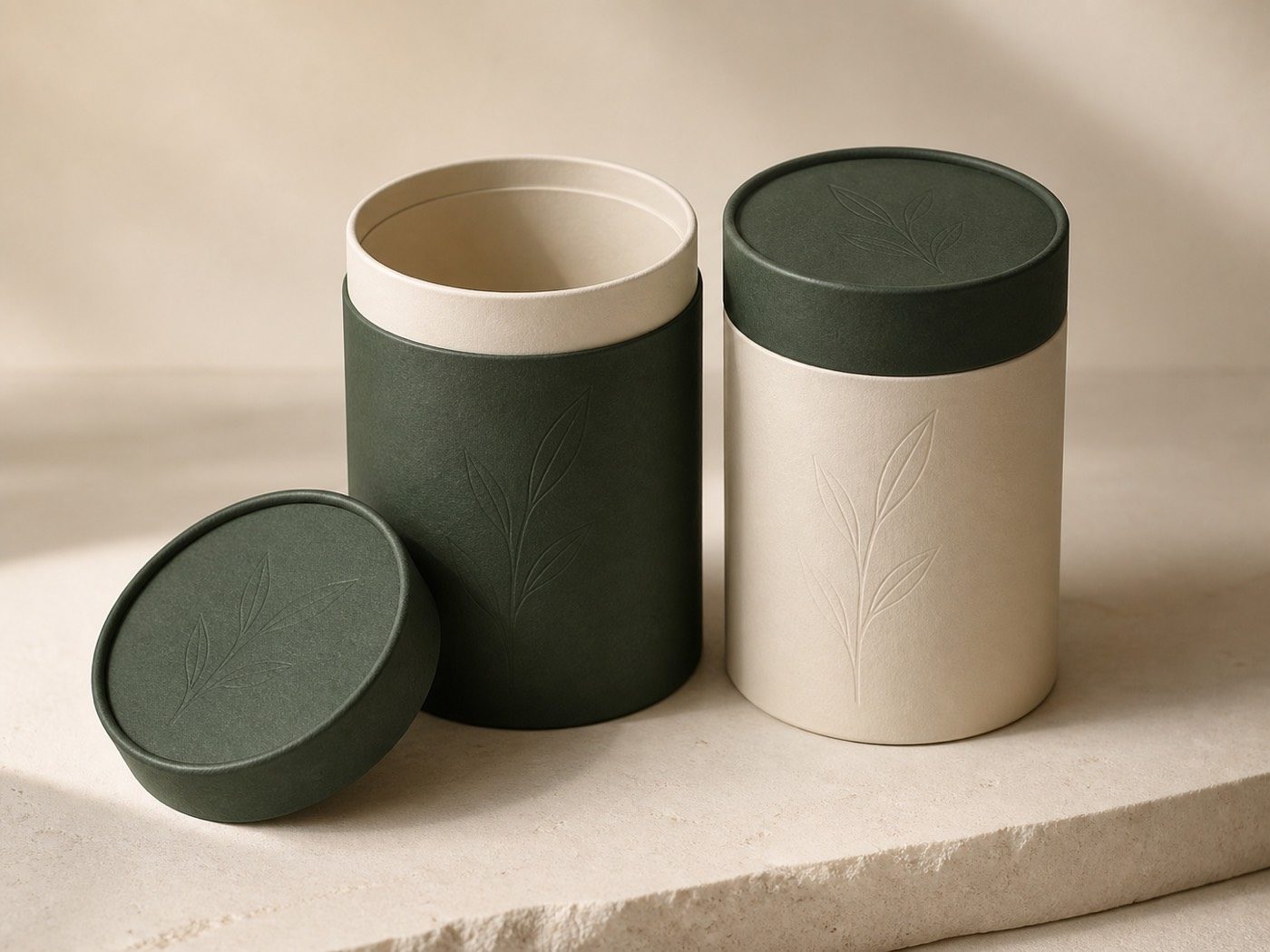
Paper tube packaging is a rigid cylinder of wound paperboard, closed with a lid, cap or end disc and usually covered in a printed wrap. For cosmetics, candles, tea and gifts, decide whether the product touches the tube, then the closure, liner and decoration, and confirm each on an assembled sample.
Key takeaways: Decide first whether the product touches the tube, and ask for food-contact documents per component, even with an inner pouch. Approve fit, lid feel, seam and colour on a sample with the product inside, and budget freight for a pack that ships assembled.
Table of Contents
- Paper Tube vs Tin, Rigid Box or Folding Carton
- How Paper Tubes Are Built: Spiral vs Convolute
- Lid and Closure Types Compared
- Liners, Inserts and Food Contact
- Finishes: Printed Wrap, Printed Ply or Label
- Samples, Defects and Shipping
- What to Send for a Quote
- How Yuan Packaging Can Help
- FAQ
- Sources
Paper Tube vs Tin, Rigid Box or Folding Carton
This comparison is general; for the two box formats, see rigid box vs folding carton.
| Factor | Paper tube | Metal tin | Rigid box | Folding carton |
|---|---|---|---|---|
| Barrier | Only with a liner or inner pack | Metal body; check the lid seal | Only with an inner pack | Only with a liner or coating |
| Recycling route | Depends on ends, liner and insert | Metal collection | Depends on wrap, magnets and insert | Depends on coatings and windows |
| Decoration | Wrap, foil, emboss or a label | Printed metal, embossing | Wrap, full finishing | Printed board, full finishing |
| Ships | Assembled | Assembled | Assembled; collapsible styles flat | Flat |
How Paper Tubes Are Built: Spiral vs Convolute
A tube body is made by winding glued layers (plies) of paperboard around a forming rod called a mandrel. The plies set the wall and the mandrel sets the diameter, so tooling is diameter-specific: one or two standard diameters across a range usually cost less than sizing every product exactly. Our paper tubes page shows the formats.
- Spiral winding runs continuously: paper strips are wound at an angle and cut to length, and the helical seams disappear under the wrap.
- Convolute winding rolls one sheet straight around the mandrel, with no helical seam. It is often chosen for a smoother interior or a heavier wall.
You rarely need to choose the method. Specify the performance, ask which method the supplier uses and why, and agree in writing:
- The product's widest point, measured over any label, cap or pump
- Inside or outside diameter, and the inside-diameter tolerance
- Lid depth, and a wall that carries the filled weight
Lid and Closure Types Compared
The closure decides how the tube opens and feels; its resistance is tuned at sampling. See our lid-and-base tube and push-fit cap tube pages.
| Closure | How it works | Suits | How to specify it |
|---|---|---|---|
| Telescoping lid (partial overlap) | The lid slides over the body; its depth is a design choice | Gift presentation | Lid depth; slow drop or firm pull |
| Lid over an inner collar | The lid closes over a raised collar, flush with the body | Tea caddies and sets | Collar height; artwork aligned across the join |
| Push-fit cap | A short friction-fit cap pushes over the top | Tea, coffee and cosmetics used repeatedly | Grip; the hold after repeated use |
| Plug or inset lid | The lid sits inside the tube mouth | A flat, flush top | Fit depth; a pull tab or thumb notch |
In a slow-drop fit, trapped air lets the lid sink gently. Edges are a finish, not a closure: the wrap is turned over a cut edge, or the board curled into a rolled edge.
Liners, Inserts and Food Contact
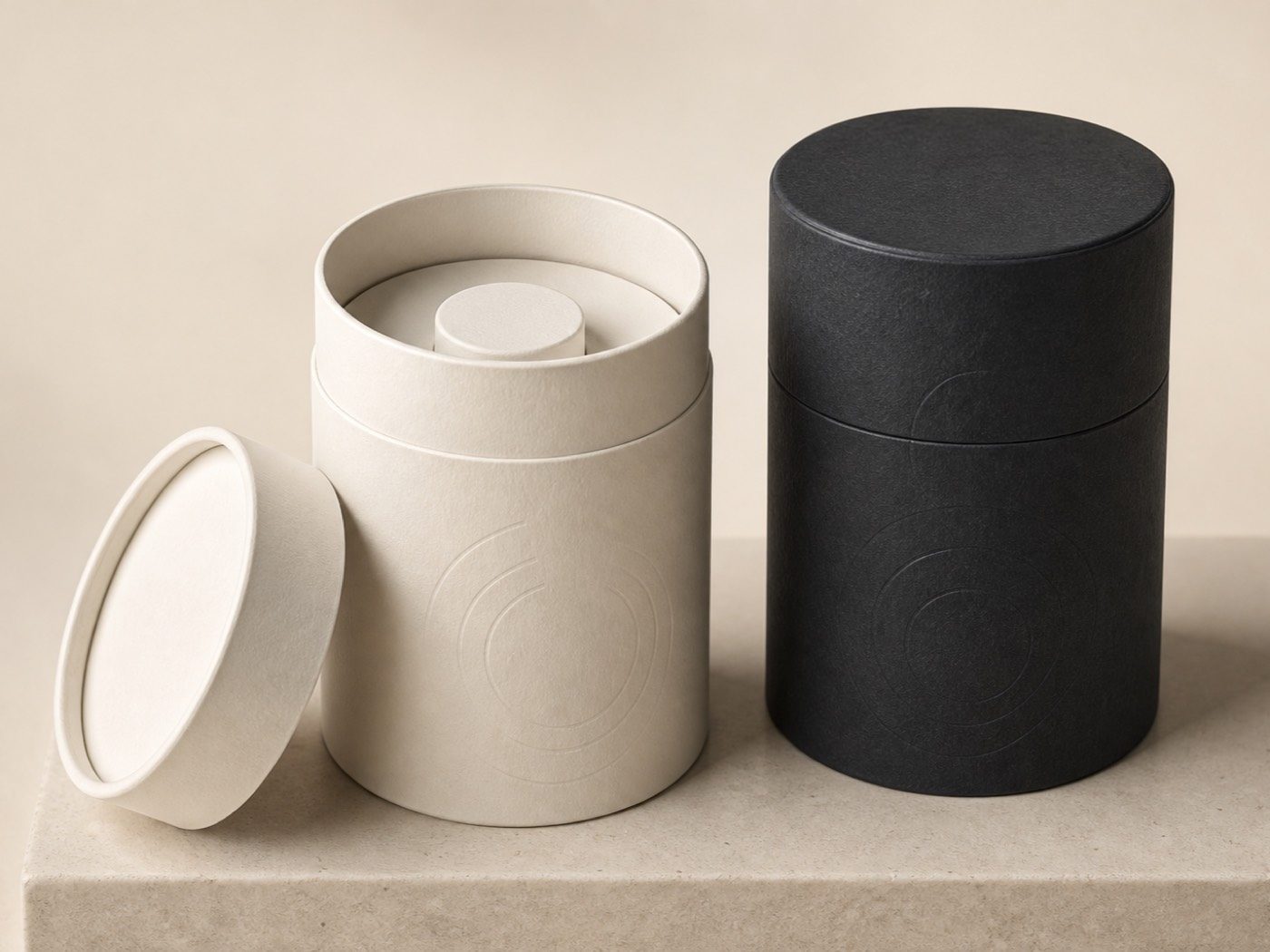
First ask: does the product touch the tube? The answer changes the inner ply, the documents and the tests. Most advice in this guide concerns the third case.
| Case | Examples | What changes | Ask for and test |
|---|---|---|---|
| Product touches the tube | Loose tea; a solid balm stick | Inner ply, liner or coating | Food-contact declaration or packaging data for the cosmetic safety report; odour |
| Product in a sealed inner pack | Tea in a pouch | The pack is the barrier and contact layer | Whether board and inks could transfer substances through it |
| Tube holds a container | Candle glass, jar, bottle | Insert or collar; wall for the weight | Fit with the product inside; if scented, grease resistance, as oil can stain the wrap |
- Pouches: a sealed inner pouch takes over direct contact and the barrier, but Regulation (EC) No 1935/2004 also covers materials that can reasonably be expected to transfer constituents to food, so ask about the tube’s board and inks too.
- Inserts and ends: for collars, cradles and dividers, see box insert options. Metal or plastic ends change how the empty tube is recycled.
Food contact: what to ask your supplier
For tea, coffee and confectionery, ask any supplier (this is not legal advice):
- Which components can touch the food or transfer substances to it: inner ply, liner, end discs, adhesive, inks?
- EU: how does each meet Regulation (EC) No 1935/2004 and the good manufacturing practice rules of Regulation (EC) No 2023/2006? Paper and board have no specific EU measure, so national rules may apply.
- Which reference does the declaration use, such as BfR Recommendation XXXVI or the Cepi food contact guidelines?
- If any ply is recycled fibre, how is mineral-oil migration controlled: a virgin-fibre inner ply or a functional barrier? EFSA updated its risk assessment of mineral oil hydrocarbons in food in 2023.
- Are inks and varnishes low-migration where they face the food or could set off (transfer) onto a food-facing surface? See EuPIA guidance.
- UK and Switzerland: Great Britain applies Regulation 1935/2004 as assimilated law (FSA); Switzerland has its own FDHA ordinance, SR 817.023.21, including rules for packaging inks.
- US: which FDA regulation does each component rely on, such as 21 CFR 176.170 or 176.180 for paper and paperboard components, or 175.105 for adhesives? See FDA’s food contact substances pages.
- Will the supplier confirm this in writing, naming the materials, food type and conditions of use covered?
Finishes: Printed Wrap, Printed Ply or Label
Decoration is usually applied to the flat wrap sheet before it goes on: offset print, hot foil, embossing, soft-touch or matte lamination and spot UV. Working flat keeps registration under control, and the seam is planned into the artwork. There are three routes:
- Printed wrap: full coverage, coordinated finishes and a controlled seam; each design is its own print job.
- Printed outer ply: some spiral tubes are wound with a printed outer ply; ask whether artwork must then be a repeat pattern.
- Plain tube with a label: one body serves several variants and short runs, and batch codes fit easily on a label. Test labels on the curve.
Plan mandatory text first: for EU cosmetics, Regulation (EC) No 1223/2009 is the main framework (cosmetic label requirements covers US rules), and candle packs in Europe often carry the EN 15494 safety pictograms (see candle box design).
Samples, Defects and Shipping
Lid feel, seam alignment and colour on a curve can only be judged in the hand:
- Send the product, or reliable dimensions, weights and photos; for bottles, jars and candle vessels, the real container.
- Check a plain sample with the product inside for diameter, height, stiffness and lid fit.
- Check a printed sample for colour, foil and seam beside any carton in the range: colour looks different on a curve.
- Approve one sample and keep it as the reference for production quality checks.
Defects to check on the approved sample
| Defect | Usual cause | How to check |
|---|---|---|
| Seam gaps or lifting | Wrap cut short; thin glue line | Run a fingertip along the seam |
| Wrinkles at a rolled edge | Wrap too stiff for the curl | Low side light on the rim |
| Out-of-round body | Crushing or uneven storage | Measure two diameters at right angles |
| Lid too tight or loose | Moisture change; diameter tolerance | Recheck after humid storage |
| Lid and body colours differ | Wraps cut from different sheets | Compare both under one light |
| Foil cracking at a curl | Foil over a tight bend | Check foil where it meets an edge |
| End disc pushing out | Heavy vessel; weak glue or wall | Drop-test with the product inside |
Packing and shipping tubes
- Tubes ship assembled, and round packs leave gaps in square cartons: ask for units per carton and carton size with the quote.
- Ask how tubes are separated, with dividers or sleeves, to stop scuffing.
- For sea freight, ask how cartons are protected from humidity in the container.
- Specify transit tests separately; see ISTA transit testing.
What to Send for a Quote
A complete brief gets a comparable quote and a closer first sample. The example entries illustrate a candle brief; they are not Yuan data:
| Field | Example entry | Why it matters |
|---|---|---|
| Product | Glass candle vessel, filled weight | Sets the wall and end disc |
| Diameter | Inside diameter 75 mm at the widest point, label included | Inside or outside changes tooling |
| Closure | Telescoping lid, slow drop | Sets lid depth and fit |
| Insert and contents | Card collar; scented, so grease-resistant wrap | Decides insert, liner and documents |
| Decoration | Printed wrap, foil lid, soft-touch | Drives set-up and lead time |
| Variants | Three scents on labels, one tube | Wrap or label route |
| Quantity | Two or three to compare | Shows unit-price steps |
| Destination and documents | EU, DDP; FSC chain-of-custody evidence if FSC-labelled | Delivery terms and paperwork |
| Ask the supplier | Units per carton, carton size | Freight cost per unit |
For food, say whether contents are loose, wrapped or sealed. Missing some details? Send what you have through our quote form.
How Yuan Packaging Can Help
Yuan Packaging has made custom packaging since 2000. Our paper tubes include candle and cosmetic tubes, tea and food caddies and bottle tubes.
- An assembled sample tube takes 5–7 working days; lid feel and seam position are judged on it in the hand.
- Production takes 15–20 working days after artwork approval, or 25–30 with complex finishing, confirmed on your quote (lead times).
- The minimum order follows the diameter and finishing, confirmed against your specification.
- We deliver DDP or DAP to the EU and the UK, and DDP to Switzerland. We never quote a duty rate; under DAP, your customs broker confirms duty and VAT (see DDP vs DAP).
Send your brief through the contact page and we will reply with questions or a quote.
FAQ
What is the difference between spiral and convolute paper tubes?
Spiral tubes are wound continuously from strips laid at an angle around a mandrel, then cut to length. Convolute tubes are rolled from one sheet wrapped straight around it, with no helical seam. Under a printed wrap they look alike.
Why does a paper tube lid feel tighter or looser after shipping?
Paperboard absorbs and releases moisture, so a friction fit can change in a sea container or a humid warehouse. Recheck the lid on a sample after humid storage before approving it.
Is a paper tube a good alternative to a tea tin?
It can be, for decoration and a mainly paper pack, but it is not a barrier on its own. Loose tea needs a suitable liner or a sealed pouch; even then, ask whether the board and inks could transfer substances to the tea.
Should I use a label or a printed wrap on a paper tube?
Use a printed wrap for full coverage, foil and a controlled seam. Use a plain or kraft tube with a label when several variants share one body or runs are short, and check adhesion on the curve at sampling.
Sources
- European Commission: Food contact materials legislation
- legislation.gov.uk: Regulation (EC) No 1935/2004, Article 1
- Food Standards Agency: Food contact materials authorisation guidance
- Fedlex: FDHA Ordinance on materials and articles in contact with food, SR 817.023.21 (German)
- BfR: Recommendations on food contact materials
- Cepi: Food Contact Guidelines for the Compliance of Paper and Board Materials and Articles
- EFSA: Mineral oil hydrocarbons
- EuPIA: Food contact materials
- eCFR: 21 CFR 176.170, Components of paper and paperboard in contact with aqueous and fatty foods
- eCFR: 21 CFR 176.180, Components of paper and paperboard in contact with dry food
- eCFR: 21 CFR 175.105, Adhesives
- U.S. FDA: Packaging and food contact substances
- European Commission: Cosmetics legislation
- BSI: BS EN 15494:2019, Candles. Product safety labels
- Forest Stewardship Council: Chain of custody
— Anthony
What is the difference between spiral and convolute paper tubes?
Spiral tubes are wound continuously from strips laid at an angle around a mandrel, then cut to length. Convolute tubes are rolled from one sheet wrapped straight around it, with no helical seam. Under a printed wrap they look alike.
Why does a paper tube lid feel tighter or looser after shipping?
Paperboard absorbs and releases moisture, so a friction fit can change in a sea container or a humid warehouse. Recheck the lid on a sample after humid storage before approving it.
Is a paper tube a good alternative to a tea tin?
It can be, for decoration and a mainly paper pack, but it is not a barrier on its own. Loose tea needs a suitable liner or a sealed pouch; even then, ask whether the board and inks could transfer substances to the tea.
Should I use a label or a printed wrap on a paper tube?
Use a printed wrap for full coverage, foil and a controlled seam. Use a plain or kraft tube with a label when several variants share one body or runs are short, and check adhesion on the curve at sampling.