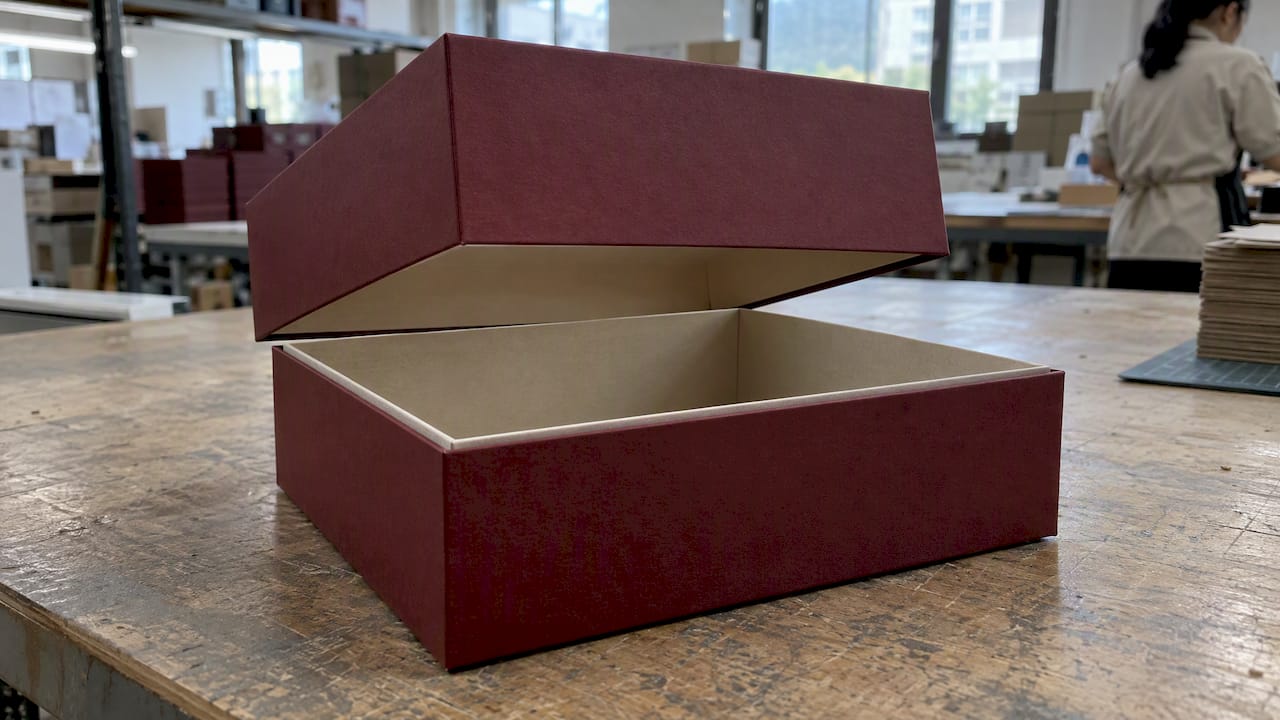
Telescoping rigid boxes are two-piece, lift-off packaging where a rigid lid slides down over a rigid base, giving products a sturdy, premium presentation without hinges or glue tabs between the pieces. We recommend them whenever a brand wants the box itself to feel like part of the gift, which is why they show up constantly in cosmetics sets and spirits packaging.
TL;DR:
- Choose a full lid when shipping protection matters; a partial lid leaves a visible base band for two tone retail presentation.
- Give manufacturers separate lid and base dimensions, usable interior space, insert details, color specifications, and vector artwork; confirm clearance with a physical prototype.
- Pairing soft touch lamination with one foil accent balances cost and impact; avoid stacking surface treatments unless the added expense serves a clear design purpose.
- Recycled board may need a heavier caliper to match virgin board’s rigidity, while plastic based coatings can prevent boxes from entering standard paper recycling.
Table of Contents
- What Telescoping Construction Actually Means
- Materials and Construction Basics
- Design and Specification Checklist for Ordering
- Finishes and Premium Touches
- Typical Uses and Industries
- Sustainability and Material Sourcing
- How We Scope a Telescoping Rigid Box Project
- What Most Buyers Get Wrong About Rigid Box Choices
- Ready to Produce Your Own Telescoping Rigid Box
- FAQ
- Internal Resources and Next Steps
What Telescoping Construction Actually Means
A telescoping rigid box is built from two separate shells: a base that holds the product and a lid that telescopes, or slides, over that base like a cap settling onto a pen. Neither piece is attached to the other, so the entire lid lifts completely free, which is where the "lift-off" name comes from. The depth of that lid is what separates one telescoping style from another.
A full telescope lid extends all the way down to the base's bottom edge, covering the entire box and creating a seamless, monolithic look. A partial telescope lid stops partway down the base, leaving a strip of the base material visible and creating a deliberate color or texture contrast.
- Full telescope lids suit shipping-heavy products and boxes that need corner and edge protection during transit.
- Partial telescope lids suit presentation sets and retail displays where a visible two-tone effect adds shelf interest.
- Deep lids work well for layered gift sets with multiple components stacked inside.
- Shallow lids fit flatter items like jewelry, cosmetics compacts, or small spirit miniatures.
Materials and Construction Basics
The strength and feel of a telescoping box start with the board underneath the printed surface, not the finish on top. Rigid setup boards for premium boxes typically run thicker than folding carton stock, since the box has to hold its shape without any folding or scoring.
- Setup board (chipboard) forms the rigid core and comes in a range of calipers depending on box size and expected load.
- Wrapped paperstock covers, including textured, linen, or specialty papers, are glued over the board to carry the print and finish.
- Linings inside the lid and base add a finished look to surfaces that would otherwise show raw board.
- Inserts such as foam, corrugated partitions, or molded pulp trays hold products in place and prevent shifting in transit.
Heavier board and well-fitted inserts add shipping durability, but they also add perceived value the moment a customer lifts the lid, which is often the point of choosing rigid over folding carton construction in the first place.
Design and Specification Checklist for Ordering
Getting an accurate quote and a prototype that matches your expectations comes down to giving a manufacturer precise, complete specifications upfront. A vague brief leads to revision rounds; a tight one leads to a sample that matches the first time.
- External dimensions for both lid and base, since telescoping boxes need separate measurements for each shell.
- Internal usable space and product clearance, accounting for insert thickness and a small tolerance gap so the lid slides smoothly.
- Dieline files with clearly marked bleed, safe area, and fold or score lines in a vector format like AI or PDF.
- Color specification, whether CMYK process or Pantone spot colors, noted directly on the artwork file.
- Insert specs and assembly notes, including material, cavity shapes, and how the insert seats inside the base.
- Confirmation of box type, specifying telescoping and lid depth so it isn't mistaken for a hinged or drawer-style request.
Most manufacturers will offer a digital proof first, followed by a physical mockup before committing to a production run; expect minimum order quantities and lead times to vary with box complexity and finish count.
Pro Tip: Send product photos with your specification request. A manufacturer can flag clearance or insert issues before cutting a single prototype.
Finishes and Premium Touches
The finish is usually what a customer notices before they even open the box, and it's where a telescoping rigid box earns its premium price point. Foil stamping adds a metallic line or logo accent that catches light without covering the whole surface. Embossing and debossing raise or press a design into the board itself, giving a tactile cue that print alone can't deliver. Soft-touch lamination gives the surface a matte, velvet-like feel that resists fingerprints. Spot UV adds glossy contrast against a matte base, and windows let the product peek through before the lid even comes off.
- Subtle foil accents on logos or edges read as understated luxury, which fits high-end cosmetics well.
- Heavy embossing across a full panel reads as bold and tactile, a common choice for premium spirits packaging.
- Soft-touch lamination paired with a single foil hit balances cost against visual impact better than full-surface foil.
- Spot UV over matte stock adds contrast cheaply when a full metallic treatment isn't in the budget.
Combining an accent finish with a full-surface treatment on the same box usually overextends the budget without adding proportional impact, so most of our clients pick one dominant finish and one supporting detail.
Typical Uses and Industries
Telescoping rigid boxes show up anywhere a brand needs the unboxing itself to carry weight. Gift sets, cosmetics, spirits, and electronics are the most common categories, each for a slightly different reason.
- Cosmetics gift sets often use a partial telescope lid with a divided foam or molded insert to separate skincare bottles or compacts.
- Spirits packaging leans on full telescope lids with heavy board for bottle protection during shipping and retail handling.
- Electronics accessories use snug internal clearances and firm inserts to keep components from shifting.
- Seasonal and corporate gift boxes rely on the lift-off lid for a clean, ceremonial reveal that feels distinct from a folding carton.
A cosmetics gift set with a divided insert, for example, lets a brand ship a cleanser, serum, and moisturizer together while keeping each bottle visually separated the moment the lid lifts.
Sustainability and Material Sourcing
Recycled board and certified virgin board both work for telescoping boxes, though recycled stock sometimes needs a slightly heavier caliper to match the rigidity of virgin fiber. FSC® certification confirms the board comes from responsibly managed forests, and we can supply FSC®-certified board (FSC® C232946) on request.
- Ask about chain-of-custody documentation if your brand needs to trace board back to a certified forest source.
- Avoid laminations and plastic-based coatings where recyclability matters, since these can keep board out of standard paper recycling streams.
- Request recycled content percentages directly, since "recycled" on its own doesn't specify how much.
How We Scope a Telescoping Rigid Box Project
Our process typically moves from spec review to a digital proof, then a physical prototype, before full production begins. Quoting moves fastest when a client arrives with a dieline, reference photos, a target quantity, and a sense of which finishes matter most. We help catch clearance or color issues before they reach a production floor.

What Most Buyers Get Wrong About Rigid Box Choices
Most buyers spend their research time comparing finishes before they've settled on the right construction, and that order of operations costs them revisions later. A gorgeous foil treatment on a box with the wrong lid depth or a sloppy insert tolerance still reads as a poorly made product the moment it's handled. The construction decision, full telescope versus partial, lid clearance, insert fit, is what determines whether the box feels solid in someone's hands, and that tactile impression lands before anyone registers the foil or the color.

The other gap we see constantly: brands treat the specification checklist as paperwork rather than the actual design decision. Dimensions, tolerances, and dieline accuracy aren't administrative steps that happen after the "real" design work; they are the design work, because a beautiful render means nothing if the physical tolerances don't match the product inside it.
Our advice is to lock construction and fit first, confirm them with a physical prototype, and treat finishes as the layer you add once the box already works. That order produces fewer revisions and a better unboxing moment than starting with the finish and hoping the structure catches up.
— Anthony
Ready to Produce Your Own Telescoping Rigid Box
We manufacture custom rigid boxes with foil stamping, embossing, soft-touch lamination, and other premium finishes.
Before reaching out, it helps to have a few things ready on your end:
- A dieline or rough dimensions, even approximate ones, to start the conversation.
- Reference photos of finishes or boxes you like, so we can match the look you're after.
- A target quantity and launch timeline, since both affect lead time and cost.
When you're ready, visit our custom rigid gift box page to request a quote or sample for your next project.
FAQ
What is the difference between a telescoping box and a hinged box?
A telescoping box has two fully separate pieces, a lid and a base, with no connection between them, while a hinged box keeps the lid attached along one edge. Hinged construction suits boxes that open and close repeatedly, while telescoping suits a single, ceremonial reveal.
What is the difference between a full telescope and partial telescope lid?
A full telescope lid covers the entire base down to the bottom edge, creating a seamless look and maximum protection, while a partial telescope lid covers only part of the base, leaving a visible band of contrasting material. The choice depends on whether you want a uniform surface or a deliberate two-tone effect.
How do telescoping rigid boxes compare to drawer-style boxes?
Telescoping boxes lift straight off, while drawer-style boxes slide open horizontally like a matchbox. Drawer boxes suit a more interactive opening experience, while telescoping boxes suit a cleaner, more traditional gift presentation.
What finishes work best for cosmetics versus spirits packaging?
Cosmetics packaging tends to favor subtle foil accents and soft-touch lamination for an understated, premium feel, while spirits packaging often uses heavier embossing and bolder finishes to convey weight and craftsmanship. Matching the finish intensity to the product category keeps the box consistent with the brand's existing shelf presence.
What should I prepare before requesting a quote on a custom rigid box?
Have your dimensions or dieline, reference images of finishes you like, your target quantity, and your preferred finish list ready before reaching out. This lets a manufacturer give you an accurate quote and move faster toward a digital proof and physical prototype.
Internal Resources and Next Steps
For two-piece lid-and-base formats, see our lid and base rigid boxes page. For a hinged alternative, browse our book-style rigid boxes.
Recommended
- One Sample Round: Factory Ready Gift Box Specs for Rigid Box Buyers
- Custom rigid gift boxes for cosmetics brands: complete 2026 guide
- Rigid Box vs Folding Carton: Which is Right for Your Brand?
- Rigid Box Design: Dielines, Materials & Production Rules
What is the difference between a telescoping box and a hinged box?
A telescoping box has two fully separate pieces, a lid and a base, with no connection between them, while a hinged box keeps the lid attached along one edge. Hinged construction suits boxes that open and close repeatedly, while telescoping suits a single, ceremonial reveal.
What is the difference between a full telescope and partial telescope lid?
A full telescope lid covers the entire base down to the bottom edge, creating a seamless look and maximum protection, while a partial telescope lid covers only part of the base, leaving a visible band of contrasting material. The choice depends on whether you want a uniform surface or a deliberate two-tone effect.
How do telescoping rigid boxes compare to drawer-style boxes?
Telescoping boxes lift straight off, while drawer-style boxes slide open horizontally like a matchbox. Drawer boxes suit a more interactive opening experience, while telescoping boxes suit a cleaner, more traditional gift presentation.
What finishes work best for cosmetics versus spirits packaging?
Cosmetics packaging tends to favor subtle foil accents and soft-touch lamination for an understated, premium feel, while spirits packaging often uses heavier embossing and bolder finishes to convey weight and craftsmanship. Matching the finish intensity to the product category keeps the box consistent with the brand's existing shelf presence.
What should I prepare before requesting a quote on a custom rigid box?
Have your dimensions or dieline, reference images of finishes you like, your target quantity, and your preferred finish list ready before reaching out. This lets a manufacturer give you an accurate quote and move faster toward a digital proof and physical prototype.