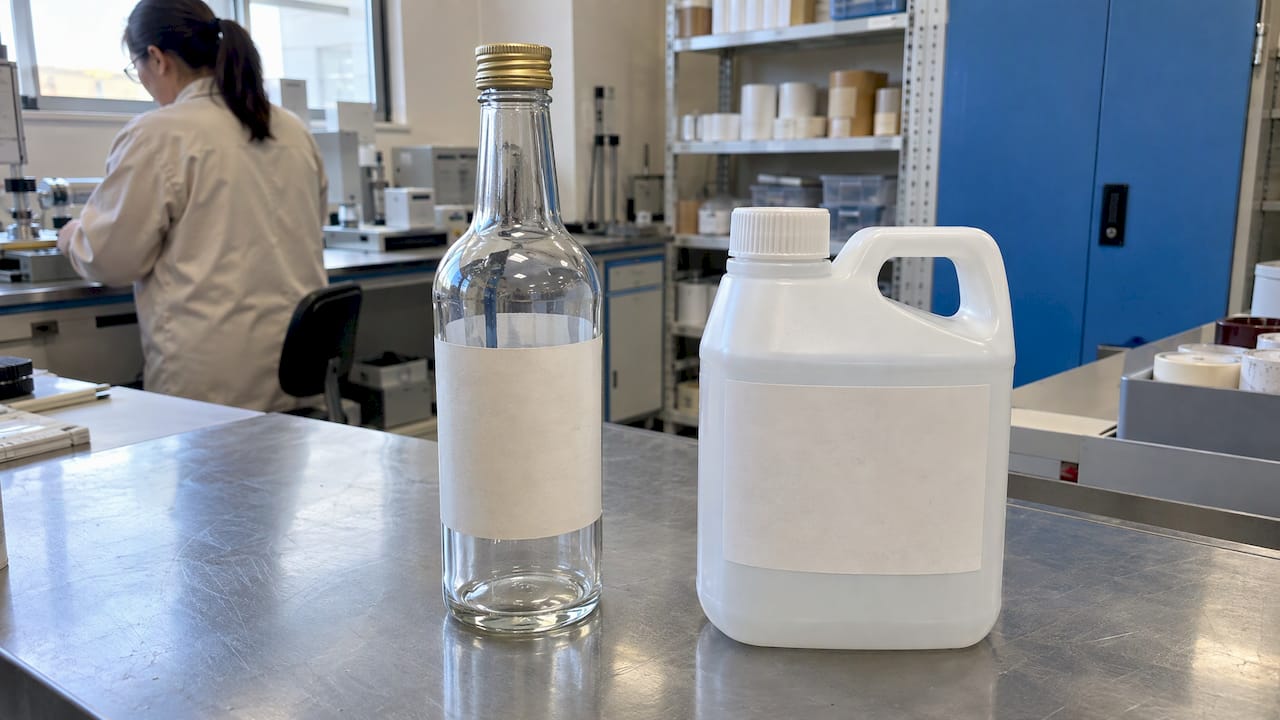
Most label adhesives fall into three families: permanent, removable and repositionable. Specialty grades cover cold application, wash-off and repeated opening. The right choice depends on four things: the surface, the conditions the pack will see, any compliance rule, and what should happen to the label at the end of its life. For a premium bottle or jar, the adhesive is part of the label specification, and it should be settled with your label manufacturer before artwork is final. At Yuan Packaging, our team guides brands through that specification from concept to finished product.
TL;DR
- Permanent adhesive suits nearly every premium product: it is built to stay put without edge lifting and cannot be removed without damaging the label or the surface.
- Removable and repositionable adhesives are for labels that must come off or be moved. They are the wrong choice for a bottle that sits in an ice bucket.
- Glass and PET are high-surface-energy materials that bond readily. HDPE is low-surface-energy and needs a more deliberate adhesive choice.
- Wine, spirits, food and pharmaceutical labels each add conditions: temperature, moisture, direct food contact, low migration, clean removal.
- Confirm the choice on your actual container, with the complete label construction, before you commit to a production run.
Table of Contents
- The main label adhesive types
- What the adhesive is made of
- What decides whether a label sticks
- How to choose an adhesive for glass labels
- How to choose an adhesive for plastic labels
- Adhesive considerations by industry
- Confirm it on your real container
- Perspective
- From adhesive choice to a finished label
- FAQ
- Sources
The main label adhesive types
A pressure-sensitive label is a stack of layers: face material, adhesive, and a liner you peel away. The adhesive is the layer that decides whether the label survives shipping, shelf life and the consumer's hands. Our guide to pressure-sensitive label materials and adhesives covers the full construction. Here we focus on the adhesive itself.
A manufacturer's technical guide to label adhesives describes these working categories:
| Type | What it does | Typical use |
|---|---|---|
| Permanent | Sticks without edge lifting; cannot be removed without damage | Bottles, jars, cartons, tubes: most branded packaging |
| Removable | Comes off cleanly while staying attached without edge lifting | Promotional labels, price tags, temporary markings |
| Repositionable | Can be lifted and placed again during application | Labels where placement may need adjusting, such as gift sets |
| Reclosure | Supports repeated opening and closing | Wipes, resealable pouches, some food and personal care packs |
| Cold-temperature | Formulated to apply and hold in cold conditions | Chilled and refrigerated products |
| Wash-off | Designed to release in a wash process | Returnable glass bottles |
Permanent adhesive
This is the default. It is cost-effective and forms a strong bond on nearly any surface. Once applied, the label and the surface are effectively one: peeling it off tears the paper or leaves residue. For luxury goods that is exactly the intent. A label that stays flat, with crisp edges, through shipping and a decade on a shelf protects the brand's perception as much as the artwork does.
Removable adhesive
Removable grades bond firmly enough to avoid edge lifting but release without damage. They suit situations where the label is temporary. They are not a gentler version of permanent: because they are designed to let go, they are the wrong tool for anything that must stay on through handling, condensation or refrigeration.
Repositionable adhesive
Repositionable grades allow the label to be lifted and moved during or just after application. They are useful in specific cases, such as a gift set where the label placement may be adjusted by hand. For a machine-applied bottle label, you will almost always want permanent.
Specialty grades
Reclosure, cold-temperature and wash-off adhesives solve single, specific problems. If your product is refrigerated at application, ask for a cold-temperature grade. If the bottle is returned and reused, a wash-off grade lets the label release in the wash. These are chosen by conditions, not by taste.

What the adhesive is made of
The same guide notes that coating technology (emulsion, hot-melt, solvent) and chemistry both matter. The main chemistries are acrylic and rubber-based, with hybrid and silicone options for challenging applications.
In practice:
- Acrylic adhesives are known for versatility and durability, and they bond to a wide range of surfaces including paper and plastic.
- Rubber-based adhesives, often hot-melt, give strong initial grab, which helps on difficult or damp surfaces.
- Hybrid and silicone options are reserved for demanding applications.
You do not need to pick a chemistry yourself. You need to describe your container, filling process and conditions clearly enough that the right one is specified for you.
What decides whether a label sticks
A technical presentation on selecting adhesives lists four variables behind adhesive performance: surface material and tension, the adhesive basis, curing time and applied pressure. It also gives the selection checklist: the application, adhesive requirements, temperature and other conditions, compliance, and the surface to be labeled.
Turn that into a brief you can hand to a label manufacturer:
- Surface: glass, PET, HDPE, coated or lacquered, textured, or paperboard.
- Application conditions: temperature at labeling, and whether the surface is clean and dry at that moment.
- Service conditions: warm storage, a chilled bucket, shower humidity, oils, transport vibration.
- Compliance: direct or indirect food contact, pharmaceutical requirements, recycling goals.
- End of life: should it stay on forever, wash off, or peel cleanly for reuse?
Send those five answers with your RFQ and the quote that comes back is built on facts rather than assumptions.
How to choose an adhesive for glass labels
Glass is a high-surface-energy substrate, which means adhesives wet out on it easily. That is why a permanent acrylic is the standard answer for most glass bottles and jars. The decisions that remain are about conditions:
- Temperature: the guide advises considering both the temperature at application and the temperature in service. A bottle labeled at room temperature and then chilled behaves differently from one labeled cold.
- Moisture and dirt: condensation, fingerprints or dust on the surface at the time of application weaken the bond.
- Returnable bottles: a wash-off solution exists for this case, so labels release in the wash instead of leaving residue.
- Clear-on-clear looks: a no-label look on glass calls for a crystal-clear permanent adhesive so the adhesive layer is invisible.
Two details from wine and spirits guidance are worth building into your schedule. A wine and spirits labeling guide states that full adhesion on glass bottles is usually reached 72 hours after labeling, and that adhesion levels vary with the type and thickness of any anti-scratch coating on the glass. So do not judge a freshly labeled bottle in the first hour, and tell your label maker if the glass has a coating.
The same guide lists the options for different conditions: an all-temperature acrylic, a permanent acrylic, a rubber-based hot melt, and a crystal-clear permanent acrylic. A rough way to read that list:
| Condition | Adhesive direction |
|---|---|
| Standard bottle, room-temperature fill | Permanent acrylic |
| Cold application or chilled service | All-temperature acrylic |
| Damp or difficult glass surface | Rubber-based hot melt |
| Clear label, transparent look | Crystal-clear permanent acrylic |
For the full wine picture, including required information and materials, see our wine label guide, and for premium spirits specifically our label printing guide for spirits.
How to choose an adhesive for plastic labels
"Plastic" is not one surface. The first step is to identify which plastic you have. According to the technical guide, PET and glass are high-surface-energy materials, while HDPE has low surface energy and can be harder to bond.
What this means for common cosmetic and personal care packs:
- PET bottles and jars behave much like glass. A permanent acrylic is usually a sound starting point.
- HDPE bottles, common for shampoos, lotions and many squeeze formats, need an adhesive chosen for low-energy surfaces. Tell your label maker the resin up front.
- Squeezable containers add a second variable: the label must flex with the wall. Our guide to labels for squeeze bottles covers facestock, sizing and application.
- Oils and surface residue: moisture, dirt and dust all reduce adhesion. Mold-release agents and formulation oils are worth flagging if your supplier's filling line is not the cleanest.
A matte, soft-touch or textured container also changes the result, because the real contact area is smaller than it looks. Mention the finish in your brief.
Adhesive considerations by industry
The technical guide names personal care, wine and spirits, food and pharmaceutical as distinct application areas. Each adds a requirement beyond "it sticks."
Luxury beauty and cosmetics
The priorities are a flat, wrinkle-free appearance, resistance to oils and humidity on a bathroom shelf, and a permanent bond that does not creep at the edges. Because beauty packaging often combines foil, embossing and soft-touch finishes, the adhesive must also suit a thicker, stiffer face material that wants to spring back from curved glass or plastic.
Wine and spirits
Here the label meets condensation, ice buckets and fridge doors. Permanent or all-temperature acrylics are the usual direction, with the 72-hour cure in mind. Heavily embossed or textured paper adds stiffness, which is where adhesive choice and paper choice are decided together; our guide to textured paper labels explains the trade-offs.
Food and gourmet
Food labels need a defined contact status. The guide states that indirect-contact adhesives are separated from the food by a functional barrier, while direct-food adhesives are intended for direct application to food. Decide which applies before you request a quote, because it changes which adhesive can be used. Seasonal gourmet packs with labels on jars, tins or cartons usually fall in the indirect category, but confirm that with your compliance team.
Pharmaceutical
The guide notes that low-migration adhesives are available for pharmaceutical applications. Pharmaceutical labels also have to meet the regulatory requirements of the market where the product is sold, so your regulatory lead should sign off the adhesive grade along with the label content.
Confirm it on your real container
The guide's advice is to test the complete label construction for the application, not the adhesive in isolation. That means face material, ink and finishes, varnish or lamination, adhesive and liner together, on the real bottle or jar filled with the real product.
A practical sequence:
- Apply at the real conditions. Use the same temperature and surface preparation you will have on your filling line.
- Wait for the cure. On glass, allow the 72 hours noted above before judging.
- Run the use cases. Chill and condense, warm, wet, rub, and flex plastic bottles. Check for edge lift, wrinkles, bubbling, or adhesive bleed at the edges.
- Measure where it matters. Industry test methods quantify the bond. The FINAT test method for 180° peel adhesion, as described in a patent filing citing it, pulls a label strip from a test plate, and a loop tack test measures immediate grab.
- Record the result. Note adhesive grade, substrate, and conditions, so reorders repeat exactly.
When we develop a project, we work from your container and conditions, not from a catalogue pick, so the sample you approve is the construction that ships.
Perspective
Brands often treat adhesive as a line item to settle after the design is done. We see it the other way. A foil-stamped, embossed label is a heavier, stiffer object than a plain one, and it will only look finished if the adhesive was chosen for that exact object on that exact surface.
Our approach, built over more than 25 years and more than 100 million units for over 5,000 brands, is to bring the adhesive question to the start of the project. We ask about the container, the fill, the chill, the shelf and the market, then specify the construction as one piece. That is what atelier-level craftsmanship means to us: the part nobody sees decides how the part everybody sees ages.
If you give us your bottle and your conditions, we will tell you which adhesive direction fits and why.
Anthony
From adhesive choice to a finished label
If you are specifying labels for wine, spirits, beauty or another premium line, our team handles the adhesive decision together with materials and finishes, from concept to finished product, and can work to requirements such as FSC certification. Our wine and spirits label range is a good place to start, and you can send your container details with an RFQ through Yuan Packaging.
For a bigger-picture view, our wine and spirits packaging guide shows how labels fit with boxes and carriers.
FAQ
What are the different types of label adhesive?
The three main families are permanent, removable and repositionable. Specialty grades add reclosure for repeated opening, cold-temperature for chilled application and wash-off for returnable glass. Chemistry is mainly acrylic or rubber-based, with hybrid and silicone options for demanding uses.
What is the best adhesive for labels?
For most premium packaging, a permanent acrylic is the standard starting point because it bonds firmly to a wide range of surfaces and stays flat at the edges. The best choice for your product depends on surface, temperature, moisture and compliance, so give those details when you request a quote.
What adhesive works best on glass bottles?
Glass bonds readily, so permanent acrylics are typical. Choose an all-temperature or hot-melt grade if the bottle will be labeled cold or chilled in use, and a crystal-clear grade for transparent labels. Allow about 72 hours for full adhesion before judging the result.
What adhesive works best on plastic bottles?
Identify the resin first. PET behaves like glass, while HDPE is low-surface-energy and needs an adhesive chosen for it. Share the resin, finish and any squeeze requirement with your label manufacturer so the construction can be specified together.
Sources
- Adhesive Technologies technical guide
- How to select the right adhesive (technical presentation)
- Wine and spirits labeling guidelines
- FINAT peel and loop tack test description