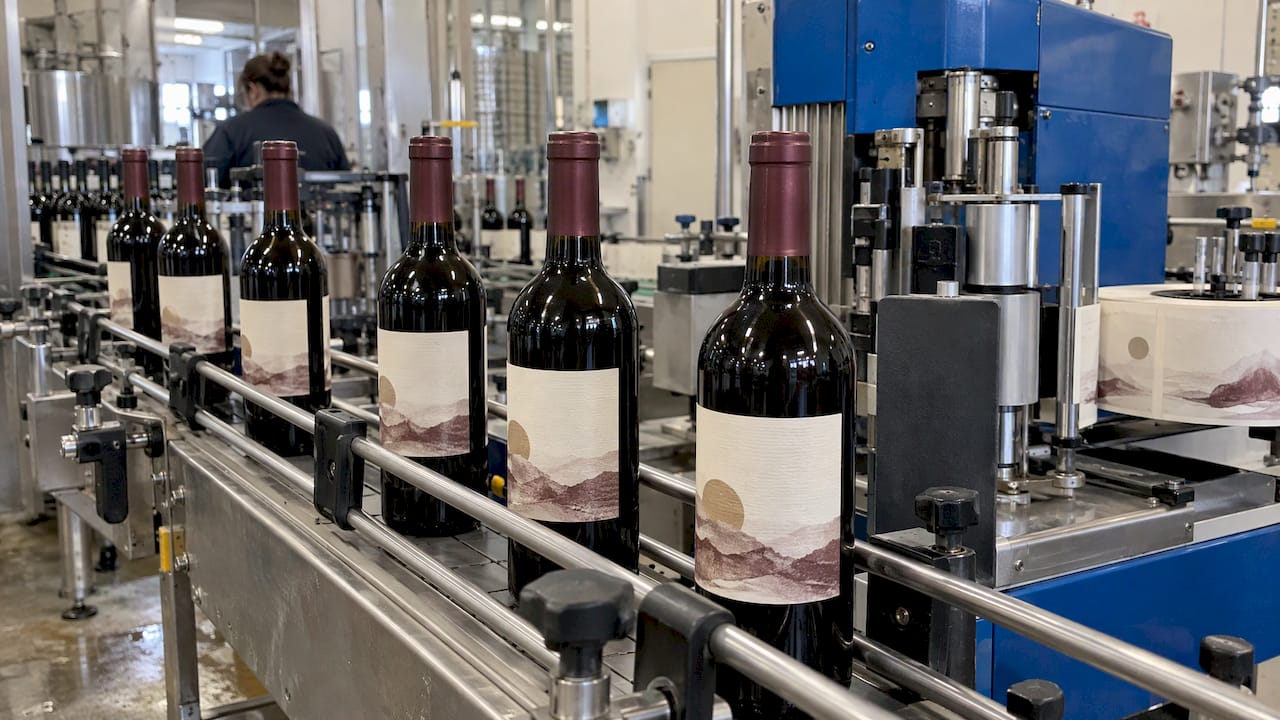
A wine label does two jobs at once: it carries the legal statements your bottle needs to be sold, and it is the first thing a buyer touches. To get both right, start with the mandatory information for your market, choose a pressure-sensitive stock and adhesive that tolerate condensation, then pick a printing method and finish that fit your volume and your brand. This guide walks through each decision in that order, so you can brief a label manufacturer with specifics.
TL;DR
- In the U.S., required label information includes brand name, class or type, alcohol content where required, name and address, net contents, a sulfite declaration and the government health warning. TTB is the authority.
- EU labels follow different rules, with sales designation, nominal volume, alcoholic strength, lot number and sulphites. Check the market before you finalize artwork.
- Material choice matters as much as design: low-absorbency paper or film, a permanent adhesive and a sealed surface keep labels flat when bottles sit in ice or humid cellars.
- Digital printing suits short runs and many SKUs. Offset and flexo suit larger volumes. Foil, embossing and spot varnish are added as embellishments.
- Proof the label for legal content, bottle fit and line trials before you approve a full run.
Table of Contents
- What a wine label has to say
- Design a label that reads at a glance
- Materials, adhesives and finishes that survive real conditions
- Choosing a printing method
- Size, fit and the bottling line
- Proof checklist before you approve
- Our perspective
- Commission your wine labels with Yuan Packaging
- FAQ
- Sources
What a wine label has to say
Start here, because every design decision sits inside these requirements. The rules differ by country, so build the artwork for the market where the bottle will be sold.
United States
For wines at 7% alcohol by volume or more that are sold in interstate commerce, TTB sets out the required label information. Brand-label requirements include the brand name, the class or type designation, an appellation of origin in certain circumstances and the percentage of foreign wine where it applies. Information required on any label includes:
- alcohol content
- the health warning statement
- name and address
- net contents
- the sulfite declaration
A few details trip up first-time bottlers:
- Alcohol content. TTB says the statement is mandatory in certain cases, for example wines over 14% alcohol by volume, and it can be a number or a range. See TTB's anatomy of a label.
- Sulfites. Any wine with 10 or more parts per million of sulfites, measured as total sulfur dioxide, needs a declaration such as "Contains sulfites" (same TTB page).
- Class and type. The designation must follow an established standard of identity. Wines that fit none are referred to as "wine specialty" and different labeling rules apply.
- Additional information. Mandatory details may be repeated in the additional information area but cannot appear only there. Adding or changing additional information can require a new Certificate of Label Approval (COLA), depending on what changes.
For the spirits side of a portfolio, our spirits label regulations guide covers what must appear on the bottle.
European Union
The EU legal text on wine labelling calls for the sales designation, nominal volume, actual alcoholic strength by volume, lot number and the presence of sulphites where relevant. It also says all compulsory particulars must sit in the same visual field on the bottle and be clearly legible. Wines from third countries must show the country of origin. Vintage, vine varieties and awards are optional.

The practical lesson: the mandatory particulars overlap, but wording, units and placement differ. If you export, plan a label per market or a layout flexible enough to take both sets of statements without crowding the brand.
Design a label that reads at a glance
A label is read from an arm's length on a shelf, then from inches once the bottle is lifted. Design for both distances.
- Rank the information. Brand and variety lead. The legal block supports quietly but must stay legible. TTB notes that the class and type designation must be separate from additional information and, in certain circumstances, directly conjoined with other mandatory information, so leave room for that grouping.
- Give mandatory text its own zone. Keeping it in one block makes proofing faster and keeps it out of the way of foil and embossing.
- Let texture carry the story. Uncoated, laid and felt papers tell a heritage story by touch. Our guide to textured paper labels explains how to choose premium stocks that still perform on press and on the bottling line.
- Treat the neck as part of the system. Front, back and neck labels should read as one composition. See our neck label design guide.
- Plan finishing before layout. Foil needs minimum line weights and embossing needs clear space around the die. Decide these early rather than retrofitting them.
Pro Tip: Place the smallest legal text on the smoothest part of the stock, away from deep embossing. Fine type that sits on a pressed area loses crispness.
Materials, adhesives and finishes that survive real conditions
A wine bottle meets condensation in an ice bucket, humidity in a cellar and handling in a case. The label has to stay flat through all of it.
Paper or film
Pressure-sensitive wine label stocks include a range of papers and films. Avery Dennison's Wine Handbook notes that clear-on-clear film constructions can deliver a "no label look" on the glass. Paper remains the classic choice for texture and warmth.
If you choose paper, an Australian pressure-sensitive label guide from Size Me Up offers useful specification points:
- Open-weave paper is more absorbent, so choose a paper with a low COBB value to reduce the risk of bubbling or lifting.
- Seal the surface with a moisture-repelling varnish.
- Use a permanent adhesive with high initial tack that works with condensation on glass.
- Paper weights in the 80 to 135 gsm range are recommended.
For labels that will see ice and water regularly, read our guide to waterproof label printing. For a deeper look at facestocks and adhesives, see our pressure-sensitive label specification guide.
Finishes
Embellishments are where a label stops being information and becomes a collector-grade object. Typical options for wine labels include cold foil, hot foil, embossing and debossing, screenprinting, spot varnish and security covert UV prints, as listed in Avery Dennison's product component guide.
How to use them well:
- Hot foil on the brand name or crest gives a bright metallic highlight.
- Embossing adds a tactile cue on the estate mark or the vintage.
- Spot UV or spot varnish creates contrast on a matte or uncoated base.
- Soft-touch lamination gives a velvety feel on film or coated stocks.
One or two finishes, placed with intent, usually look more premium than five competing for attention.
Authentication
If your bottles are high value or heavily exported, consider building protection into the label. We make custom anti-counterfeit labels for brands that want it.
Choosing a printing method
The right process depends on run length, number of SKUs and the finish you want. The IOPP overview of wine label printing describes the trade-offs:
| Method | Strength | Consider |
|---|---|---|
| Sheet-fed offset | Excellent quality potential | Foil, embossing and die-cutting need additional press passes |
| Flexography | UV-cured inks give better quality | Tooling is typically expensive |
| Rotary offset | Described as the best overall quality solution | Typically runs slower than flexo |
| Digital | Fast-growing, suited to low-volume, multi-SKU projects with no plate changes | Embellishments are done offline |
The printing technology also interacts with the material. Avery Dennison explains that certain papers work best with certain technologies, and many are engineered for a specific one, so choose stock and process together rather than one after the other. Its guide lists analog options such as UV flexo, water-based flexo and offset, and digital options such as UV inkjet and electrophotography.
A simple way to decide:
- Launching a limited cuvée or several varieties? Digital keeps each SKU economical.
- Running a flagship at scale with heavy embellishment? An analog process with inline or offline finishing is the natural fit.
- Unsure? Send us the artwork, quantity and finishes, and we will recommend the route.
Our label printing guide for premium spirits shows how these processes apply to high-end bottles, and the same logic carries to wine.
Size, fit and the bottling line
A beautiful label that wrinkles on the line is an expensive mistake. Settle size early.
- State label sizes at the start. Artus Bottling's co-packaging specifications say sizing must be given early so trials can be assessed or arranged before bottling.
- Know the machine limits. The same document lists a minimum label height of 7 mm and a maximum of 180 mm, a minimum width of 12 mm and a maximum of 300 mm combined front and back. Extreme values need assessment and trials.
- Design to the bottle. The Size Me Up guide is written for 750 mL bottles and is meant to be used at the design and concept stage.
- Trial under production conditions. Avery Dennison's handbook advises trials to confirm that the label stock and finished label work on each bottling line, especially where labels face high humidity and wet conditions.
- Print dielines at 100%. Specification sheets should be printed at 100% scale rather than "fit to page", otherwise measurements are wrong.
Also confirm roll details with your bottler: unwind direction, core size and the way neck and body label rolls feed.
Proof checklist before you approve
Use this list at the proof stage, ideally with someone who did not design the label.
- Legal content. Brand, class or type, alcohol statement, net contents, name and address, sulfite declaration and health warning are all present and spelled correctly for the target market.
- COLA match. For U.S. sales, the final artwork matches what was approved. TTB notes that changing additional information can require a new COLA.
- Legibility. The smallest text is readable on the real stock, not just on screen.
- Finish registration. Foil, emboss and varnish layers align with the print. Ask for a physical sample.
- Bottle fit. The label size fits the bottle shape and your line limits.
- Wet test. The sample has been run through your cold and humid conditions.
- Barcode and codes. Any scannable code has sufficient clear space around it.
Our perspective
Brands often treat the label as the last step before bottling. We see it as the first physical sentence your wine speaks. A buyer reads it with their hands before their eyes.
That is why we approach wine labels like an atelier. We design for precision: the registration of a foil crest, the depth of an emboss, the way a textured stock takes ink. We also design for the bottling line, because a premium label that cannot be applied cleanly is not premium at all.
Our experience of more than 25 years and 100 million units delivered to over 5,000 brands taught us one habit above all: settle material, finish and size together, early, and send the full brief in one go. Brands that do this launch seasonal releases smoothly and keep their shelf presence consistent from one vintage to the next.
If sustainability matters to your estate, ask for it at the start. We can work with sustainable materials and with requirements such as FSC certification.
Anthony
Commission your wine labels with Yuan Packaging
We manufacture custom pressure-sensitive wine labels in Huai'an, China, with foil stamping, embossing, spot UV and soft-touch lamination, for wineries, spirits houses and beauty brands worldwide. Our team guides you from concept to finished product. Share your artwork, bottle, quantity and finishes through our wine and spirits labels page to request a quote.
If your launch also needs gift boxes or carriers, see our wine and spirits packaging overview and our guide to labels, boxes and carriers. You can also browse all our pressure-sensitive labels.
FAQ
What information must be on a wine label in the U.S.?
For wines at 7% alcohol by volume or more, TTB requires the brand name, class or type designation, name and address, net contents, the health warning and a sulfite declaration. Alcohol content is mandatory in certain cases, such as wines over 14%, and an appellation of origin is required in certain circumstances. Always check the current TTB page for your wine type.
What is the best material for a wine label?
It depends on where the bottle will live. Low-absorbency paper with a moisture-repelling varnish and a permanent adhesive with high initial tack suits condensation. Clear film suits a no label look. Trial the final stock on your bottling line before you commit to a full run.
Which printing method should I choose for a small run?
Digital printing is described as well suited to low-volume, multiple-SKU projects because no plate changes are needed. Embellishments such as foil are done offline. For larger runs and heavier finishing, an analog process is often the better fit.
What size should a wine label be?
There is no single size: it depends on bottle shape and your bottling line. As one example, a co-packer's specification allows label heights from 7 mm to 180 mm and combined widths up to 300 mm, with extremes needing trials. Confirm sizes with your bottler at the design stage.
Sources
- TTB: Wine labeling, overview of requirements for wines at 7% or more
- TTB: Anatomy of a wine label
- EUR-Lex: Labelling of wine and certain other wine sector products
- Avery Dennison: Wine Handbook
- Avery Dennison: Product Component Guide
- Size Me Up: Getting Ready for Bottling
- IOPP: Wine label printing
- Artus Bottling: Co-packaging label specifications