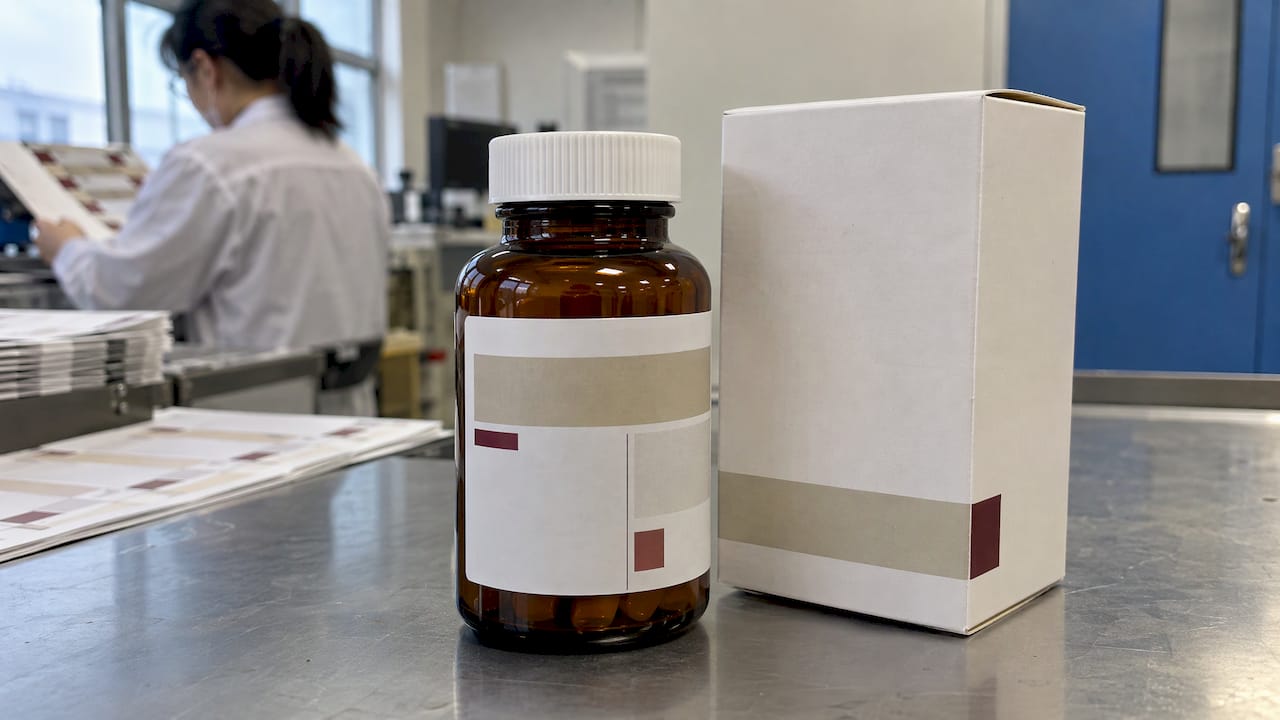
A pharmaceutical label is a regulated document that happens to be printed on a pack. It has to carry the right information in the right order, stay legible for the whole shelf life, survive the product it touches, and in many markets show proof that nobody has tampered with the pack. Getting that right is a joint job for regulatory affairs, packaging engineering and the manufacturer who prints the labels and cartons. At Yuan Packaging, we make pressure-sensitive labels and pharmaceutical cartons for brands in regulated categories, so this guide covers what your specification needs to settle before an order goes to print.
TL;DR
- Label content is set by the regulator of each market (FDA, EMA and national bodies, MHRA, Health Canada), so artwork is built per market, never copied across.
- Legibility is part of compliance: the UK MHRA, for example, sets a minimum type size and line spacing, and critical information should sit together, unbroken by graphics.
- Cartons, inner labels and security seals work as one system. Tamper evidence and serialization codes change label size, layout and adhesive choice.
- Label materials and adhesives need risk-appropriate evidence, from an indirect food additive reference for low-risk products to extractables and leachables studies for higher-risk ones.
- A tight specification (market, pack format, substrate, adhesive, finishes, codes, approvals) prevents the re-approval cycles that cost the most time.
Table of Contents
- What a pharmaceutical label has to carry
- Legibility and layout rules that affect artwork
- Types of pharmaceutical packaging and how labels differ
- How requirements change by market
- Tamper evidence, anti-counterfeit features and Braille
- Materials and adhesives: matching the label to the risk
- How to specify custom pharmaceutical labels and cartons
- Work with a manufacturer that treats labels as part of the pack
- Our view: the label is the last mile of regulatory work
- FAQ
- Sources
What a pharmaceutical label has to carry
Start with the product category, because it determines the content. In the US, an over-the-counter (OTC) product carries a standardized Drug Facts panel. According to the FDA's guidance on the Drug Facts label, that panel lists active ingredients and amounts, purpose, uses, warnings, directions and inactive ingredients. The pack also shows the product identity, net quantity, an expiration date, a lot or batch code, and the name and address of the manufacturer, packer or distributor.
Prescription medicines work differently. The FDA's labeling FAQ explains that labeling for an approved prescription medicine has three parts: Prescribing Information for healthcare professionals, carton and container labeling, and patient or caregiver labeling such as Medication Guides and Instructions for Use. As a label buyer, you work mainly on the second part, the carton and container labeling, but it has to stay consistent with the other two.
The principal display panel (the face of the pack a patient or pharmacist sees first) is where regulators focus. Health Canada's good label and package practices guide names eight elements for the principal display panel of inner and outer labels:
- Brand name
- Non-proprietary name
- Strength
- Dosage form
- Route of administration (other than for oral solids)
- Critical warnings
- Relevant population, such as pediatric
- Storage instructions
The drug identification number is required separately under Canada's Food and Drug Regulations. The guide's reasoning on route is worth remembering whatever your market: in a hospital or home setting with IV access, any liquid could be injected, so the intended route is a safety element, not a formality.
The lesson for procurement is simple. Content lists differ by country, and each list is a minimum. Your regulatory team supplies the approved text, and the label manufacturer must reproduce it exactly.
Legibility and layout rules that affect artwork
Regulators now write down how information should look, not only what it should say. The UK MHRA best-practice labelling guidance gives some of the most concrete figures:
- Label particulars should be at least 7-point type, with a lower-case "x" at least 1.4 mm high, and at least 3 mm line spacing.
- Critical information should usually appear together, in the stated order, unbroken by logos or graphics.
- Strength must match section 1 of the summary of product characteristics (SmPC, the approved prescribing document).
- Different strengths of one drug are expressed the same way (250 mg, 500 mg, 750 mg, 1000 mg, not 1 g), with no trailing zeros (2.5 mg, not 2.50 mg).
- "Micrograms" is spelled out in full, although "mcg" may be used on small labels when needed.
- Route of administration is a positive statement, such as "For oral use" or "For intravenous injection only".
These rules come from the UK, but they show what regulators across markets are guarding against: misread strengths and confused routes. Even where your target market has no equivalent numbers, designing to this standard is a sound habit.
Two practical consequences follow for printing. First, small type on a small label puts real demands on print resolution, substrate smoothness and registration, so the specification should name minimum type sizes up front. Second, decorative finishes need care. A foil or emboss that interrupts a block of critical information works against the rule that graphics should not break it. Our pharmaceutical carton requirements guide covers how Braille, serialization space and leaflets share the same panel area.
Types of pharmaceutical packaging and how labels differ
The WHO's guidelines on packaging for pharmaceutical products separate primary packaging (bottles, vials, closures and blisters, in direct contact with the product) from secondary packaging (aluminium caps and cardboard boxes), plus special unit-dose and device formats. Materials include cardboard, paper, glass, plastic, metal and rubber. Each layer asks something different of a label.
| Pack format | Typical label or print | What it demands |
|---|---|---|
| Bottle, vial, jar (primary) | Wrap or panel pressure-sensitive label | Adhesion to curved glass or plastic, legibility at small sizes, resistance to the product |
| Blister or strip (primary) | Printed lidding foil, abbreviated inner text | Outer carton carries the full required text |
| Ampoule, sachet, syringe (primary) | Small label or direct print | Abbreviated inner labeling in some regimes |
| Folding carton (secondary) | Printed carton, plus seal or label | Full information, codes, Braille where required, tamper-evident closure |
| Shipper or transport pack | Logistics labels | Handling and traceability marks |
Abbreviation on tiny containers is only allowed because the outer pack picks up the load. Pakistan's regulator, for instance, permits abbreviated inner labels on blister packs, strips and ampoules of 2 ml or less, provided the outer label meets all requirements. That is why the carton is the workhorse of pharmaceutical labeling. If you source the label and the carton from one manufacturer, text, colors and codes stay aligned across both. Our pharmaceutical cartons range and unit medicine cartons are built for this secondary-pack role.
How requirements change by market
There is no single global pharma label. Three differences matter most when you plan artwork for several markets.
Content and language. New Zealand's Medsafe, for example, requires mandatory label content in English and demands that labels be legible and durable. Other regulators add local-language text and local registration numbers. Plan for a separate artwork version per market.
Serialization and tamper evidence. In the EU and EEA, prescription packs have needed a tamper-evident device and a 2D Data Matrix unique identifier since 9 February 2019, according to a serialization comparison from IntuitionLabs. The same source reports that the US Drug Supply Chain Security Act enhanced requirements took effect on 27 November 2023, with an exemption for small dispensers running through 27 November 2027. A code needs space. The analysis notes that serialization often means multi-line print areas or larger packaging, and that any pack format change triggers regulatory re-approval.
Environmental labeling. For EU sales, Strategic Packaging Insights' pharma packaging rules tracker reports that the Packaging and Packaging Waste Regulation excludes immediate medicinal packaging from the 2030 recyclability duty but keeps secondary cartons, leaflets and transport packaging in scope. It also reports that the harmonized material-composition label is due by 12 August 2028 at the earliest. Because pharma graphics carry regulated information, the tracker advises planning such sorting-label changes with regulatory affairs, not as a purely packaging decision. Check the tracker and official EU sources for the current position, as these dates and scopes can move.
In short, a carton designed in one market may need a new layout, new codes and a new approval in the next. A manufacturer that works from your dielines and approved text, and can rebuild layouts without disturbing the approved content, saves you weeks.

Tamper evidence, anti-counterfeit features and Braille
Tamper evidence is now a standard expectation, not an extra. The WHO guidance records that the US FDA defined tamper-evident packaging for OTC human drugs in 1982 as having an indicator or barrier to entry which, if breached or missing, gives visible evidence to consumers that tampering has occurred. The CPHI compliance guide adds that European standard NEN-EN 16679 sets requirements for tamper-proof features on medicinal product packaging, and that a common implementation is a self-adhesive label acting as a security seal across a cardboard box.
In practice, you choose among three routes:
- A label seal across the carton closure. It is fast to apply and easy to see. Its performance depends on the adhesive meeting the varnish on the carton.
- A built-in carton closure feature. Glued or locked flaps that tear visibly on opening.
- Combined features. A seal plus a printed security element, such as the ones on our anti-counterfeit labels.
We cover the buyer's decision points in tamper-evident packaging: what buyers must know, and our tamper-evident cartons and seals page shows the carton-side options. Where your market expects tactile product names for visually impaired patients, Braille-embossed pharmaceutical cartons put the embossing on the carton without crowding the required text.
Materials and adhesives: matching the label to the risk
A label that fails on the shelf is a compliance problem, not just a cosmetic one. The CPHI guide explains how evidence scales with product risk:
- US, low risk (for example oral tablets or capsules not for chronic use): a reference to indirect food additive regulations such as 21 CFR 175.105 for adhesives is generally what the guide describes as sufficient.
- US, medium and high risk (sterile injection powders, ophthalmic solutions, transdermal ointments, nasal sprays): extractables and leachables studies under USP <1663>.
- EU: food-contact approval under Regulation 1935/2004/EC and plastics Regulation 10/2011 (with an overall migration limit of 60 mg/kg) can serve as a reference, but it does not replace drug-packaging conformity, which calls for extractables and migration studies at medium and high risk.
The same guide frames safety as a property of the fully assembled package and product together. So your regulatory and quality teams decide which evidence the pack needs, and the manufacturer's job is to supply labels and cartons whose facestock, adhesive, ink and varnish combination is documented and stays fixed once approved. A change of adhesive or varnish is a change to the pack.
For a deeper look at facestocks and adhesive families, see our pressure-sensitive label specification guide. If your cartons use varnishes or coatings, remember that adhesion of a seal label depends on that surface, so name the varnish in the brief.
Claims on the label
What the label says about regulatory status is also regulated. Terms such as "registered" and "approved" are not interchangeable. Check every status statement against your regulatory file before it reaches artwork.
How to specify custom pharmaceutical labels and cartons
A clear brief is the cheapest compliance tool you have. Work through these steps with your regulatory team before requesting a quote.
- Fix the market and the product category. OTC, prescription, nutraceutical or device each carry different content. Name every target market, because each may need its own artwork.
- Supply approved text and layout rules. Give the manufacturer the final regulatory text, plus any minimum type size and positioning rules that apply. Ask that no text is reflowed or edited in prepress.
- Define the pack format. State whether the label goes on a bottle, vial or carton, the container material and diameter, and the label's maximum dimensions. For cartons, include the dieline. Our guide to folding carton design lists what a dieline must contain.
- Name materials and adhesives. Specify facestock, adhesive type, ink and varnish, and the risk level of the product, so the right documentation path is followed.
- Reserve space for codes and seals. Leave room for the 2D code, batch and expiry area, tamper-evident seal and, if needed, Braille.
- Choose finishes with the text in mind. Foil, embossing and soft-touch lamination can lift a brand, but keep them away from critical information.
- Agree a change-control routine. Any change to artwork, substrate or pack format may trigger re-approval, so agree who signs off proofs and how revisions are tracked.
- Plan sustainability inside the approval. If you need FSC-certified board, say so at the start. Material choices are far easier to settle before artwork approval than after.
A manufacturer that handles labels and cartons together helps at steps 3 to 6, because the seal label, the carton varnish and the code area are designed against each other. Our custom folding cartons page lists the carton styles available for these projects.
Work with a manufacturer that treats labels as part of the pack
Yuan Packaging is a custom packaging manufacturer based in Huai'an, China, with more than 25 years of experience and 100 million units delivered to more than 5,000 brands. We produce pressure-sensitive labels, folding cartons and specialized pharmaceutical cartons, with options for sustainable materials such as FSC certification and finishes including foil stamping, embossing, spot UV and soft-touch lamination. Projects usually start with an RFQ, and our team offers guidance from concept to finished product.
If you are planning a medicine carton, a label set or a tamper-evident seal, send your dielines and approved text through the Yuan Packaging site and ask for a quote.
For cartons specifically, start with our pharmaceutical cartons and medicine packaging range.
Our view: the label is the last mile of regulatory work
Every pharmaceutical project we see starts the same way. The formulation is done, the dossier is approved, and the pack is treated as the final small task. Then the label turns out to be where those months of regulatory work become visible to a patient.
We think about it as a small ceremony of trust. A patient opens a carton, reads a strength, checks a seal, and decides in seconds whether the product is what it should be. Precision in type size, registration, varnish and adhesive is what makes that moment quiet and uneventful, which is exactly what you want.
That is why we favor one manufacturing partner for the label and the carton. When the seal label, the carton varnish and the code area are specified together, there is less to reconcile at approval and less to re-approve when something changes. Atelier-level craftsmanship, for us, means holding the approved text and the approved materials steady while the finish does its work around them.
Our advice is to bring us in at dieline stage, with your regulatory text and market list in hand. Settle materials, codes and seals early, and the print run becomes a repeatable routine rather than a negotiation.
Anthony
FAQ
What information must be on a pharmaceutical label?
It depends on the product and the market. For US OTC medicines, the FDA requires a Drug Facts panel plus identity, net quantity, expiration date, lot code and the responsible company's name and address. Prescription cartons and containers follow the approved labeling, and other regulators such as Health Canada list their own principal display panel elements.
Do small containers need the full label text?
Not always. Some regulators allow abbreviated inner labels on blisters, strips and small ampoules, provided the outer carton carries all the required information. Check your target regulator's rule before designing the inner label.
What is the difference between a pharmaceutical label and a carton?
A label is usually a pressure-sensitive item applied to a primary container such as a bottle or vial, or used as a seal. A carton is the printed secondary pack that holds the product and typically carries the full text, codes and Braille. Many projects need both, and they should be designed together.
Does a tamper-evident feature change the label design?
Yes. A seal label or closure needs reserved space and an adhesive that works with the carton varnish. In the EU, prescription packs also need a 2D code and a tamper-evident device, which can add to the print area.
Who approves a label change?
Your regulatory affairs team and, where the rules require it, the relevant authority. Any change to pack format can trigger re-approval, so route artwork, substrate and adhesive changes through your regulatory process before ordering.
Sources
- The Over-the-Counter Drug Facts Label | FDA
- Frequently Asked Questions about Labeling for Prescription Medicines | FDA
- Good Label and Package Practices Guide for Prescription Drugs | Health Canada
- MHRA best practice guidance on labelling
- WHO Annex 9: Guidelines on packaging for pharmaceutical products
- Pakistan DRA Guidelines on Labeling and Packing
- Medsafe: Labelling of medicines and related products
- DSCSA vs. EU FMD: serialization and traceability
- Pharma and Healthcare Packaging Rules 2026 | SPI
- Package Labeling compliance guide | CPHI