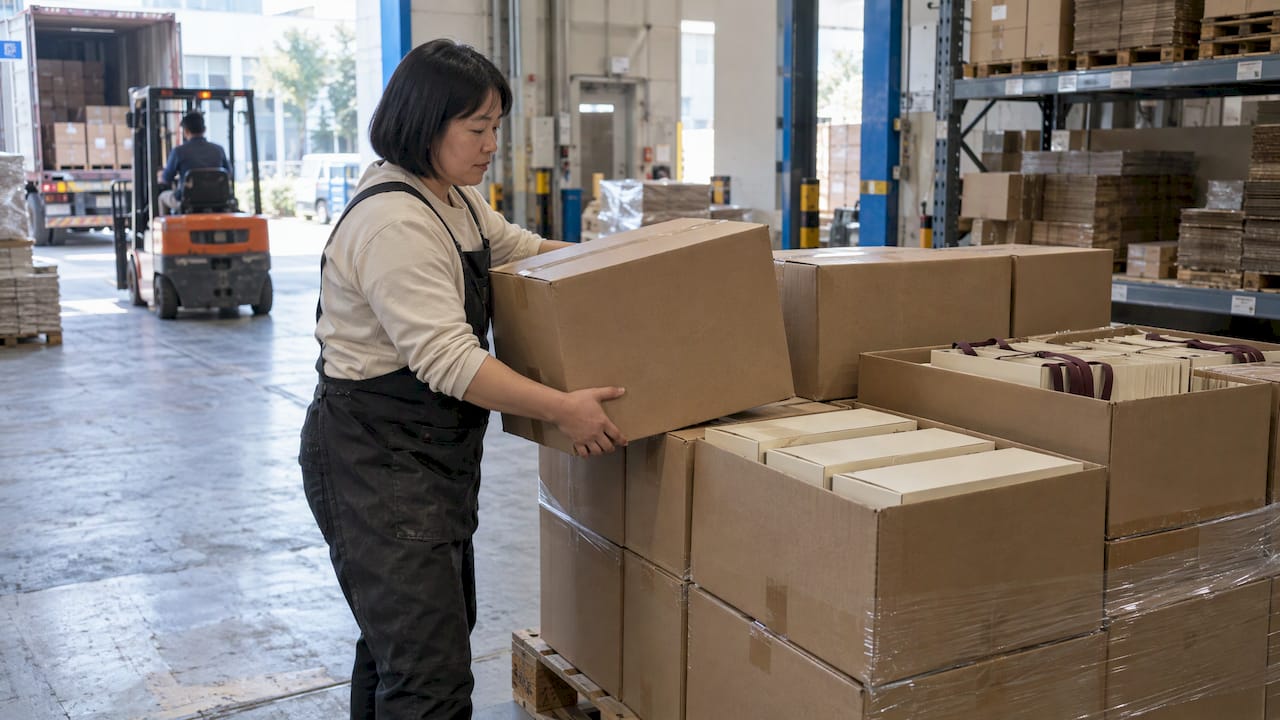
A packaging supply chain is the path packaging takes from raw material to the customer's hands and then to its end of life. Managing it well means treating labels, boxes, cartons and bags as specified, inspected and measured components, not as a line item bought on unit price. For a luxury beauty, wine, spirits, pharmaceutical or gourmet brand, the strongest setup is a single manufacturer that controls printing, finishing and conversion under one specification. At Yuan Packaging, we make pressure-sensitive labels, rigid gift boxes, carrier bags and folding cartons from our base in Huai'an, China, and this guide shows what to manage at each stage and why.
TL;DR
- The packaging supply chain runs from material sourcing through printing and conversion, logistics, use on your line, retail and end-of-life. A weak link at any stage shows up on the shelf.
- Packaging cost is not packaging price. Tooling, freight, damage, inventory, minimum order quantities and compliance all count.
- Write a spec sheet for every SKU, keep a reference sample, inspect incoming goods and review suppliers on a few measures, not dozens.
- Rules such as extended producer responsibility (EPR) now shape material choices, so ask for material data at the quoting stage.
- Fewer handoffs mean fewer failure points: one manufacturer for labels, rigid boxes and cartons keeps the specification consistent.
Table of Contents
- What the packaging supply chain actually includes
- Why packaging does more than look good
- Where packaging supply chains break
- Cost: look past the unit price
- A practical routine for managing packaging suppliers
- Compliance and sustainability are now supply chain tasks
- Why one manufacturer simplifies the chain
- Match the packaging to the product
- Work with us on your next packaging program
- Our perspective
- FAQ
- Sources
What the packaging supply chain actually includes
The Open3P standard describes the packaging supply chain as a sequence: raw-material sourcing (paper, cardboard, plastic, glass, metal), manufacturing, design and printing, distribution and logistics, use by manufacturers, retail distribution, and finally recycling, reuse, composting or disposal. It also stresses that collaboration across those stages is essential.
The World Packaging Organization frames supply chain management, citing the Council of Supply Chain Management Professionals, as the planning and management of sourcing, procurement, conversion and logistics, including coordination with suppliers, intermediaries and customers. Packaging management is that same discipline applied to the things that contain, protect and sell your product.
For a brand buyer, it helps to think of five handoffs:
- Specification: your brand team, designers and regulatory staff decide size, material, print and finish.
- Conversion and printing: the manufacturer turns board, paper, film and adhesive into finished labels, boxes, cartons or bags.
- Transport: the goods move from factory to your filling line, warehouse or fulfillment center.
- Application and assembly: labels go on bottles, products go into boxes, bags and cartons are packed out.
- Distribution and end of life: packed products go to retail or consumers, and the packaging is discarded, recycled or reused.
Problems that appear at step four or five, such as a label wrinkling on a bottle or a box crushed in a carton, usually began as a gap at step one.
Why packaging does more than look good
The World Packaging Organization lists the functions of packaging: it contains, protects, preserves, informs, sells and enables handling, storage and transport. Extended functions include convenience and security, such as preventing tampering, pilferage and theft. The same paper sorts packaging into primary, secondary and tertiary layers.
For your categories, the layers look like this:
| Layer | What it is | Typical examples |
|---|---|---|
| Primary | Touches or directly holds the product | Wine or spirits label on the bottle, cosmetic jar label, pharmaceutical carton |
| Secondary | Groups or presents the primary pack | Rigid gift box, folding carton, drawer box, carrier bag |
| Tertiary | Moves and protects units in bulk | Shipping cartons, pallets, corrugated cases |
The German transport information service TIS-GDV adds a useful split: the protective function covers inward protection of goods from loss, damage, theft and climate, and outward protection of people and the environment, especially for hazardous materials. Sales, promotion and service functions sit beside it.
Luxury brands feel both sides at once. A rigid box has to look like a small ceremony on a shelf and still survive a pallet. A wine label has to carry legal information and still feel collector-grade under a thumb. The Ontario government's manufacturing guide makes the same point for food and beverage: a good package meets legal requirements, resists mechanical damage, stands up to shipping and display, and sells itself. It also notes that packaging weight can raise shipping costs.
Where packaging supply chains break
Disruption is the norm, not the exception. RRD's Q4 2024 Packaging & Labels Insight Report found that 93% of packaging respondents had operations affected by supply chain disruptions in the prior year, and 61% reported missed deadlines. Of the same respondents, 72% cited material price increases and 67% cited shortages as top factors affecting label operations, and 86% said inflation and rising raw-material costs changed how they source packaging.
Three failure patterns matter most for premium brands.
Shortages and late deliveries
A seasonal launch is only as reliable as the slowest component. Gift sets for the holidays depend on boxes, inserts, labels and bags arriving in sequence. If one component slips, the whole set waits. Packaging Impressions' operational guide, drawing on industry association experts in 2022, noted that truck driver shortages kept transportation a problem and that 40-foot container costs, while down from their peak, remained above pre-crisis levels.
Damage in transit
The University of Turku's seaworthy packing guide states that most cargo damage could be prevented with the right planning and packing, and that damage always creates indirect costs and is not always compensable. It also argues that a broken package is the least ecological outcome, because the product must be made and shipped again.
Format affects this directly. Large-format bottle sizes, from 0.75 L up to 30 L, change carton dimensions, weight per case and pallet patterns, so a label, box or carrier designed around a standard bottle may not suit them.

Quality drift
A first production run matches the approved sample. The fifth one, ordered from a different plant or on a different material lot, may not. Foil registration, embossing depth, soft-touch lamination feel and Pantone color are all easy to drift when there is no written tolerance. Our guide to packaging quality control and AQL sampling explains how inspection levels and tests turn "looks right" into a measurable standard.
Cost: look past the unit price
Efficio's procurement guide draws a distinction every buyer should keep: packaging cost is not packaging price. Total cost also includes ordering behavior, tooling, line performance, warehousing, product damage, administration, EPR exposure and the cost of managing exceptions. A pack that is cheaper per unit can raise freight costs, slow your filling line, inflate inventory or add compliance risk.
The same guide recommends mapping packaging spend by supplier, SKU, format, substrate, specification, region and business unit, then flagging specifications that are business-critical, bespoke or single-sourced. Premium packaging is often all three, which is why it deserves its own plan.
Here is a simple worked example of the logic. Suppose two quotes for a folding carton differ slightly in unit price, but the cheaper one ships flat in a larger box and needs a higher minimum order quantity. Freight cube and warehouse space rise, and you hold more stock of a seasonal item that may not sell through. The right comparison is the landed cost per usable unit, after damage and rejects, not the figure at the top of the quote.
Cost questions to put in every request for quote (RFQ):
- What is the minimum order quantity, and what is the batch size for a repeat run?
- Which costs are one-time (tooling, dies, plates) and which recur?
- How will the goods be packed for transport, and how many units fit per carton and pallet?
- What happens if a lot fails inspection?
A practical routine for managing packaging suppliers
Supplier management does not need a large team. A lightweight system covers most of the risk.
1. Write a spec sheet for every SKU
Include dimensions, materials, Pantone references, print placement, finishes and tolerances. For labels, add the face stock, adhesive, liner and the surface it must stick to. Our guide to pressure-sensitive label specifications covers materials and adhesives. For wine, the wine label guide covers required information, materials and printing.
2. Lock a reference sample
Keep an approved physical sample for each packaging SKU. Finish quality, such as the depth of an emboss or the gloss contrast of spot UV, is judged by hand and eye, and a photo does not settle a dispute.
3. Inspect what arrives
Sampling a share of every delivery catches drift early. The principle is simple: agree an inspection level in advance, use a recognized sampling standard such as ISO 2859, and record results by lot.
4. Review performance on a few measures
Odette International says the KPIs in its packaging recommendation should form the basis of a performance measurement system, and that customers may add their own criteria. Academic work on packaging supply chains points the same way. A peer-reviewed study of Indonesia's plastic packaging industry narrowed 45 candidate indicators to 29 across five dimensions and weighted reliability highest at 0.262, ahead of asset management, responsiveness, cost and flexibility.
For a brand team, a short scorecard is enough:
| Measure | What it tells you |
|---|---|
| On-time, in-full delivery | Whether launches and replenishment hold |
| Defect rate by SKU and defect type | Whether quality is stable |
| Label read or scan failures | Whether barcodes and codes work at your line |
| Damage or claim rate | Whether packing and transport design work |
| Cost change against the agreed quote | Whether pricing stays predictable |
Review it on a regular schedule with the supplier and tie future orders to the result.
5. Qualify before you commit
Before a first order, check a manufacturer's process, certifications and capacity. We set out the steps in how to qualify a packaging supplier in China.
Compliance and sustainability are now supply chain tasks
Packaging rules increasingly follow the product through the chain. According to the PMMI Packaging Compass study, as of January 2023 extended producer responsibility laws for packaging had passed in four US states: California, Colorado, Maine and Oregon. EPR means the company that puts packaging on the market carries responsibility, usually financial, for its end of life. The study also reports that EPR runs in five Canadian provinces and across Europe, with different designs in each.
The research on readiness is sobering. In McKinsey's 2022 survey analysis, about 75% of organizations had clear sustainable-packaging commitments, yet fewer than 30% were well prepared for regional requirements and fewer than 30% had clear metrics on recyclability or recycled content. McKinsey's five levers are: use less, refresh designs, improve transport, switch materials and optimize circularity. It says most solutions can be implemented in six to 12 months with leadership commitment and clear metrics.
What this means in practice for a buyer:
- Ask for material data at quoting time: fiber source, coatings, adhesives, recycled content.
- Decide which markets you ship to, since rules differ by region. Our US EPR compliance plan and our summary of the EU PPWR for printers cover the two regimes most export brands meet first.
- Verify recycled-content claims before printing them. See how to verify post-consumer recycled content.
- If your retailers or markets require FSC-certified material, say so in the specification. We can meet requirements such as FSC certification.
This is also where finishes and sustainability meet. Foil, soft-touch lamination and spot UV change how a pack is recycled, so decide the finish and the end-of-life claim together, not one after the other.
Why one manufacturer simplifies the chain
Every additional supplier adds a handoff, a specification to align and a quality record to keep. A premium launch typically needs a label, a rigid or folding box, and a carrier bag that look as if they belong together. Sourced from three plants, they can differ in white point, ink shade and finish feel. Sourced from one manufacturer working to one specification, they are far easier to keep consistent.
That is the idea behind how we work. We make pressure-sensitive labels, rigid gift boxes, carrier bags and folding cartons, and we offer finishes including foil stamping, embossing, spot UV and soft-touch lamination, plus sustainable material options. With more than 25 years of experience, 100 million units delivered and more than 5,000 brands served, we guide projects from concept to finished product. For wine and spirits specifically, our wine and spirits packaging guide shows how labels, boxes and carriers work together.
Match the packaging to the product
Each of your categories stresses the chain differently.
- Luxury beauty: the box is the first physical contact. Finish consistency across reorders matters most, so reference samples and tolerances carry real weight.
- Wine and spirits: labels must survive condensation, ice buckets and handling while carrying legally required information. Bottle shape and size drive carton and carrier design.
- Pharmaceutical: compliance and traceability lead. Specifications, lot records and label accuracy come before decoration.
- Gourmet food: seasonality drives everything. Work backward from the shelf date to set order and approval deadlines, with time for transport built in.
The Billerud-style advice that procurement should join product development early holds across all four: bring your supplier in during design, not after artwork is final. Changes to a die line or label size after approval cost more than changes made at concept stage.
Work with us on your next packaging program
If you are planning a label, box, carton or bag program, we can quote and produce it. Wine brands can start with our wine labels, and you can see the full range of labels, rigid boxes, carrier bags and folding cartons on our main site.
Send your specification, target quantities and launch window when you request a quote, and we will guide the project from concept through finished product.
Our perspective
We see the packaging supply chain as a quality problem first and a logistics problem second. Most delays and disputes we hear about from brand teams trace back to a specification that was never written down precisely enough, or a finish that was approved once and never held to a tolerance.
Our view is that luxury packaging deserves atelier-like craftsmanship at industrial scale. That means precision in registration and finishing, expert guidance from concept to finished product, and sustainable materials chosen deliberately, including FSC-certified options where a brand needs them.
When labels, rigid boxes, cartons and bags come from one manufacturer, you get one specification, one set of finishes and one point of accountability. That is the simplest way we know to protect shelf presence and keep seasonal launches on schedule.
Anthony
FAQ
What is packaging supply chain management?
It is the planning and coordination of everything involved in getting packaging made, delivered, used and disposed of: sourcing, conversion, logistics and supplier relationships. The aim is to have the right packaging, to specification, at the right place and time, at a total cost you understand.
What are the main functions of packaging?
According to the World Packaging Organization, packaging contains, protects, preserves, informs, sells and enables handling, storage and transport. For premium brands the selling and informing functions, meaning shelf presence and legal label content, matter as much as protection.
Which measures should I track for packaging suppliers?
Keep the list short. On-time and in-full delivery, defect rate by SKU, label scan failures, damage claims and cost change against the quote cover most of the risk. Review them with your supplier on a regular schedule.
How early should I involve my packaging manufacturer?
During product and artwork development. Decisions on size, material, finish and transport packing are cheapest to change before artwork and dies are approved.
Sources
- Key Concepts, Open3P Standard v3.0
- Packaging and Supply, World Packaging Organization
- Functions of packaging, TIS-GDV
- Food packaging and labelling, Government of Ontario
- The Packaging & Labels Insight Report, Q4 2024, RRD
- An Operational Guide To The Supply Chain, Packaging Impressions
- Seaworthy packing guide, University of Turku
- The CPG procurement leader's 90-day agenda, Efficio
- Packaging Resources, Odette
- Framework pengukuran kinerja rantai pasok industri kemasan, Operations Excellence
- Packaging Compass, PMMI
- Sustainable packaging: Five key levers for impact, McKinsey