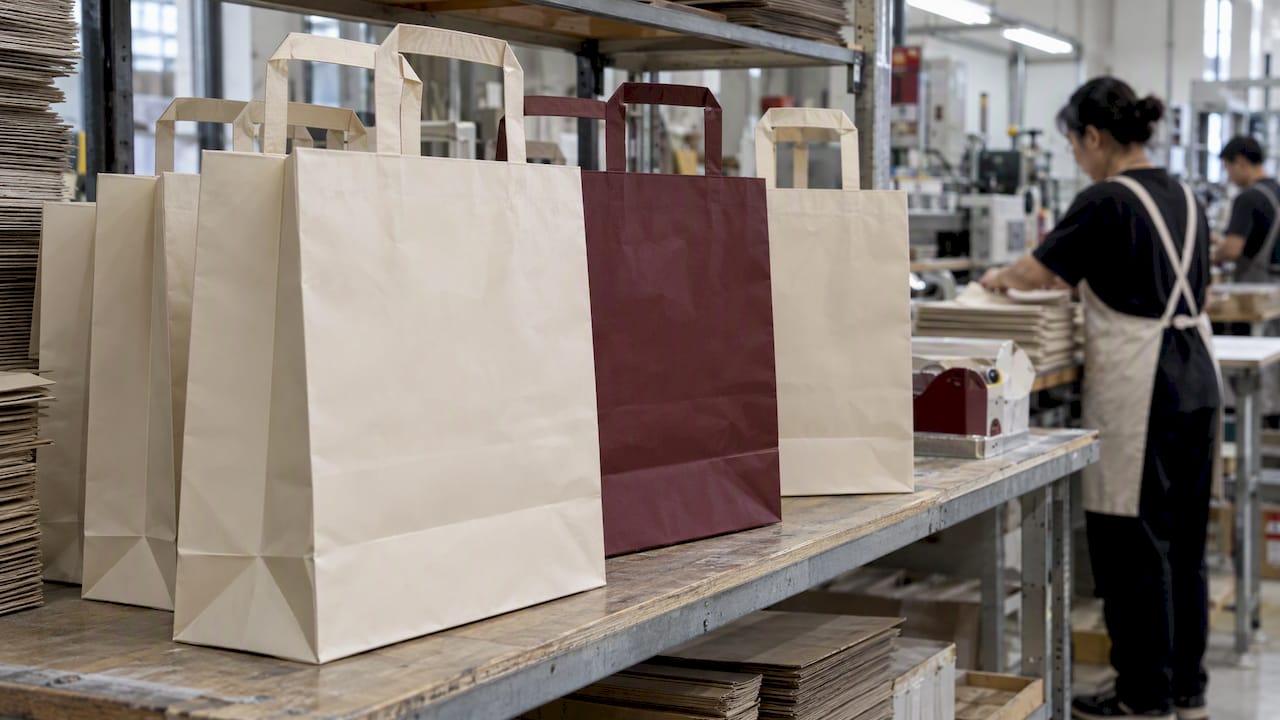
For most durable retail and luxury carrier bags, specify single-sided film lamination on the outer face of a strong kraft or coated paper. It balances water and scuff resistance, repeat reuse and a premium finish. Ask for written paper strength values and handle construction details, agree the load target, and check it on the pre-production sample. Where a retailer or market requires it, have an independent lab test the finished bag to EN 13590 before you approve production. We make custom laminated paper carrier bags at Yuan Packaging, with matte or soft-touch film lamination, and these are the specs to put in your RFQ.
TL;DR:
- Use at least 6 kg and up to five reuses as the design baseline, and ask for performance evidence from the finished bag rather than paper strength alone.
- For heavy products, specify a reinforced or taped bottom, stiffening board, and fully anchored handles; concentrated weight often makes the base the first failure point.
- For laminates applied to one side, keep plastic at or below 5% of bag weight, with 3% preferred; choose peelable films and light adhesives.
- Request a physical preproduction sample with the exact lamination and finish combination, then load test it before approving the full production run.
- Require suppliers to list paper grade, film material, handle reinforcement, order minimum, and test method; confirm strength claims on the pre-production sample.
Table of Contents
- What are the main lamination and construction types?
- Which performance specs should you request?
- How do sizes, gussets and handles work together?
- What about finishes, printing and production limits?
- How does lamination affect recyclability?
- What belongs in your RFQ spec checklist?
- Which bag shapes and bottom constructions are typical?
- Our view on specifying laminated bags for premium brands
- Get custom laminated paper bags from us
- FAQ
What are the main lamination and construction types?
Lamination bonds a thin film or foil to paper. The method and the number of laminated sides decide how the bag performs, feels and recycles.
- Single-sided film lamination: a film applied to the outer face only. It gives a smooth, water-resistant surface and keeps the inside as plain paper.
- Extrusion lamination: molten polymer such as PE or PP is applied directly to the paper. It tends to give a strong bond and good moisture resistance, which suits bags that get reused.
- Adhesive lamination: a pre-made film is glued to the paper. It offers wide freedom in surface feel and print effects, and the adhesive choice matters for recycling.
- Metallised or foil facings: mostly decorative. Choose them for a mirror or metallic look, not as a functional barrier.
- Two-sided lamination: more protection, but harder to recycle. Industry guidance warns that two-sided laminates and strong adhesives can prevent fibre release in pulping.
Peelable laminates are the smart compromise. Industry experts advise using the minimum non-paper lamination that meets your barrier needs, ideally on one side only.
Which performance specs should you request?
Start with EN 13590. This European standard evaluates the carrying capacity of flexible carrier bags through repeated heavy lifting. It tests the finished bag under load, not just the raw paper, so it says more about handle-attachment reliability than paper data alone. Agree the load target with your supplier and check it on the pre-production sample; where a retailer or market requires EN 13590, have an independent lab test the finished bag before you approve production.
Then ask for the paper's strength parameters and tie each to a real failure:
- Tensile strength: resists stretching and tearing along the paper when the bag is loaded.
- TEA (tensile energy absorption): shows how much shock the paper absorbs, which matters when someone drops or swings a loaded bag.
- Bursting strength: predicts whether the bottom or sides split under pressure.
- Tear strength: indicates whether a small nick near a handle spreads.
Handle choice, glue selection and storage conditions also shape final durability, so ask for a handle-attachment test and how reinforcements are fixed.
Industry quality guidelines suggest designing paper carrier bags to carry at least 6 kg and be reusable up to five times. Use that as your baseline load requirement in any quote request.
How do sizes, gussets and handles work together?
Bag size starts with the product. Measure the widest, deepest and tallest item, then add room for tissue or inserts. Gusset depth is the lever people overlook. A deeper gusset raises usable volume, but it also moves weight toward the base, so the bottom construction has to keep up.
Handles follow the load. A handle-type guide maps this in detail; the practical bands are:
- Light loads: twisted paper or flat paper handles are usually enough for light cosmetics and accessories.
- Moderate loads: rope or ribbon handles with an internal patch reinforcement hold up better.
- Heavy loads: add a reinforced or taped bottom, a stiffening board and fully anchored handles.
For a bottle or gift set, our bottle and gift set carrier bags show how a reinforced base and handle anchors work in practice. Heavier SKUs should always get a reinforced bottom, because the base fails first when weight is concentrated.
What about finishes, printing and production limits?
Gloss lamination deepens color and gives a shiny, protective face, though it can throw glare under bright retail lighting. Matte lamination softens reflections and reads as understated and premium, but it can mute saturated color slightly. Our matte vs gloss comparison covers glare, color and recyclability side by side.
Premium finishes that pair well with laminated paper:
- Soft-touch lamination for a velvety hand feel
- Hot foil stamping for logos and accents
- Embossing and debossing for tactile depth
- Spot UV to highlight artwork against a matte field
Foil and embossing demand a stable, well-bonded surface, so confirm which lamination supports each finish reliably. Production limits matter just as much: ask about minimum print runs, dieline templates, preflight checks and color matching against Pantone references before you approve artwork.
Pro Tip: Request a physical pre-production sample with your exact lamination and finish combination, then load-test it yourself before approving the full run.
How does lamination affect recyclability?
Paper is generally recyclable, but adding non-paper layers must not hamper recycling. Packaging recyclability guidance says that when non-paper parts are needed, they should be as easy to separate as possible.

Design guidelines suggest keeping plastic to no more than 5% of pack weight on single-sided laminates, with 3% preferred. Treat that as a target to write into your spec.
Practical design moves:
- Laminate one side only when the function allows it.
- Prefer peelable laminates so the film separates from the fibre.
- Choose lightly bonded or water-soluble adhesives. The lamination guidance from the Confederation of Paper Industries prefers them for fibre recovery.
- Add a tear-off tab so users can peel the film before disposal.
- Print clear disposal instructions on the bag.
Two-sided laminates can be difficult for standard paper mills, and recycling compatibility depends on the lamination type, adhesive and local mill capability. When lamination levels are high, testing is recommended.
What belongs in your RFQ spec checklist?
Paste these fields into your request so every supplier answers the same questions:
- Paper grade and grammage
- Lamination type, film material and which side is laminated
- Target non-paper content as a percentage of bag weight
- Handle type, material and reinforcement method
- Expected load and number of reuses
- EN 13590 test report requirement
- Finishing specs: gloss or matte, foil, embossing, soft-touch
- Minimum order quantity and lead time
- Packing and palletization method
Also ask how the supplier stores paper and finished bags, whether the converting machinery suits your construction, and who performs the testing. Vague answers such as "industry standard strength" or "tested in-house" without a method or report are red flags.
Pro Tip: Ask each supplier to return your checklist filled in line by line, so quotes can be compared on specs rather than on sales language.
Which bag shapes and bottom constructions are typical?
Most laminated carrier bags fall into three practical size bands. Small bags suit cosmetics, jewelry and accessories. Medium bags carry apparel, boxed gifts and skincare sets. Large bags handle shoes, folded garments and multi-item purchases. Within each band, the gusset sets the bag's footprint. A narrow gusset gives a slim boutique look, while a wide gusset creates a squarer base that stands on a counter and holds boxed products upright.
Bottom construction matters as much as size. A standard flat bottom with a folded and glued base works for light to moderate loads. A bottom reinforced with a card insert spreads weight and prevents sagging, which is why we recommend it for bottles and heavier sets. Handle options then complete the build:
- Twisted paper handles: economical and recyclable
- Flat paper handles: clean look, good for light loads
- Rope or cotton handles: soft grip and a premium feel
- Ribbon handles: strong brand color accents
- Die-cut handles: a no-attachment option, shown in our die-cut handle paper bags
Match the whole package to the product, not just one element. A beautiful rope handle on an unreinforced base only moves the failure point lower.
Our view on specifying laminated bags for premium brands
After years making packaging for beauty, spirits and lifestyle brands, we see the same pattern: single-sided lamination wins when a bag must look flawless and survive reuse. Heavier barriers rarely earn their recycling cost. We coordinate finishing.
Get custom laminated paper bags from us
If you want laminated carrier bags that look right and carry the load, send us your spec. We produce bespoke finishes and deliver worldwide. Browse our custom paper carrier bags or see the full product range, then request a sample or a custom quote today.
FAQ
What is the best lamination for paper carrier bags?
Single-sided film lamination on the outer face, such as matte or soft-touch, suits most retail and luxury bags. It resists moisture and scuffing, survives repeat use and keeps recycling simpler than two-sided lamination.
What is EN 13590 and why does it matter for laminated bags?
EN 13590 is the European standard that tests a finished carrier bag's carrying capacity through repeated heavy lifting. It proves handle attachment and overall strength under real load. Agree the load target and check it on the pre-production sample; where a retailer or market requires EN 13590, have an independent lab test the finished bag before approving production.
Are laminated paper bags recyclable?
Often yes, when lamination is minimal and well designed. Single-sided or peelable laminates with light adhesives help fibres separate during pulping. Two-sided laminates may need specialist mills.
How much weight should a laminated paper bag carry?
Industry guidelines suggest designing for at least 6 kg and up to five reuses. Heavier products need reinforced bottoms and anchored handles.
Recommended
- Match Bag Handle Types to 0–2, 2–8, 8+ kg Loads for Packaging Buyers
- Custom Paper Carrier Bags
- Die-Cut Handle Paper Bags
- Custom Paper Rope Handle Bags
What is the best lamination for paper carrier bags?
Single-sided film lamination on the outer face, such as matte or soft-touch, suits most retail and luxury bags. It resists moisture and scuffing, survives repeat use and keeps recycling simpler than two-sided lamination.
What is EN 13590 and why does it matter for laminated bags?
EN 13590 is the European standard that tests a finished carrier bag's carrying capacity through repeated heavy lifting. It proves handle attachment and overall strength under real load. Agree the load target and check it on the pre-production sample; where a retailer or market requires EN 13590, have an independent lab test the finished bag before approving production.
Are laminated paper bags recyclable?
Often yes, when lamination is minimal and well designed. Single-sided or peelable laminates with light adhesives help fibres separate during pulping. Two-sided laminates may need specialist mills.
How much weight should a laminated paper bag carry?
Industry guidelines suggest designing for at least 6 kg and up to five reuses. Heavier products need reinforced bottoms and anchored handles.