A gusseted paper bag has an inset, folded panel at the sides or the base that lets a flat sheet open into a three-dimensional container. Which gusset you choose decides how the bag stands, how much it holds, how it stacks and how well your print survives production. This guide covers the main gusset types, the specification points that matter in a premium or regulated order, and how to write a brief a manufacturer can quote accurately.
TL;DR
- Side gussets suit dense, compact contents such as coffee or powders and pack tightly. Square-bottom (SOS) gussets suit retail and heavier loads because the bag stands on its own.
- Decide the load and reuse target first. Industry guidelines use a benchmark of 6 kg carried and up to five reuses for a durable carrier bag, and that target drives paper weight, glue and handle construction.
- Leave safe zones in the artwork near the gusset folds, because creasing stresses ink, foil and laminates.
- For food contact, ask for documentation of inks, adhesives and coatings. For sustainability claims, check FSC chain of custody before any label goes on the bag.
- Give your supplier dimensions in width x gusset x height, contents weight, closure type and finish in one brief.
Table of Contents
- What a gusset does
- Gusset types compared
- Match the bag to the load and the reuse
- Design with the gusset in mind
- Paper, inks and adhesives
- Food contact and regulatory points
- Certified fiber: FSC in practice
- Our perspective: where gusseted bags go wrong
- How to write an RFQ for gusseted paper bags
- Ordering from Yuan Packaging
- FAQ
- Sources
What a gusset does
A flat paper bag holds almost nothing. Add a gusset and the same sheet gains depth. When the bag is filled, the folded panel unfolds, and the width, the gusset depth and the height together define the volume.
Bag dimensions are conventionally written as width x gusset x height. A supplier listing such as 6 1/2 x 1 x 8 inches for a single-serve bakery bag follows this order, with a narrow 1-inch gusset for a thin, flat item. A retail carrier might be 10 x 5 x 13 inches, where the 5-inch gusset is what lets a boxed product sit upright inside.

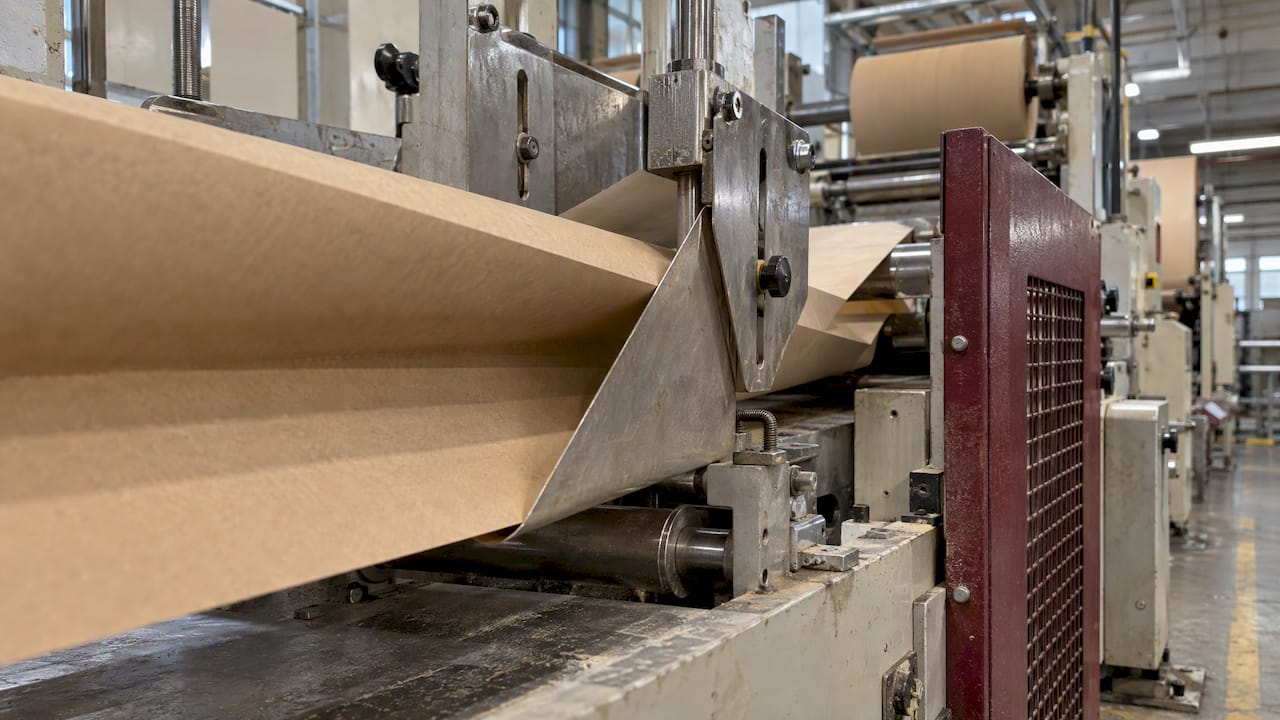
The gusset also matters on the production line. It is formed before the paper tube enters the bag machine, so the alignment of the forming parts affects every bag in the run. Small misalignments show up as jams on automated filling lines or as bags that do not square up when opened. This is one reason to ask a manufacturer how it controls folding tolerances rather than only asking for a sample.
Gusset types compared
There are three gusset styles you will see most often. The table summarizes how they behave in practice, based on the way packaging engineers describe them and the way the major formats are generally used.
| Style | Where the gusset sits | Shape when filled | Best for | Watch out for |
|---|---|---|---|---|
| Side gusset | Vertical folds along both sides | Brick-like, rectangular | Coffee, powders, baked goods, stackable dense contents | Does not always stand unaided when lightly filled |
| Square-bottom (SOS) | Flat base panel folded out | Stands upright with a flat floor | Apparel, gifts, retail, heavier items | Higher paper and glue demands at the base |
| V-bottom (plow bottom) | Shallow V fold at the base | Narrow base, tapers | Lightweight goods, simple takeaway | Limited load and stability |
In short, if the bag must stand on a shelf or a counter and carry real weight, specify a square bottom. If it is a stackable pack for dense contents, a side gusset is usually the efficient choice. If the contents are light and the price per unit is the priority, a V-bottom may be enough.
Side gusset bags
Side gusset bags take a rectangular shape when filled and sit neatly in cartons and on retail shelves. They are common in coffee, tea, flour, spice and bakery packaging. Their bottom is typically a single flat seal across the width, so the bag does not need a pre-formed base.
They are also the format in which print runs are most economical, since the front and back panels are large, uninterrupted areas for a brand.
Square-bottom (SOS) bags
The square-bottom bag is what most people picture as a retail paper bag. The base is folded and glued into a flat plate, so the bag stands by itself and spreads weight across the base. That is why it is the usual choice for apparel, cosmetics sets, gifts and anything handed to a customer at a till.

Because the base carries the load, it is also where quality differences appear. Glue coverage, paper grammage and, for heavier items, a reinforcing card insert in the bottom are the details to ask about.
V-bottom bags
V-bottom bags are simple to produce and efficient for light loads such as pastries or small hardware. They can hold a lot of volume for the paper used, but they rely on the contents for stability. They are rarely the right answer for a premium product presentation.
Match the bag to the load and the reuse
The most common specification mistake is choosing size and artwork first and thinking about weight last. The industry guidelines for high-quality paper carrier bags say the fit-for-purpose criteria should reflect the transport route, the weight of the items and the number of reuses expected. They use a bag meant to carry 6 kg and be reused up to five times as a reference case, which needs the right paper grammage, glue type and a well-anchored handle.
In that construction, the handle's anchor point is the usual place for failure. A beautiful bag that tears at the handle patch is remembered for the tear, not the foil.
A practical way to set your target:
- Weigh the heaviest realistic item, including tissue, inserts and any gift set components.
- Decide the journey. A short walk from a boutique counter is a different test from a trip on public transport in the rain.
- Set a reuse expectation. If you want the bag to become a lasting brand carrier, say so in the RFQ.
- Choose the handle to match. Twisted paper handles, flat paper handles, die-cut handles and rope each have a load range. Our guide to matching bag handle types to 0–2, 2–8 and 8+ kg loads goes through the options.
- Request a loaded test sample at the target weight, not an empty one.
Rope handles are a good fit when the bag has to feel premium and carry a boxed bottle or gift set, and our own paper rope handle bags follow the same logic with brand-specific finishes.
Design with the gusset in mind
A dieline for a gusseted bag is not just a flat rectangle. The folds move, and the print has to survive being folded.
- Keep safe zones at the folds. Designers often underestimate how high-speed creasing stresses ink and finishes near the gusset. Keep critical type, logos and large solid foil areas away from fold lines, or ask the manufacturer to specify scoring that protects them.
- Plan which panel faces the customer. On a side gusset bag, the gusset panels are narrow and fold inward, so a logo that wraps across them will be broken when the bag is closed.
- Match finish to function. Soft-touch lamination feels luxurious but can show scuffs at the base of a carrier bag. Matte or aqueous coatings are easier to maintain on high-use surfaces. Foil stamping and blind embossing look best on the large front panel, not across folds.
- Colour on kraft behaves differently. Uncoated brown kraft shifts and darkens most colours, so white ink underprints or a white paper stock are used when brand colours must be exact.
If you are designing related rigid packaging at the same time, our guide to rigid box dielines, materials and production rules covers the same logic of tolerance and finish on a different structure.
Paper, inks and adhesives
Paper choice sets the look and the performance. Kraft (brown or bleached white) is the usual base. Grease-resistant paper suits bakery and food service. Coated or laminated paper gives a premium surface and better wet strength, though laminating affects recyclability, so confirm the claim you plan to make. For the case for and against lamination in premium orders, see our piece on laminated paper bags and the 6 kg, 5 reuse benchmark.
The adhesives and inks matter as much as the paper. The industry guidelines note that natural water-based inks and starch-based adhesives help a bag stay recyclable in standard municipal streams. If recyclability is part of your claim, put those requirements in the brief.
The broader environmental picture is not simple. Research on carrier bag value chains shows that the paper versus plastic question depends on how the whole production chain is built, so a paper bag is not automatically the better choice by default. The honest claim is a documented one: certified fiber, responsible sourcing and a bag that is reused.
Food contact and regulatory points
If the bag touches food, whether bakery goods, coffee, snacks or confectionery, it is food packaging and needs to be specified as such. Paper bags are among the paper-based food packaging materials whose health and safety issues are reviewed in the scientific literature, with attention to inks, coatings and recycled content.
The rules differ by market, so state your destination country in the RFQ. As one example from Europe, a draft Greek national rule notified to the European Commission sets out that recycled paper in food contact is restricted, generally to dry foods or behind a functional barrier, and that total migration from organic-coated paper and board is capped at 10 mg/dm². Treat that as an illustration of how strict a market can be, not as a universal rule. For the United States, check the current FDA requirements for your specific coating and food type with your compliance team.
For a pharmacy, supplement or cosmetics brand, ask for a declaration of the materials used, and keep the documentation with your batch records.
Certified fiber: FSC in practice
If you want to put a forest certification label on a bag, the rules are specific. According to FSC's own printing guidance, printed materials and packaging can only carry an FSC label when produced and labeled under a valid chain of custody, and the label must clearly show whether it refers to the product or the packaging. A brand that only buys finished, certified packaging and does not transform or relabel it does not necessarily need its own certificate, but many brands hold one so the license code links to their corporate record.
The practical step is to ask your supplier for its certificate number, check it in the FSC database and have the label artwork approved through the certification body before print. We explain the label types in our guide on FSC versus PEFC and how to check a supplier, and we announced our own FSC® Chain of Custody certification (licence code FSC® C232946) for brands that need certified production.
Our perspective: where gusseted bags go wrong
We make paper carrier bags, rigid boxes, labels and cartons for beauty, spirits, lifestyle and regulated brands, and the failures we see in gusseted bag briefs are rarely about the artwork. They are about assumptions.
The first is that the bag is judged empty. A bag looks good flat on a render and fails when a 1.2 kg gift set pulls on the handle patch. We would rather quote with the real contents weight in front of us, then match paper, base construction and handle to that.
The second is that the finish is chosen separately from the structure. A gusset is a moving fold, and a foil panel that crosses it will crack. Because we combine hand-finishing craft with automated production in one facility, we can discuss the finish and the fold together instead of passing the problem between suppliers.

The third is the sustainability claim written before the supply chain is checked. A certified label is a procedure, not a color. If a bag needs to carry an FSC mark, the paper, the printer and the label wording all have to line up.
The most useful thing a buyer can do is send us the product, the weight, the journey and the reuse goal, and let us propose the construction.
— Anthony
How to write an RFQ for gusseted paper bags
A clear brief shortens quoting and prevents surprises at sampling. Include:
- Bag style: side gusset, square bottom or V-bottom.
- Dimensions: width x gusset x height, in inches or millimeters, stated once and consistently.
- Contents and weight: what goes in, the heaviest case, and whether it is food, cosmetics, a pharmaceutical item or a retail product.
- Reuse and journey: target load and number of reuses.
- Paper: kraft, white, coated or grease-resistant, and the grammage range you want to compare.
- Handles and closure: none, twisted, flat, die-cut or rope, or a fold-over or sealed top.
- Print and finish: colors, foil, embossing, soft-touch or matte coating, and where they sit relative to folds.
- Certification and compliance: FSC, destination market, food-contact documents.
- Quantity and timing: run size, split by size if needed, and delivery window.
- Samples: a white mock-up for fit, then a printed, loaded pre-production sample.
Ordering from Yuan Packaging
If you are choosing between bag styles for a launch, we can help you specify the construction, print and finish together. Our custom paper carrier bags are made for retail and luxury use, with die-cut handle options and bottle and gift set carriers for heavier presentations. For a reusable alternative, we also make gusseted non-woven carrier bags. Prices depend on specification and quantity, so send us your brief through our contact page.
FAQ
What is a gusseted paper bag?
It is a paper bag with a folded panel at the sides or base that expands when the bag is filled. The gusset gives the bag depth, so it can hold boxed or bulky items and, with a flat base, stand upright.
Which gusset is best for retail shopping bags?
A square-bottom (SOS) gusset is the usual choice. It forms a flat base that lets the bag stand on a counter and carry heavier loads. Pair it with a handle rated for the weight of your product.
Are gusseted paper bags food safe?
They can be, if the paper, inks, adhesives and any coating are suitable for food contact in the market where you sell. Ask your supplier for documentation and check the rules for your destination, since requirements differ between the US and the EU.
Can I print a brand logo across the gusset fold?
It is better not to. Folding and creasing stress ink, foil and laminate, so keep logos and solid foil areas on the flat panels and leave safe zones near the folds.
Sources
- Industry Guidelines: High-quality paper carrier bags
- FSC in Print
- Designing Value Chains of Plastic and Paper Carrier Bags for a Sustainable and Circular Economy
- Paper and paper based food packaging materials: health safety and environmental concerns
- EU technical regulation notification on paper and paperboard in contact with food
Recommended
- Gusseted Non-Woven Carrier Bags
- Die-Cut Handle Paper Bags
- Match Bag Handle Types to 0–2, 2–8, 8+ kg Loads for Packaging Buyers
- Custom Paper Rope Handle Bags
What is a gusseted paper bag?
It is a paper bag with a folded panel at the sides or base that expands when the bag is filled. The gusset gives the bag depth, so it can hold boxed or bulky items and, with a flat base, stand upright.
Which gusset is best for retail shopping bags?
A square-bottom (SOS) gusset is the usual choice. It forms a flat base that lets the bag stand on a counter and carry heavier loads. Pair it with a handle rated for the weight of your product.
Are gusseted paper bags food safe?
They can be, if the paper, inks, adhesives and any coating are suitable for food contact in the market where you sell. Ask your supplier for documentation and check the rules for your destination, since requirements differ between the US and the EU.
Can I print a brand logo across the gusset fold?
It is better not to. Folding and creasing stress ink, foil and laminate, so keep logos and solid foil areas on the flat panels and leave safe zones near the folds.