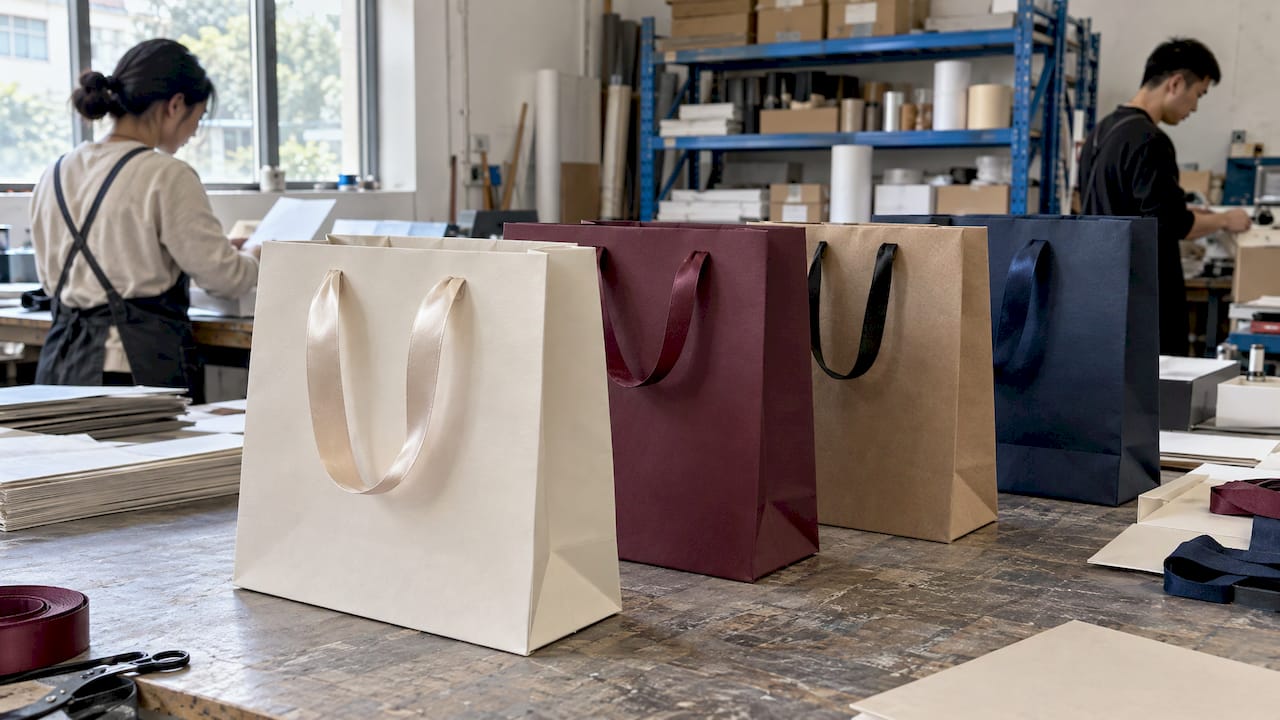
A ribbon handle paper bag is a paper carrier bag whose handles are cut lengths of woven or satin ribbon, fixed to the bag at the top, usually inside the mouth. Ribbon gives the softest hand-feel and the most polished look of any common handle, which is why it dominates premium gifting, beauty and boutique retail. The handle is also the part that decides whether the bag survives the walk home, so the construction matters as much as the color.
This guide covers how ribbon handles compare with rope, twisted paper and die-cut handles, what the bag body is made from, how handles are attached, and what to put in a specification before you request a quote.
TL;DR
- Choose ribbon when presentation leads: gifts, fragrance, cosmetics, jewelry, fashion and seasonal launches. Choose rope for a heavier, more tactile feel, and twisted paper when sustainability and cost lead.
- The handle is the fragile point of any paper carrier bag. Strength comes from handle material, how it is fixed, and a reinforcing patch, not from ribbon width alone.
- Specify the bag in numbers: dimensions, paper type and weight, handle material and length, finish, and the weight the bag must carry.
- Industry guidelines for high-quality paper carrier bags set a benchmark of at least 6 kg carried and up to five reuses. Use it as a starting point for premium briefs.
Table of Contents
- What counts as a ribbon handle paper bag
- Paper bag handle types compared
- How ribbon handles are attached
- Carrier bag materials: body, base and handle
- When ribbon handle bags are the right call
- What to specify before you request a quote
- Our perspective
- Match the bag to the rest of your packaging
- Request ribbon handle bags from Yuan Packaging
- FAQ
- Sources
What counts as a ribbon handle paper bag
The name varies by market. In North America, buyers usually search for paper shopping bags or gift bags; in the UK and Europe the same product is a paper carrier bag. The label matters less than the specification: handle type and bag dimensions are what a manufacturer needs from you.
A ribbon handle bag has four parts:
- The body: a printed sheet of paper, glued into a tube with a side seam and folded into a flat-bottom or gusseted shape.
- The base: folded and glued, often with a card insert to keep the bag square and carry weight.
- The top fold: the paper turned inside the mouth, which gives a clean edge and a place to anchor the handle.
- The handles: two lengths of ribbon passed through holes punched in the top fold, with the ends knotted inside the bag or held behind a reinforcing patch.
If you want the full range of constructions, our guide to gusseted paper bags explains how the body shape changes capacity and shelf display.
Paper bag handle types compared
There are five handle families you will meet when you source bags. Each has a visual identity and a practical profile.
| Handle type | Look and feel | Typical use | What to watch |
|---|---|---|---|
| Ribbon (satin, grosgrain, cotton tape) | Smooth, flat, colored to match the brand | Beauty, fragrance, jewelry, fashion, gifting | Edge fray if cut poorly; fixing method decides strength |
| Rope (cotton, polyester, nylon cord) | Rounder, tactile, a little heavier | Wine and spirits, boutique retail, premium gifts | Knot size and bag-wall reinforcement |
| Twisted paper | Natural, kraft look | Retail, food, eco-led brands | Less luxe appearance; paper grade drives strength |
| Flat paper | Simple, low profile | Takeaway, bakery, high-volume retail | Comfort under heavier loads |
| Die-cut | Handle punched out of the bag wall | Promotional, fast-moving retail | Limited to lighter loads and a casual look |
Two of these have their own pages if you want to see formats: ribbon handle paper bags and paper rope handle bags. For fast-moving retail, die-cut handle paper bags are the practical option.
Ribbon versus rope
This is the choice most luxury buyers wrestle with.
Ribbon is flat, so it sits comfortably across the fingers and carries color and sheen. You can match a satin to a Pantone, choose a matte cotton tape for a quieter look, or pick grosgrain for texture. It suits bags that will be carried briefly and admired: a fragrance gift set, a skincare launch, a holiday collection.
Rope is rounder and reads as more substantial. It tends to be the choice for bottle bags and heavier gift sets because the cord holds its shape and the knot anchors firmly. If your product is a wine or spirits bottle, look at bottle and gift set carrier bags, where the structure is planned around weight from the start.

A simple rule: the lighter and more design-led the contents, the more ribbon makes sense. The heavier the contents, the more you should check the fixing and reinforcement whichever handle you pick.
Where twisted paper fits
Twisted paper handles are made from kraft paper rolled into a cord. They are a natural fit when the brief puts recyclability and a mono-material look first, and they can be printed or left natural. They read as honest and eco-minded rather than ceremonial, so they suit gourmet food and lifestyle brands more than high-gloss beauty.
How ribbon handles are attached
The attachment method is where good bags and disappointing bags separate. The industry guidelines for high-quality paper carrier bags note that studies have shown that the handles are the fragile point when a paper carrier bag is used and reused, and that the weakness can be designed out by choosing the right handle paper quality and the best construction to fix it to the bag.
Those guidelines recommend handles made from paper with high-strength properties, fixed inside the bag and reinforced with a paper patch. The same logic applies to ribbon. There are two ways to fix the ends, and the holes can also be finished with eyelets:
- Knotted through punched holes. The ribbon passes through two holes punched in the top fold and is knotted inside the bag. Often paired with a card strip so the knot cannot tear through the paper.
- Held behind a reinforcing patch. The ribbon passes through the punched holes and its ends are held inside the bag behind a reinforcing patch, which also strengthens the paper around the holes. The patch shows on the inside of the bag and the holes on the outside.
- Eyelet-finished. A metal or plastic eyelet lines the punched hole of a knotted or patched handle, protecting the hole edge and giving a finished, boutique look.
Whichever method you choose, ask for the reinforcement to be in the specification, not left to the factory default.
What affects carrying comfort
- Ribbon width. Wider ribbon spreads pressure across the hand. Very narrow ribbon looks elegant but can bite on a heavier bag.
- Handle drop. The length from bag mouth to the top of the loop. Too short and the bag cannot be carried on the forearm or shoulder; too long and it drags.
- Material. Satin is slick, cotton tape grips, grosgrain has a ribbed surface that holds in the hand.
- Bag balance. A rigid base card and a correct gusset keep the bag upright and the load centered.
Carrier bag materials: body, base and handle
The body is the easiest part to choose and the most visible.
- Coated art paper (often laminated). A smooth white surface suited to full-color print, with matte, gloss or soft-touch lamination. This is the usual choice for luxury beauty and fashion.
- Kraft paper. Brown or white kraft gives a natural look and good tear resistance. It is common for lifestyle, gourmet and eco-led briefs.
- Specialty and textured papers. Textured stocks add tactility under hot foil or embossing.
- Certified fiber. If your brand needs FSC®-certified paper, say so at the RFQ stage so material is sourced accordingly.
Finishes layered on top of the paper include foil stamping, embossing, spot UV and soft-touch lamination. These are what turn a paper bag into a brand moment: a debossed logo, a foil monogram, a matte body with a glossy spot UV pattern. Our guide to laminated paper bags covers how lamination interacts with strength and the 6 kg and five-reuse benchmark in premium RFQs.
Base and reinforcement. A card base insert stiffens the bottom and carries weight. A top-fold reinforcement stops the mouth from collapsing and anchors the handles.
Handle materials. Satin and polyester ribbon, cotton tape, grosgrain, cotton or polyester rope, and twisted paper. Pick the handle for look and load, then confirm the fixing.
When ribbon handle bags are the right call
Ribbon suits situations where the bag is part of the product's presentation:
- Beauty and fragrance launches, where the bag is the first thing a customer sees and carries through a mall.
- Seasonal and holiday gift programs, where color-matched ribbon ties the bag to a campaign.
- Boutique retail and jewelry, where lighter products meet high expectations for finish.
- Event and VIP gifting, where a set of bags needs to look consistent and special.
- Wine and gourmet gift sets, when paired with a structure built for the weight.
If the bag will carry something dense, such as several bottles or boxed sets, bring the weight into the brief early and let the construction follow.
What to specify before you request a quote
A complete brief shortens the quote cycle and prevents mismatches between proof and production. Include:
- Dimensions: width × gusset × height, in inches or millimeters, and the largest product the bag must hold.
- Paper: type, weight and color, and whether FSC® certification is required.
- Print: number of colors, coverage, and whether the artwork bleeds over the folds.
- Finish: matte, gloss or soft-touch lamination; foil stamping, embossing, spot UV.
- Handle: material, color reference, width, drop, and attachment method.
- Reinforcement: top-fold reinforcement and base card.
- Load target: the weight the bag must carry and how many times it should be reused.
- Quantity and timeline: run size, delivery window, and shipping destination.
- Pre-production sample: ask for a sample or mockup to confirm size, handle feel and color before the full run.
Load capacity and testing
The European guidelines state that a high-quality paper carrier bag should carry at least 6 kg of products home from the supermarket and be reusable up to five times for the same purpose. Durability can be measured against the EN13590 test standard, which subjects the bag to heavy weights while lifting it repeatedly, and certification lets the bag be marked with the weight and volume it can carry. These are European guidelines; if you sell in the US, treat them as a practical benchmark for your own brief rather than a US legal requirement.
Our perspective
We see the handle as the most underspecified part of a premium bag. Brands spend weeks on the foil and the Pantone, then leave the handle to a line that says "ribbon, black." The bag is the first object a customer carries out of your store, and the handle is the part their hand touches.
Our approach is to work from the contents backward. We ask what the bag will hold, how far it will be carried and how it should feel, then match paper, handle, fixing and reinforcement to that answer. Ribbon is a beautiful choice for the right product, and when it is the right choice, details like the drop, the width and the reinforcement patch are what make it feel collector-grade rather than disposable.
We also believe in making the decision easy to audit: dimensions, materials, finish and load target written down, with a sample approved before production. That is how a bespoke bag arrives looking the way the proof promised.
Anthony
Match the bag to the rest of your packaging
A bag rarely travels alone. Tissue and wrapping sheets inside the bag finish the unboxing, and a printed wrap can carry your pattern and logo; see custom wrapping and tissue paper. If your program also needs reusable totes, non-woven carrier bags are a durable companion.
Request ribbon handle bags from Yuan Packaging
Yuan Packaging is a custom packaging manufacturer in Huai'an, China, producing luxury paper carrier bags, rigid gift boxes, folding cartons and pressure-sensitive labels for beauty, wine and spirits, pharmaceutical and gourmet brands. We offer finishes such as foil stamping, embossing, spot UV and soft-touch lamination, and can supply FSC®-certified paper (FSC® C232946) on request. Send your dimensions, paper, handle and finish preferences and we will guide you from concept to finished bag through our paper carrier bags range.
If you are building a matched set, our rigid gift boxes and custom labels can be briefed in the same RFQ so the whole range shares one finish language.
FAQ
What are paper bags with handles called?
Most often they are called paper shopping bags or paper carrier bags, and in gifting contexts, paper gift bags. "Shopping bag" is the common term in North America, while "carrier bag" is more common in the UK and Europe. For a manufacturer, handle type and dimensions matter more than the name.
Are ribbon handles or rope handles stronger?
Neither wins on material alone. Strength depends on the handle's own quality, how it is fixed and whether the bag wall is reinforced where the handle attaches. Rope is usually chosen for heavier bottle and gift-set bags, ribbon for lighter, design-led products. State your target load in the brief.
Can I print my logo on a ribbon handle paper bag?
Yes. The bag body can carry full-color print with finishes such as foil stamping, embossing or spot UV. The ribbon itself can be specified in a color that matches your brand palette. Send your artwork and Pantone references with the RFQ.
What paper is best for luxury paper carrier bags?
Coated art paper with matte or soft-touch lamination suits beauty and fashion. Kraft or textured stocks suit natural and gourmet looks. Pick the paper for the image you want and the load the bag must carry, and add FSC® certification to the brief if your brand needs it.