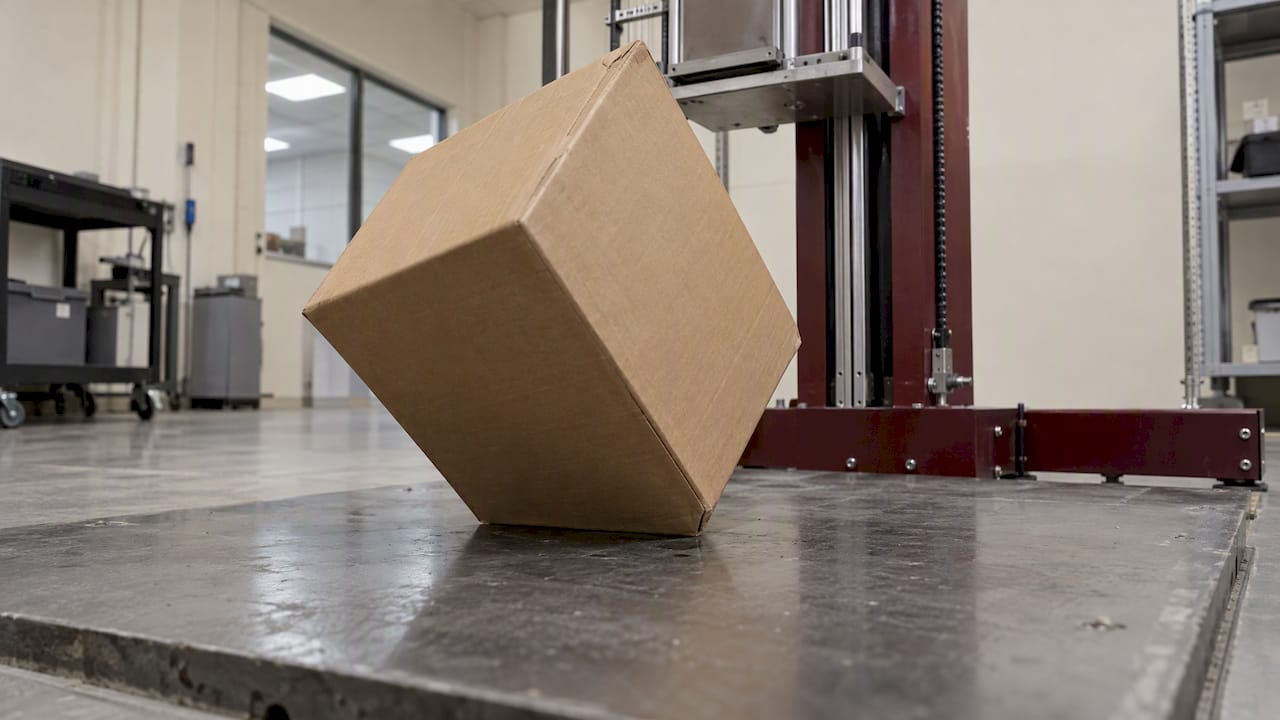
A packaging drop test releases a loaded package from a set height onto a hard surface, in a defined sequence of corners, edges and faces, then checks whether the package and the product inside still do their job. The standard you follow (ASTM, ISTA or a retailer's own rule) decides the height, the number of drops and what counts as a pass. This guide explains how each one works, what the numbers are, and how to prepare packaging so it passes the first time.
TL;DR
- A drop test simulates handling impacts in shipping so weaknesses at corners, edges and faces show up before distribution, not after.
- FedEx's test guide for packages up to 150 lb uses 10 orientations and a height set by weight: 30 in up to 75 lb, 24 in above 75 lb to 100 lb, 18 in above 100 lb to 150 lb.
- ISTA 3A, the common parcel-shipping simulation, also adds vibration and further impacts, and it does not by itself prove carrier or dangerous-goods compliance.
- Dangerous-goods packaging follows regulation (UN performance testing, 49 CFR in the US), where drop heights depend on packing group, not on a voluntary standard.
- Pass criteria are set by the shipper. Write them down before the first drop.
Table of Contents
- What a packaging drop test actually evaluates
- The main standards: ASTM, ISTA and regulation
- Drop height and orientation requirements
- How to perform a drop test, step by step
- Pass criteria: who decides what counts as damage
- Designing packaging to pass
- Which test for which situation
- Our perspective
- Working with a manufacturer on tested packaging
- FAQ
- Sources
What a packaging drop test actually evaluates
A drop test evaluates how the package and its contents withstand the impacts they meet during shipping, handling and sometimes use, according to Westpak's testing guidance. Its main value is finding weak points at corners, edges and faces before distribution, which matters most for delicate or high-value goods.
That last point is why the test is so relevant for premium goods. A perfume carton, a spirits gift box or a pharmaceutical carton is rarely expensive because of its board. It is expensive because of what a dented corner, a scuffed foil or a cracked bottle does to the brand and the customer. The test tells you whether the outer packaging, the inner structure and the product work as one system.
Three things are being judged at once:
- The product. Is it undamaged and does it function?
- The inner packaging. Did inserts, dividers or cushioning hold the product in position?
- The outer packaging. Is it intact enough to continue through the supply chain and, for retail, to look acceptable on delivery?
Westpak's laboratory view is that package and product should be evaluated together, because the damage you observe points to design weaknesses that can be corrected by changing the packaging, the cushioning or the product itself.
The main standards: ASTM, ISTA and regulation
There is no single drop test. There are three families, and people mix them up constantly.
ASTM D5276: free-fall of loaded containers
ASTM D5276 covers free-fall testing of loaded boxes, cylindrical containers, bags and sacks to evaluate how well the container resists shock and protects its contents, as summarized by the ANSI Blog. It is a method, not a pass mark: you choose heights, orientations and criteria that suit your distribution environment. Check the current edition with ASTM before you cite it in a specification.
ISTA procedures: pre-defined test plans
ISTA (International Safe Transit Association) publishes complete test procedures that combine drops with other hazards. ISTA's selection guidelines indicate that you should choose a procedure by objective and distribution environment. The range runs from early design screening to general simulation and to retailer or shipment-specific performance testing.
The two you will meet most often:
- ISTA 1A is an integrity test for individual packaged products of 150 lb (68 kg) or less. ISTA's overview says it is meant to evaluate package-product performance and compare design alternatives, and it notes that moisture, pressure and unusual handling may not be covered. That makes it a good tool for choosing between two structures.
- ISTA 3A is a general simulation for individual packaged products shipped through parcel-delivery systems, weighing 70 kg (150 lb) or less, per ISTA's 3A overview. It suits e-commerce and direct-to-consumer shipments.
ISTA also publishes an equipment table showing that a drop apparatus is required for procedures including 1A, 1B, 1C, 1D, 1G, 1H, 2A, 2B, 3A, 3B, 3F and 3L. If your lab cannot run a drop in the specified way, it cannot certify to these.
For a deeper look at planning the full sequence, see our guide to an ISTA transit testing workflow.
Regulatory drop tests: a different category
When the contents are classified as dangerous goods, the drop test is not optional or voluntary. In the US, 49 CFR § 178.603 requires the drop test for qualifying all packaging design types, repeated periodically as § 178.601(e) specifies. Globally, UK Department for Transport guidance explains that UN dangerous-goods performance provisions form the basis of ADR, RID, the IMDG Code and ICAO Technical Instructions, and that the UN recommendations are revised every two years. For example, the official text of RID 2025, the rail regulation in that group, says packagings other than inner packagings must conform to a design type successfully tested under the applicable provisions of its Chapters 6.1, 6.3, 6.5 or 6.6, unless RID provides otherwise.
The practical consequence goes both ways. Passing ISTA 3A does not make a package compliant for dangerous goods, because ISTA states that general-simulation tests challenge packages with transport hazards but do not necessarily comply with carrier packaging regulations. Compliance has to be checked separately.
Drop height and orientation requirements
Height depends on weight, and weight is the packed weight, not the empty carton. In FedEx's guide to testing packaged products weighing up to 150 lb, packages fall freely onto a flat, firm, nonyielding steel base from these heights:
| Packed weight | Drop height |
|---|---|
| Up to 75 lb | 30 in |
| Over 75 lb to 100 lb | 24 in |
| Over 100 lb to 150 lb | 18 in |
The same FedEx guide specifies 10 orientations: one corner, the three edges radiating from that corner, and the opposing small, medium and large faces. A requirement worth noting: the package must be inspected after the sequence.
ISTA 3A is more elaborate. Its overview lists nine drops at weight-dependent heights for standard, elongated and flat packages, followed by vibration and a second sequence of eight drops that includes a drop onto a hazard block. For flat and elongated packages it also lists a 200 mm rotational-edge drop and a full rotational flat drop, plus a hazard box dropped from 400 mm (a concentrated impact for flat packages, a bridge impact for elongated ones). Always take the exact heights for your weight from the current procedure document, because they change with weight and package type.
If a retailer sends you a vendor manual, that overrides your own assumptions. Retailer requirements usually state that packages must be dropped onto a flat, firm, non-yielding surface, with the height read from a weight chart in their own document.
Dangerous-goods heights
For regulated packagings, the height depends on the packing group and the packaging type. As one example, a dangerous-goods testing laboratory's FIBC guide gives UN drop heights of 1.80 m for Packing Group I, 1.20 m for Group II and 0.80 m for Group III, with X, Y and Z marks respectively. These are also the general UN drop heights for most packagings tested with the substance to be carried, or with water for liquids with a relative density up to 1.2. Denser liquids tested with water use heights calculated from the relative density, and IBCs, including FIBCs, have their own drop test. Check the regulation that applies to your design before testing.

How to perform a drop test, step by step
You can run a basic screening drop in-house, but a certification claim needs a lab and the standard's apparatus.
- Define the goal. Design screening, supplier comparison, retailer approval or regulatory qualification? The goal picks the standard.
- Pick the procedure. Use ISTA 1A to compare structures, ISTA 3A for parcel shipments, the retailer's manual for retail compliance, or the regulation for dangerous goods.
- Prepare the package as shipped. Use the real product or a representative stand-in, the real inserts, the real closure and the real outer carton. Condition it if the procedure asks.
- Set the height from the packed weight. Weigh the loaded package, then read the height from the procedure.
- Drop onto the specified surface. A flat, firm, nonyielding surface, released without rotation so the impact energy is transferred as intended.
- Follow the sequence and orientations. Each drop on a defined corner, edge or face, in the prescribed order.
- Inspect after each drop or at the end, as the procedure requires, and photograph everything.
- Record and decide. Compare against the pass criteria you set in advance.
Pro tip: Mark the corner, edges and faces on the carton before the first drop, with numbers matching the procedure. Photographs then map directly onto the test report.
Pass criteria: who decides what counts as damage
Voluntary tests rarely come with a universal pass mark. In ISTA 3A, the shipper determines the product-damage tolerance and the acceptable package condition. That freedom is useful, but it means your criteria must be written down before testing, not argued over afterward.
A workable criteria list for premium goods looks like this:
- Product: no breakage, no functional failure, no leakage, no cosmetic marks that would cause a return.
- Inner structure: product remains in its position, inserts are not crushed beyond a stated tolerance.
- Outer carton: no tears or open seams, corner crush within a stated limit, closure still secure.
- Print and finish: for retail-facing cartons, no rub or scuff that is visible at arm's length. Foil, embossing and soft-touch lamination are the first places scuffs appear.
For regulated packaging, the criteria are set by the regulation. For a composite or combination package, the UN-based Chapter 6.1 provisions, as published in the official RID 2025 text, require that the outer packaging suffers no damage liable to affect transport safety, that inner receptacles remain completely inside, and that the filling substance does not leak.
Reading failures
The pattern of damage tells you the fix:
| What you see | Likely cause | Typical response |
|---|---|---|
| Crushed corners | Board too light or too little corner support | Stronger board grade, reinforced corners, different structure |
| Product shifted or rattled | Insert too loose | Tighter insert or added divider |
| Product cracked at contact point | Hard contact with the wall | More clearance or cushioning |
| Seam opened | Weak closure or glue | Locking base or revised closure |
| Print scuffed | Finish too exposed | Protective coating or an outer shipper |
If you see the same failure in the same orientation twice, fix the design before you retest. A retest without a change simply repeats the result.
Designing packaging to pass
Most failures are decided before the test, at the structure stage.
Start with the inner support. Most bottle and jar damage is movement, not outer-carton crush. We cover the main options in our guide to box insert options, and for corrugated protection see die-cut corrugated inserts.

Choose the structure for the load path. For shipping cases, flute, board grade and style matter, which is covered in our corrugated box design guide. For retail cartons, a locking base such as a crash-lock carton can behave differently under impact than a tuck-end style, so test the actual style you intend to ship.
Treat the rigid box as a presentation layer. A rigid box is chosen for the unboxing, and it is usually shipped inside a corrugated shipper. Test the combination, not the rigid box alone. The rigid box design guide explains how dielines and materials affect construction.
Protect finishes. Foil stamping, blind embossing and soft-touch lamination give a tactile premium feel, but they can show scuffing sooner than a plain gloss surface. If the carton is shipped bare, include a scuff check in your criteria.
Remember sampling. One passing sample proves little about a production run. Our article on packaging quality control shows how AQL sampling and basic tests keep production consistent with the tested sample.
Which test for which situation
| Situation | Start with |
|---|---|
| Comparing two package designs early | ISTA 1A, per its stated purpose of comparing design alternatives |
| Parcel or e-commerce shipment | ISTA 3A |
| A free-fall method you adapt to your own distribution | ASTM D5276 |
| A big-box retailer's vendor requirement | The retailer's own manual |
| Hazardous contents | UN, 49 CFR or IMDG packaging provisions, tested at an accredited facility |
| Pharmaceutical cartons | Your regulatory labeling requirements, plus a shipping test for the shipper |
Pharmaceutical cartons add labeling and content rules on top of transit performance. Our pharmaceutical carton requirements guide covers braille, leaflets and other elements that must survive the same handling.
Our perspective
We see drop testing go wrong in one pattern more than any other: teams test a finished design once, near the end of the project, and treat the result as a verdict. By then the artwork is approved, the finish is chosen and every fix is expensive.
We prefer to push the test earlier. At the dieline and sample stage, a handful of screening drops on the real structure, with the real insert, tell you more than a polished report at the end. A design that fails an early screening costs a revised dieline. One that fails at production costs a run.
We also treat the finish and the structure as one decision. Because we make rigid boxes, folding cartons, labels, corrugated cases and bags under one roof, the person choosing the insert can see the board and the finish at the same time. That is useful when a foil panel sits right on a corner that will take the first impact.
Our advice to brand and procurement teams is simple. Write the pass criteria before you test, test the package as it will really ship, and keep the sample you tested so production can be compared against it.
— Anthony
Working with a manufacturer on tested packaging
If you are developing packaging that has to survive shipping, bring the target standard to the first conversation. We manufacture custom folding cartons, corrugated and e-commerce boxes and rigid gift boxes, and we can build samples around your insert, board and finish so your test lab evaluates the real thing. Browse the full range on our packaging products page.
FAQ
What is the standard drop height for a packaging test?
There is no single height. FedEx's test guide for packages up to 150 lb uses 30 in up to 75 lb, 24 in above 75 lb through 100 lb and 18 in above 100 lb through 150 lb. ISTA 3A uses its own weight-dependent heights, and regulatory tests set heights by packing group, so read the procedure that applies to you.
Is ASTM or ISTA better for drop testing?
They do different jobs. ASTM D5276 is a free-fall method for loaded containers that you adapt to your needs, while ISTA publishes complete procedures that may combine drops with vibration and other hazards. Pick by your goal and distribution channel, or by what your retailer requires.
Does passing an ISTA test mean my packaging is compliant for dangerous goods?
No. General-simulation tests such as ISTA 3A challenge packages with transport hazards but do not necessarily comply with carrier packaging regulations. Dangerous-goods packaging must be tested to the UN-based regulations that apply to your mode of transport, such as 49 CFR in the US.
Who decides whether a package passes?
For voluntary tests, the shipper does. In ISTA 3A the shipper determines the product-damage tolerance and the acceptable package condition. For regulated packaging, the regulation sets the criteria, such as no leakage of the filling substance.
Can I run a drop test in-house?
Yes, for screening. A controlled drop onto a hard flat surface from a measured height shows weak corners and loose inserts early. For a certification claim or a retailer approval, use a laboratory with the apparatus the procedure specifies.
Sources
- Westpak: Drop Testing, Impact Drop Test Standards and Procedures
- ANSI Blog: Drop Test of Loaded Containers by Free Fall in ASTM D5276
- ISTA: Guidelines for Selecting and Using ISTA Test Procedures
- ISTA: Procedure 1A overview
- ISTA: Procedure 3A overview
- ISTA: Required Equipment for ISTA Testing
- FedEx: Testing Packaged Products Weighing up to 150 Lbs.
- 49 CFR § 178.603, Drop test (Cornell Law School)
- UK Department for Transport: Arrangements for the performance testing, certification and marking of packagings
- IMO: The International Maritime Dangerous Goods (IMDG) Code
- OTIF: RID 2025, Regulation concerning the International Carriage of Dangerous Goods by Rail
- Labordata: Testing for dangerous-goods FIBCs
Recommended
- Packaging Quality Control for QA & Procurement: ISO 2859, AQL, 3 Tests
- Reduce Lab Retests: ISTA Transit Testing Workflow for Packaging Teams
- 3 Tests Packaging Pros Must Run on Labels for Curved Surfaces
What is the standard drop height for a packaging test?
There is no single height. FedEx's test guide for packages up to 150 lb uses 30 in up to 75 lb, 24 in above 75 lb through 100 lb and 18 in above 100 lb through 150 lb. ISTA 3A uses its own weight-dependent heights, and regulatory tests set heights by packing group, so read the procedure that applies to you.
Is ASTM or ISTA better for drop testing?
They do different jobs. ASTM D5276 is a free-fall method for loaded containers that you adapt to your needs, while ISTA publishes complete procedures that may combine drops with vibration and other hazards. Pick by your goal and distribution channel, or by what your retailer requires.
Does passing an ISTA test mean my packaging is compliant for dangerous goods?
No. General-simulation tests such as ISTA 3A challenge packages with transport hazards but do not necessarily comply with carrier packaging regulations. Dangerous-goods packaging must be tested to the UN-based regulations that apply to your mode of transport, such as 49 CFR in the US.
Who decides whether a package passes?
For voluntary tests, the shipper does. In ISTA 3A the shipper determines the product-damage tolerance and the acceptable package condition. For regulated packaging, the regulation sets the criteria, such as no leakage of the filling substance.
Can I run a drop test in-house?
Yes, for screening. A controlled drop onto a hard flat surface from a measured height shows weak corners and loose inserts early. For a certification claim or a retailer approval, use a laboratory with the apparatus the procedure specifies.