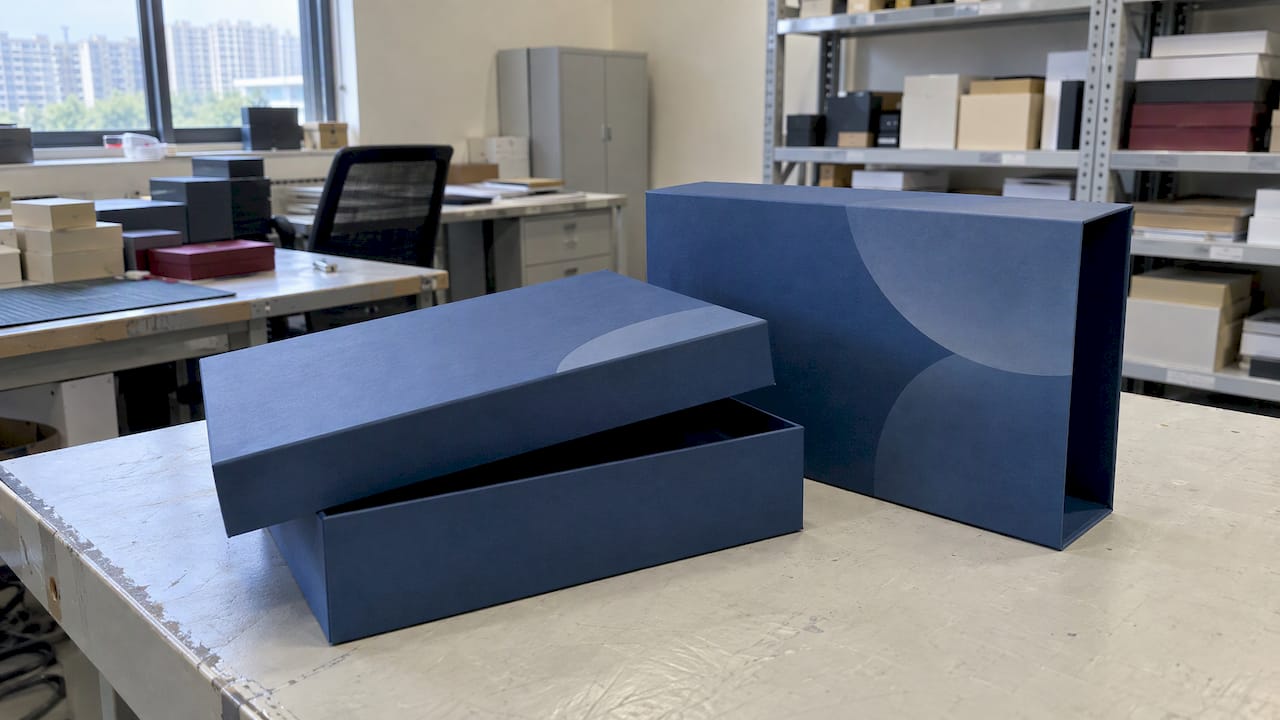
Soft touch packaging is a surface finish that makes a box, label or bag feel dry, velvety and suede-like in the hand, while looking deeply matte. For a luxury brand, it is the finish a customer registers before reading a single word. It can be applied as a coating or as a laminated film, and the route you choose decides how it feels, how it wears, how your colors read and whether the pack can be recycled. We make soft-touch rigid boxes, folding cartons, carrier bags and pressure-sensitive labels, and this guide gives you the decisions in the order you will face them.
TL;DR
- Soft touch describes how a surface feels, not just how it looks. Matte describes low shine; the two should be specified separately.
- There are two main routes: soft-touch coating (usually cheaper, keeps recyclability) and soft-touch lamination (more scuff resistance and rigidity, higher cost, slightly muted color).
- The finish scuffs more easily than gloss and shows marks most on dark solids, so rub testing and a protective layer belong in the spec.
- It pairs well with spot UV and, with testing, with foil stamping. It suits cosmetics, wine and spirits labels, gift boxes and cartons.
- Approve color and feel on a sample made with the exact finish and board you will order.
Table of Contents
- What soft touch means on a package
- Coating or lamination: the core decision
- How the finish is applied
- Where soft touch earns its place
- Specifying it so it performs
- Perspective
- Soft touch with Yuan Packaging
- FAQ
- Sources
What soft touch means on a package
A soft-touch surface gives a dry, velvety fingertip drag with a deep matte appearance. Arctic Materials' technical data sheet describes this for coatings supplied in water-based and UV-curable grades, used on cartons and sleeves handled at the point of sale. The same sheet gives a specular gloss of 2 to 10 gloss units at 85°, which is why the finish looks so flat.
For a buyer, the point is the hand feel. Unboxing becomes a small ceremony: the customer lifts the lid and the surface already says premium. The finish changes how the pack feels more than how it looks, as Packaging Digest notes, and it mutes saturated graphics.
Soft touch vs matte

Matte is an appearance property: how little light the surface reflects. Soft touch is a tactile property: a soft, suede-like feel. A surface can be matte without feeling soft, and soft-touch finishes usually also look matte. Printers also use "matte" loosely for a paper stock, a coating or a film, and terms like velvet or suede do not identify one standard construction. So your spec should name the construction (coating or film), not just the adjective. Our guide to matte vs gloss lamination covers the wider matte decision.
Coating or lamination: the core decision
| Factor | Soft-touch coating | Soft-touch lamination |
|---|---|---|
| What it is | Water-based or UV-cured layer applied in the press or coating unit | Pre-formed matte film bonded to the printed sheet |
| Cost | Usually lower, often no extra press pass | Higher, separate post-print step |
| Scuff resistance | Lower than gloss varnish; protective layer often added | Better scuff resistance, adds rigidity |
| Color | Keeps inks closer to the proof | Slight shift, inks look more muted |
| Recycling | Water-based coating leaves paper as paper | Film can complicate recycling; depends on the film |
The cost and color points come from PostPress, which also notes that lamination adds rigidity and works with diecutting, stamping, spot varnishing and overprinting. Packaging Digest explains that lamination costs more mainly because it is a separate step after printing, and that UV coatings cost more than water-based ones but hold up better to rubbing.
A third route, Cast and Cure, applies UV varnish, casts a matte film over it, cures it, and reuses the film. PostPress describes it as one of the least expensive and most sustainable soft-touch options, applicable to paperboard, labels and aluminum.
How to choose
- Rigid gift boxes and premium cartons that are handled often: lamination is the durable choice. Our buyer's specification guide to soft touch lamination sets out what to write into the brief.
- Cartons where recyclability and color fidelity matter: a water-based or UV soft-touch coating. See aqueous vs UV coating for durability and eco impact.
- Labels: coatings are the usual fit, since the label sits on a bottle and sees little rubbing once applied.
How the finish is applied
Coatings go on by flexo, gravure or roller coater. The Arctic Materials sheet specifies a dry or cured coat weight of 3 to 6 g/m² over a fully dried printed or laminated surface. Water-based grades are dried; UV grades are cured at a measured dose. Coating chemistry varies, from two-component waterborne polyurethane to UV-cured tactile systems, and the better systems resist abrasion, marring and fingerprints.

Press conditions matter too. CA Coatings notes that inks needing a lot of fountain solution can create an unstable emulsion, which calls for a primer applied wet-trap and the soft-feel coating applied dry-trap. This is production planning that your manufacturer should own, not something you should have to manage.
Where soft touch earns its place
- Cosmetic and wine packaging: Polytexus lists cosmetic and wine packaging, book covers and gift cards among uses of aqueous soft-touch coatings, with good water and alcohol resistance.
- Folding cartons, labels, folders and POP displays: CA Coatings lists these among applications for its soft-feel coating.
- Spirits and wine labels: a soft-touch surface lets embossing and metallic details stand out against a flat field. See our notes on luxury wine labels.
- Pharmaceutical and gourmet food cartons: a quiet, premium surface for seasonal and gift editions. Confirm any regulated text and food or drug contact requirements with your compliance team.
Combining with foil and spot UV
The contrast of spot UV gloss against velvet is one of the most requested effects. Our spot UV guide covers file setup. Foil stamping needs adhesion testing first on laminated surfaces, so hot foil vs cold foil and our foil stamping guide are worth reading before you finalize artwork. All of our options are on the finishes page.
Specifying it so it performs
- Name the construction. Write "soft-touch film lamination" or "soft-touch water-based coating", not "velvet matte".
- Choose the board. Soft-touch film on a lighter board can warp from film tension. See our materials and board types.
- Plan for dark solids. Marks and fingerprints show worst on heavy dark coverage, and color approved over the coating reads lighter, per the Arctic Materials sheet. Approve color through the finish, not before it.
- Add protection. The coating's rub resistance is lower than a gloss overprint varnish, so an anti-scratch layer is usually run to protect the feel.
- Test before the run. CA Coatings advises qualifying rub resistance before full production, and Packaging Digest recommends a filled-carton shipping test to check for scuffs.
- Decide on recycling early. Recyclability depends on the specific film named in the spec, so state your sustainability requirement in the brief. FSC-certified board is one of the requirements we can meet.
Perspective
Soft touch works best when it is treated as a system, not a surface effect. The board, the coating or film, the ink coverage and the secondary finishes all decide whether the pack still feels luxurious after a warehouse, a courier and a shelf.
Our approach is atelier-like: we plan the finish together with the construction, from concept to finished product. For a rigid gift box that will be handled constantly, we usually steer brands toward a laminated soft-touch surface. For labels and cartons where color fidelity and recyclability lead, a coating is often the cleaner answer. Either way, we would rather you approve a physical sample than a description.
With over 25 years of experience and 100 million units delivered to more than 5,000 brands, we have learned that the brands who specify the finish precisely get the smoothest seasonal launches.
Anthony
Soft touch with Yuan Packaging
We manufacture custom pressure-sensitive labels, rigid gift boxes, carrier bags and folding cartons in Huai'an, China, with soft-touch lamination, spot UV, foil stamping, embossing and sustainable material options for beauty, wine, spirits, pharmaceutical and gourmet food brands. Start with our wine labels or the full packaging range and send us your brief for a quote.
FAQ
Is soft touch the same as matte?
No. Matte describes a low-shine look, while soft touch describes a velvety feel. Soft-touch finishes usually look matte too, but the tactile effect is what defines them, so specify both.
Does soft touch scuff easily?
It scuffs more readily than high-gloss UV, and marks show most on dark solid colors. An anti-scratch layer, a suitable laminate and rub testing before production protect the finish.
Is soft touch packaging recyclable?
It depends on the construction. A water-based coating leaves paper as paper, while a film lamination depends on the specific film. Name your recyclability goal in the brief.
Which is better for labels, coating or lamination?
Coatings are the common route for labels, as they keep color closer to the proof and add little thickness. Your label's application and handling decide the final call.
Sources
- Arctouch SF technical data sheet, Arctic Materials
- Laminate, Coating or Cast and Cure, PostPress
- Types of Carton Finishes, Packaging Digest
- Soft Feel vs Matte Finish
- Soft Touch vs Matte Lamination, The Print Reviewer
- Softfeel coating technical note, CA Coatings
- Soft Touch Coating TDS, Polytexus