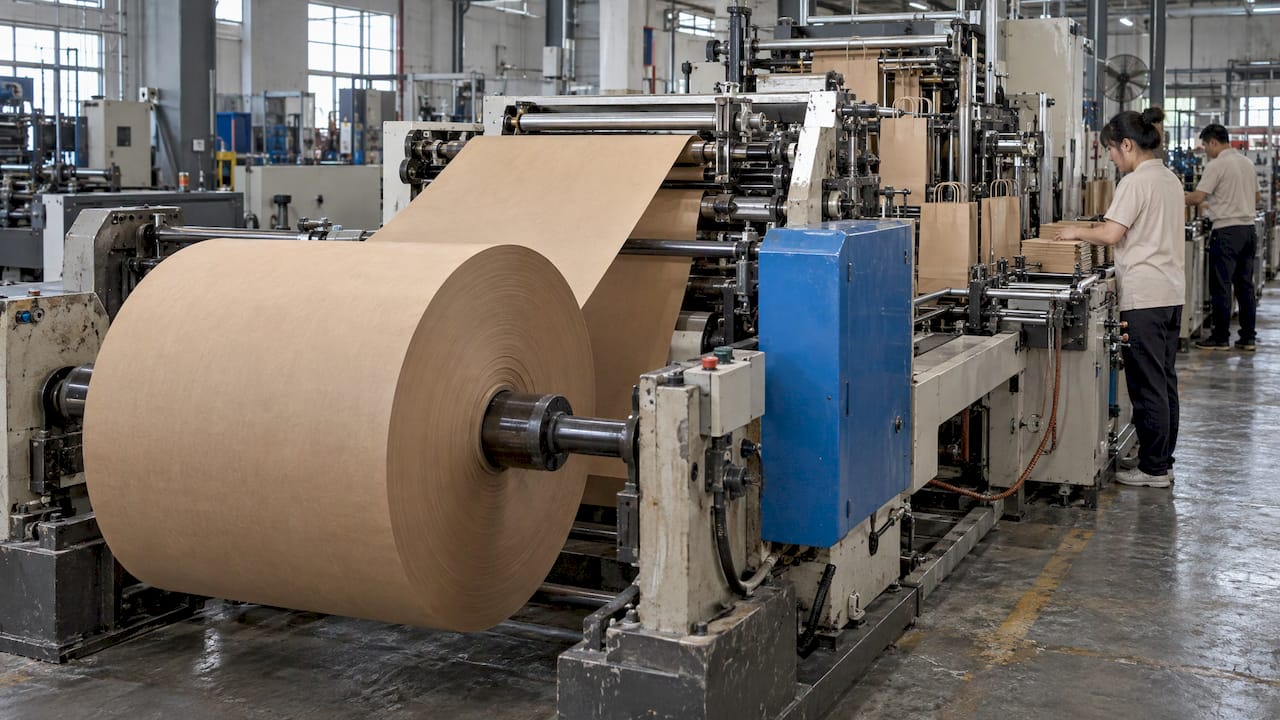
A paper carrier bag is made in six stages: paper is selected and stored, printed, formed into a tube, shaped into a bottom and gussets, fitted with handles, then finished and tested. Each stage sets something you will feel in your hand at the counter: strength, color accuracy, touch and how the bag survives being reused. If you are commissioning bags for a beauty line, a wine or spirits release or a seasonal gourmet gift, knowing the sequence lets you write a tighter specification and spot where a project can go wrong. At Yuan Packaging we make custom paper carrier bags for brands like these, and the walk-through below follows the order of the factory floor.
TL;DR
- Bag quality starts with the paper: tensile, bursting and tear strength are matched to the load the bag must carry and how often it will be reused.
- Printing (flexographic or offset) happens before the bag is formed, while coatings, foil and embossing are applied after the ink.
- The tube, the bottom and the gussets are formed by machine with water-based glue, and the handle type decides how much load the bag can take.
- Durability is measured with a standard lifting test (EN 13590), so ask for a stated load in kilograms, not just a paper weight.
- Cost is driven by paper, print method, handle type, run size and waste, so a quote needs a full spec to be accurate.
Table of Contents
- Step 1: Paper is chosen and conditioned
- Step 2: Printing the artwork on the web or sheet
- Step 3: Forming the tube
- Step 4: Shaping and closing the bottom
- Step 5: Handles and how they change the build
- Step 6: Coatings, foil and embossing
- How a bag is tested
- What drives the cost of a paper bag
- Ordering custom bags from Yuan Packaging
- Our perspective
- FAQ
- Sources
Step 1: Paper is chosen and conditioned
Everything begins with a roll of paper, usually kraft. Kraft is paper made from wood pulp cooked with chemicals so the fibers stay long and strong, which is why it dominates carrier bags. Paper can also be made from recycled fibers, and brands that need FSC-certified stock (a certification showing the fiber comes from responsibly managed forests) should state it at the start, because it changes which paper can be bought.
The paper is not picked by look alone. The paperbag.org industry guidelines say paper should be selected against measured mechanical values: tensile strength (ISO 1924-3:2008), tensile energy absorption, bursting strength (ISO 2758:2014) and tear strength (ISO 1974:2012). These are matched to the load the bag should carry and to the number of times it will be reused. The same guidelines describe a high-quality carrier bag as one that withstands at least 6 kg and can be reused up to five times.
Storage matters too. The guidelines advise keeping paper and finished bags dry and well ventilated, following the paper supplier's recommendations, to avoid mould and loss of strength. For a brand with a seasonal launch, that is a reason to agree delivery timing and warehouse conditions before production, not after.
What to specify: paper type and weight, fiber certification if you need it, the load in kilograms and the expected number of reuses.
Step 2: Printing the artwork on the web or sheet
Most bag lines print before the bag is formed. There are two main routes, and the choice shapes both the look and the budget:
| Method | Best for | Trade-off |
|---|---|---|
| Flexographic printing with water-based inks | Logos, solid colors, long runs | Less fidelity on photographic images |
| Offset lithography on pre-cut sheets | Photographic images, gradients, fine detail | Higher cost per bag |
As a bag manufacturing guide explains, flexo runs fast on roll-fed lines and offset on sheets gives higher resolution. For a luxury beauty bag with a skin-tone photograph, offset is usually the safer route. For a wine merchant's single-color wordmark on kraft, flexo is often all you need.
Substrate changes the print method again. If you are comparing paper with fabric totes, the options for ink and heat on cloth are different.
Where it goes wrong: brown kraft absorbs and dulls ink, so a pantone color that looks bright on white stock will read darker and warmer. Specify the paper before you approve color, and judge proofs on the actual stock.
Step 3: Forming the tube
Once printed, the paper web is fed into the bag machine. The paperbag.org guidelines describe how the flat web is folded twice over forming plates, with guiding shoes and pressing rollers keeping the tube at the right width. A glued overlap along the seam closes it into a continuous tube, which is then cut to length for one bag.

The adhesive deserves attention. The guidelines recommend a strong water-based glue, chosen for its better environmental footprint, with a viscosity matched to the paper and the converting machine and applied in the right position, so the bond holds through the whole forming cycle. Glue that is too thin soaks into the paper. Glue that is too thick can leave weak spots at the seam.
If your bag has a gusset, the side fold that lets the bag open into a box shape, it is formed before the tube enters the bag machine, using a gusseting assembly with inner and outer former plates.
Step 4: Shaping and closing the bottom
The bottom is formed inside the machine. Grippers open the tube, breakers and folders shape the bottom panels, glue is applied and the bottom is closed, after which the finished bag is pulled to the delivery chute. This is the point where heavy loads are decided: a bottle gift bag with two bottles puts all its weight on that glued fold.

For heavy products, a reinforcement card (a separate stiff base insert) is often added in the bag. If your bag will hold a bottle or a gift set, say so in the brief. Our bottle and gift set carrier bags are built for that kind of carry.
Step 5: Handles and how they change the build
Handles are where bag styles split. The guidelines describe three families:
- Flat handles: strips of paper folded several times, fixed inside or outside the bag and optionally reinforced with a paper patch.
- Twisted paper handles: twisted paper rope, usually fixed inside with a reinforcing patch. See our paper rope handle bags.
- Die-cut handles: a handle shape punched out of the bag body itself, with no extra material. See our die-cut handle paper bags.
For maximum strength, the guidelines recommend high-strength paper handles fixed inside the bag and reinforced with a paper patch. Ribbon handles add a softer, more premium feel. We usually hold the ribbon ends inside the bag behind a reinforcing patch; we can also knot them or glue them inside the top fold. Eyelets can be added to finish the punched handle holes. Our guide to ribbon handle paper bags covers the materials and specs, and the ribbon handle bag range shows the finished result.
Match the handle to the load, not just the look. Our breakdown of bag handle types for 0 to 2, 2 to 8 and 8+ kg loads sets this out by weight band, so a lipstick bag and a three-bottle wine carrier are not specified the same way.
Step 6: Coatings, foil and embossing
Finishing is where a bag stops being packaging and becomes part of the brand. The effects fall into a few groups, and they are added after printing:
- Varnish and aqueous coating: a clear layer over the ink. The CEPI/CIPTA presentation to the EU food contact materials network notes that varnish goes over the printing ink, comes in spot, matt, gloss and UV options, and helps reduce set-off migration from ink to the inside of the bag.
- UV varnish: according to the Iggesund Graphics Handbook, UV-cured varnish gives the best effect and highest gloss, and can be applied inline or offline.
- Spot varnish: the same handbook explains that spot varnishing creates different gloss values on one surface, drawing the eye to a logo or illustration.
- Hot stamping and cold transfer: the CEPI/CIPTA presentation lists these as the methods for metallic surface effects.
- Lamination and soft-touch: a film or coating that changes feel and durability. Our comparison of matte vs gloss lamination covers glare, color and recyclability, and the guide to laminated paper bags shows how to set a 6 kg, five-reuse target in an RFQ.
The Iggesund handbook also makes a design point worth remembering: gloss varnish makes colors look more saturated, while a matte surface makes text easier to read. A gloss logo on a matte bag is a classic luxury move for exactly that reason.
We offer foil stamping, embossing, spot UV and soft-touch lamination, and you can see how they look on our finishes page.
Where it goes wrong: stacking too many effects on one bag. Foil, deep embossing and heavy lamination on thin paper can crack at the folds. Choose the one or two effects that carry the brand and let the rest of the bag stay quiet.
How a bag is tested
A bag that looks right can still fail at the handle. The paperbag.org guidelines point to the European test standard EN 13590, which determines volume and carrying capacity by repeatedly lifting the bag with heavy weights. A quality certification system based on the standard allows bags to be marked with the weight and volume they can carry.
For a buyer, that means you can write a performance requirement into the RFQ: a stated load in kilograms and a number of reuses, rather than only a paper weight. It also gives your procurement team something concrete to compare between quotes.
Appearance checks are the other half: registration of the print against the folds, color against the approved proof, glue visibility at the seam and clean creases at the bottom. Agree on the reference sample before the run, so everybody judges the same thing.
What drives the cost of a paper bag
There is no reliable universal price per bag. Paper is the largest single material cost, and the final figure moves with:
- Bag size and paper weight: more paper area and heavier paper cost more.
- Print method and number of colors: offset for photographic work costs more than flexo for a logo.
- Handle type: die-cut needs no extra material, twisted rope adds a forming step and flat or ribbon handles add material.
- Finishing: each extra effect adds a process and material.
- Order quantity: setup costs are spread over the run, so per-bag cost falls as quantity rises.
- Waste: a quote should reflect saleable bags, not theoretical machine output.
For that reason, a bag quote is only as good as the brief behind it. Send size, paper, print, handle, finish, load requirement, quantity and delivery window together.
Ordering custom bags from Yuan Packaging
Our team in Huai'an, China, has more than 25 years of experience, with 100 million units delivered to more than 5,000 brands. We make bespoke carrier bags for beauty, wine and spirits, pharmaceutical and gourmet food brands, with expert guidance from concept to finished product and the option to meet requirements such as FSC certification. Projects are commissioned per order, usually through an RFQ.
If you have a bag in mind, send the spec points above through our paper carrier bags page. If the bag is one part of a larger set, our team can also work with you on matching rigid gift boxes and wine labels so the full unboxing feels like one piece.
Our perspective
A paper bag is a small ceremony. It is the last thing your customer touches before they reach the product, and often the first thing other people see them carry.
That is why we treat the bag as part of the brand system, not an add-on. We start from the load and the setting: what goes in it, who carries it, how long it must last. Then we choose paper, handle and finish to match. A premium bag is not the one with the most effects. It is the one where every choice is deliberate, from the glued bottom fold to a single well-placed foil mark.
Our atelier-like approach to craftsmanship means we would rather help you narrow a brief than stack finishes. Bring us the product, the occasion and the volume, and we will help you turn them into a specification that is ready to quote.
Anthony
FAQ
How are paper shopping bags made in a factory?
A roll or sheet of paper is printed, folded into a tube and glued along the seam. The bottom is then shaped and closed, handles are attached and the bag is finished and tested. Coatings, foil or embossing are added after the printing stage.
What glue is used in paper bag production?
Industry guidelines recommend a strong water-based glue for high-quality carrier bags, with viscosity matched to the paper and the machine. It must be applied in the right position so the bond holds during forming and carrying.
How strong should a paper carrier bag be?
The paperbag.org guidelines describe a high-quality carrier bag as one that carries at least 6 kg and can be reused up to five times. Durability is measured under EN 13590, so you can ask for a stated load in your specification.
Which handle is best for a premium paper bag?
It depends on the load and the look. Die-cut handles are simplest, twisted rope and ribbon suit a more premium feel, and for maximum strength the guidelines recommend paper handles fixed inside with a reinforcing patch. Match the handle to the weight band of your product.
Sources
- High-quality paper carrier bags, industry guidelines (paperbag.org, 2023)
- Converting paper and board, CEPI/CIPTA presentation to the EU FCM Network (2025)
- Graphics Handbook: Paperboard the Iggesund Way (2009)
- How Are Paper Bags Made? The Complete Manufacturing Guide