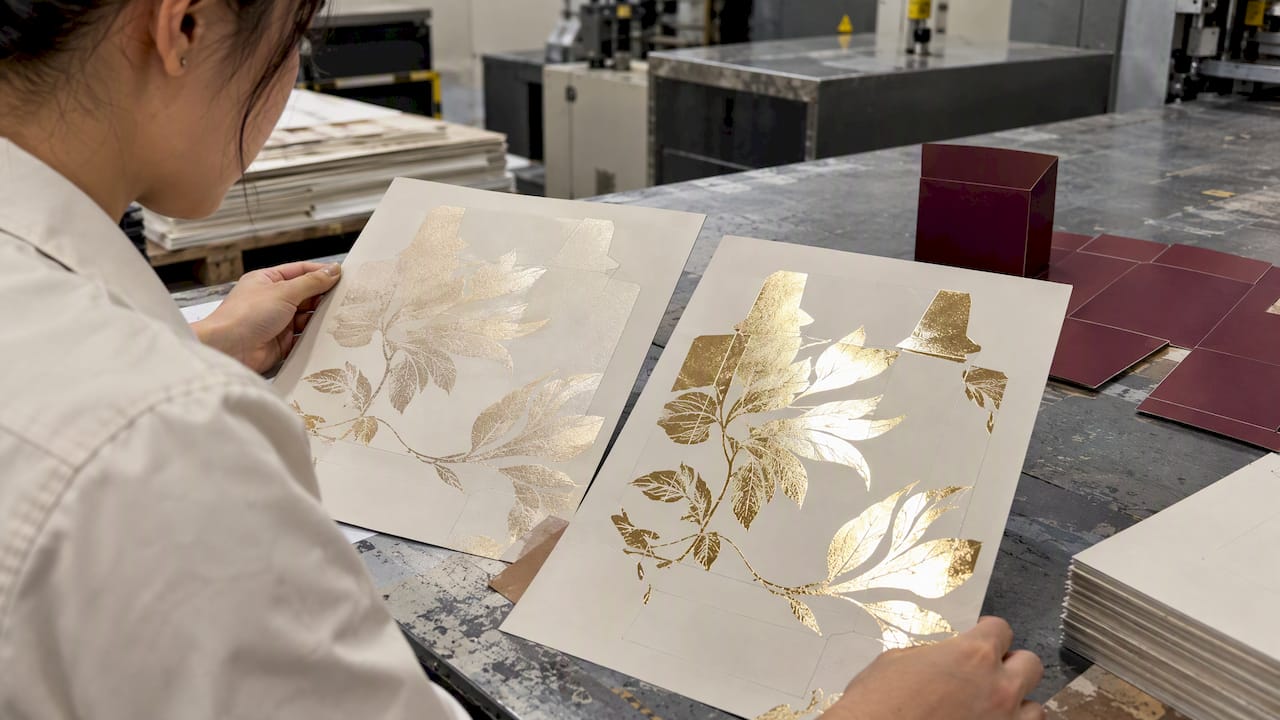
Metallic ink is a printed effect: tiny metal particles sit in the ink and give a soft, satin shimmer at a modest cost. Foil is a transferred effect: a thin metallic layer is pressed or bonded onto the surface, giving a brighter, mirror-like result that usually costs more and needs extra tooling. Choose ink when you want shine across large areas, gradients or a tighter budget. Choose foil when one logo, rim or edge has to look unmistakably premium. This guide explains how each method works, where each one fails, and how to decide for labels, cartons and rigid boxes.
TL;DR
- Metallic ink prints inline with your other colors and usually costs less. Its sheen is softer and depends heavily on stock, coverage and coating.
- Foil stamping gives the brightest, most reflective finish and holds up on dark and uncoated stocks. It adds a die, often a separate pass, and more cost.
- Cold foil is the label-world middle path: inline, faster and imaged without an engraved die, but it cannot match hot foil on texture and embossing.
- Embossing over metallic ink risks cracking it, so test first. If you want foil combined with a raised or sunken logo, plan a combination die.
- Recyclability depends on the construction, not only the method. Test the full label or carton with your recycling stream before you commit.
Table of Contents
- How metallic ink creates its shine
- How foil stamping and gold foil labels are made
- Metallic ink vs foil: side-by-side comparison
- Appearance and durability in practice
- Emboss, deboss and texture
- Where cold foil fits
- Metallized paper: the third route
- Recyclability and sustainability
- How to choose: a quick decision guide
- Our perspective
- Let us proof your finish
- FAQ
- Sources
How metallic ink creates its shine
Metallic inks contain small metal particles, typically bronze, aluminum, copper or zinc. As the ink dries, the particles migrate toward the surface in a process called leafing, and that is where the reflective effect comes from. Because the particles sit in a binder, the surface reads as a metallic color rather than a true metal skin.
The practical consequence is that metallic ink behaves like any other ink on the press. It is printed inline with the rest of the job on offset, flexo or digital equipment, while hot foil stamping is usually a separate finishing operation. One pass means fewer handling steps and no extra die for each artwork.
Three things decide how good the result looks:
- The substrate. A harder, less porous surface maximizes the metallic effect. Coated stock keeps the particles near the surface, while uncoated paper absorbs the vehicle and dulls the shine.
- Coverage and ink system. Sheen also depends on how the ink dries and how much is laid down: fast UV curing can dull the effect, and a dull or uncoated sheet may need two hits of ink for even color, so there is no single universal result.
- Protection. Leafing can let particles rub off, which a protective coating such as spot varnish or aqueous coating can address. Any coating changes the final sheen, so proof it with the coating applied.
If you are comparing how metallic ink performs across press types, our guide to offset versus digital printing for short runs shows how run length changes the economics.
How foil stamping and gold foil labels are made
Hot foil stamping is a dry process. It uses heat and pressure to transfer an image from a metal plate to the label substrate, using metallic or colored foil. A 2022 academic review describes it as a separate transfer step: a heated, shaped die presses the foil against the substrate and activates an adhesive, so the metallized transfer layer stays only in the shape of the die.
Two details matter when you specify it:
- Foil and substrate must match. The foil type and adhesive release factor have to be selected for the material, with die temperature and dwell time controlled for each job. Smoother coated stocks enhance reflection, while porous stocks may need a special foil formulation.
- It is often a separate pass. The same academic review notes that hot foiling normally takes place after color printing and is limited to roughly 6,000 to 8,000 sheets per hour because heat has to pass through the foil. On label presses, hot foil units can also run inline with printing.
The reward is the look. Gold foil labels, the form that most brand managers picture first, owe their glow to a continuous metallic layer rather than a pigment suspension. Hot foil can also be used on coated and uncoated paper, films, paperboard and many label types, which is why it shows up on everything from cosmetic jars to spirits bottles. For a closer look at production, see The Art of Foil Stamping.
Metallic ink vs foil: side-by-side comparison
| Factor | Metallic ink | Hot foil stamping | Cold foil |
|---|---|---|---|
| Look | Softer, satin sheen | Mirror-bright, highly reflective | Bright, but less reflective than hot foil |
| Process | Printed inline as a spot ink | Heated engraved die, often a separate pass | Inline, printed adhesive, no imaged die |
| Fine detail | Good, but fine reversed type can fill in | Crisp, but tiny type and close lines can fill in | Halftones possible, adhesive is printed like an image |
| Embossing | Can crack on a deep emboss; test first | Bonds well to embossed areas | Limited |
| Relative cost | Usually lowest | Usually highest, die and extra pass | Usually between the two |
| Dark or uncoated stock | Weaker | Holds up well | Best on smooth coated or film stock |
| Speed | Press speed | Slower, heat transfer limits it | Can run at very high press speeds |
A foil maker's primer puts the trade-off plainly: metallic inks can roughly mimic the effect of foil stamping, but foil stamping is more brilliant. Ink usually costs less because it needs no die or extra pass, although layout and coverage can narrow the gap, or even make foil the cheaper option. Treat the table as a starting point, because stock and coating can shift any row.
Appearance and durability in practice

Foil gives a mirror-bright, opaque finish that suits dark stocks and also works on uncoated ones, whereas ink produces a softer satin sheen. On a black rigid box lid, a foiled logo reads as polished metal, while the same logo in metallic ink can look like a pale gray-gold in some lights.
Metallic ink has its own strengths. Large solid areas are cheap to cover, gradients and halftones are possible, and the result is more even across a big panel. Foil on a high-friction edge can scuff if the adhesion is weak, which is why adhesion tests matter. We cover this in running adhesion tests before holographic foil stamping.
Pro tip: Ask for a press proof on the real stock with the real coating. A metallic ink swatch on a coated sample sheet tells you very little about a soft-touch laminated carton.
Emboss, deboss and texture
This is where the choice is often made for you. Embossing over printed areas is common in label work, but a deep or sharp emboss can crack a metallic ink film, so test it on the real stock, whereas foil adheres well to raised elements. Hot foil can create dimensional effects with a combination die that binds foil while forming an impression in the substrate. The academic review adds that deformation of the paper can create non-flat effects of high artistic value.
If your concept depends on a raised metallic crest or a sunken metallic wordmark, plan for foil. Our comparison of embossing versus debossing explains what each finish costs and which stocks suit them.
Where cold foil fits
For labels, cold foil deserves a serious look. It is an inline, faster and more cost-effective alternative to hot foiling: adhesive is printed on the label web and the foil is transferred without an imaged die. Hot foiling, by contrast, is more expensive and slower to prepare because it needs an engraved die and a controlled heat source.
Cold foil can run inline with very high-speed presses, and some cold foilers can create Cast and Cure effects by pressing a microtextured film into just-cured UV varnish, producing a diffracting surface. That is useful for holographic-style detail on pressure-sensitive labels.
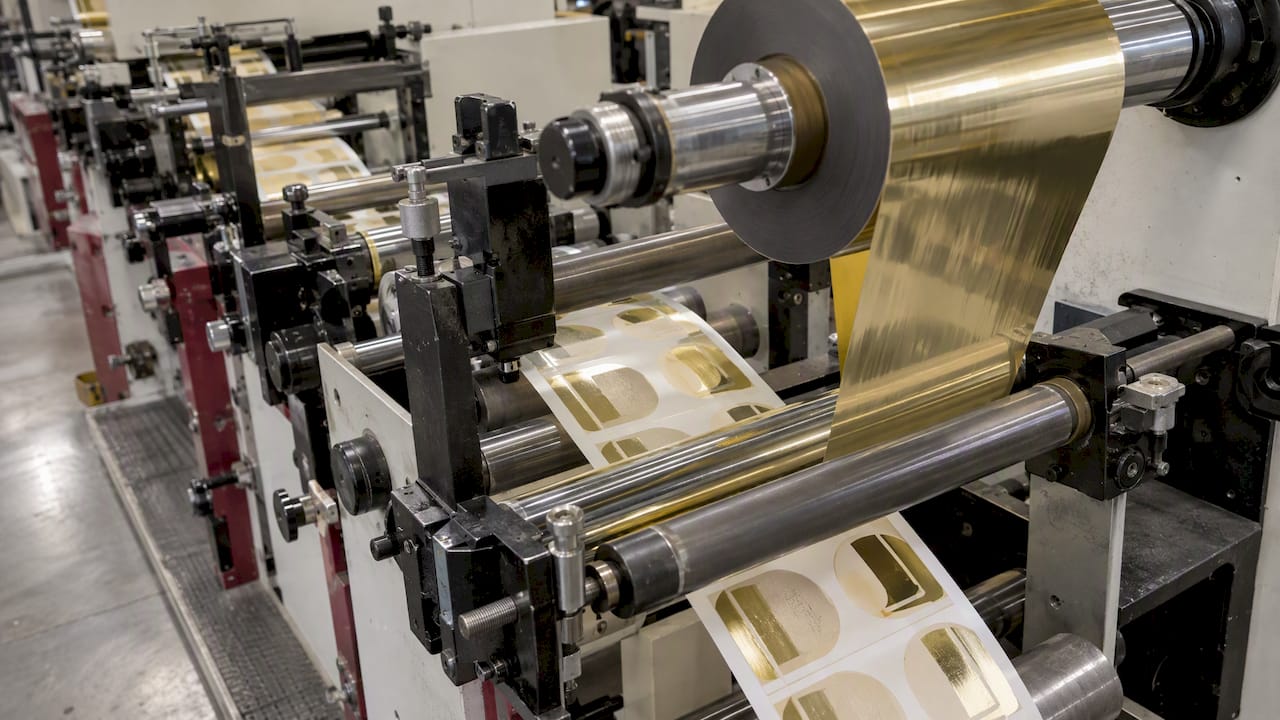
The trade-off is texture. Because the heated die irons the surface, hot foil can metallize rough substrates, and by deforming the paper it can create non-flat, 3D effects that cannot be produced inline with cold foil. For a deeper cost and recycling view, read our hot foil versus cold foil guide.
Metallized paper: the third route
Some brands skip both methods and print on metallized paper or board. Metallization is a thin aluminum layer deposited by physical vapor deposition, often applied to the substrate before printing, and printing on metallized surfaces often requires a primer before white or color inks. The whole sheet is metallic, so it suits designs where most of the surface should shine; keeping the metal to a single logo means covering everything else with opaque white. Recyclability also needs care, as covered below.
Recyclability and sustainability
The method matters less than the construction, but there are real differences.
- Process impact. Metallic inks require water wash-ups on press, whereas foil stamping is a dry process, and metallic foils require significantly less energy to produce than metallic inks, according to a foil manufacturer's primer. Treat this as a supplier's view and ask your printer for its own data.
- Paper and board. Hot-foil-stamped papers and paperboards can be recycled using conventional techniques. In the United States and Canada, fiber industry guidance reports that mills generally found no meaningful difference between foil treatments, but stamped foil tends to involve less foil and be less severe, while metallized films can be more problematic because their thin plastic backing is hard to separate.
- PET bottle labels. Avery Dennison's technical guide says metallic printed, metalized and metal-foil labels require testing to determine their recyclability category, and that the whole label construction must meet density and separation requirements.
- Flexible PE packaging. The Association of Plastic Recyclers states that metal-foil labels can make a PE flexible package non-recyclable, because they may trigger metal detectors or clog melt filters.
If recyclability is a claim on your pack, tell your printer before artwork is final. Avoiding full-coverage metallic films and limiting foil to small accents is the safest default.
How to choose: a quick decision guide
- Is there embossing or debossing on the metallic element? If yes, foil is usually the safer answer.
- Is the metallic area large? Large panels favor ink or cold foil for cost and consistency.
- Is the stock dark, textured or uncoated? Foil, especially hot foil, copes best.
- How tight is the budget and run length? Ink needs no die, so it suits shorter, cost-sensitive runs. Foil's die cost is spread more efficiently across larger quantities.
- Does the pack have a recyclability claim? Keep metallic area small and test the final construction.
- Is authenticity part of the message? Foil's recognizable look is used in certain categories to communicate authenticity, tradition and trustworthiness, which is why it is common on spirits and prestige beauty.
Often the best answer is both: metallic ink for a soft tonal background and a foiled wordmark as the focal point.
Our perspective
We have produced labels, rigid boxes and cartons for beauty, spirits and lifestyle brands for over 25 years, and the argument we hear most is ink against foil as if one must win. In our experience, the stronger designs assign each a role. Ink carries the color story across large surfaces. Foil marks the one place a hand should land first, such as a logo, a cap seal or a label rim.
We also see brands choose foil for the wrong reasons, then discover on a dark soft-touch laminate that adhesion needs testing, or choose ink for a premium spirits label and find it looks flat beside a competitor's foil. That is why we keep hand-finishing and automated production under one roof: the person who proofs your foil is the same team that runs your carton, so surprises show up at sampling, not at delivery. Our view is simple. Decide the finish with the stock, the coating and the recycling claim on the table together, and sample before you approve.
— Anthony
Let us proof your finish
If you are weighing these options for a label or box, we can sample ink, hot foil and cold foil on your actual stock. Our custom label printing covers pressure-sensitive labels with foil and embellishment options, and you can see the full range of packaging finishes and print effects before you brief us.
For spirits brands that also need security features, our anti-counterfeit labels combine decorative finishes with authentication. For beauty, the cosmetic label range is the place to start, and our rigid gift boxes take foil and embossing together. Browse everything on the products page or contact us through Yuan Packaging.
FAQ
Is metallic ink cheaper than foil?
Usually, yes. Metallic ink prints inline as a spot color and needs no die, while foil adds a die, adhesive or foil material and, for hot foil, often a separate pass. Exact savings depend on run length, coverage and stock.
Can metallic ink look like gold foil?
It can come close on coated stock with the right coating, but it rarely matches the mirror finish of foil. Ink gives a softer, satin sheen, and results vary with stock and coverage. For a gold foil label look on dark or uncoated stock, foil is the safer choice.
What is the difference between hot foil and cold foil on labels?
Hot foil uses heat, pressure and an engraved metal die, often in a separate pass. Cold foil prints adhesive on the web and transfers foil inline without an imaged die, making it faster and typically cheaper for label runs. Hot foil remains better for embossed and textured effects.
Can I emboss over metallic ink?
It can be done, but it is risky. A deep emboss can crack the ink and spoil the effect, so test it on your actual stock, whereas foil bonds well to embossed elements. If you want a raised metallic logo, ask for a foil and emboss combination die.
Are foil labels recyclable?
It depends on the construction and the stream. Foil-stamped paper and paperboard can generally go through conventional paper recycling, but metal-foil and metallized labels on plastic containers need testing and can be a problem for PE flexibles. Confirm with your recycler before making any claim.
Sources
- Metallic Inks: Unusual, Eye-Catching, Simple, Billerud
- Embellishments: foil stamping processes, Labels & Labeling
- Embellishments: embossing, Labels & Labeling
- Printing methods used in the label and package printing industry for the production of metallic embellishments with a focus on metal effect pigments, JPMTR 2022
- Hot Foil Stamping: Luxurious Brilliance, Unmistakable Quality, ITW Foils
- Categorically Embellished: An Embellishment Primer, WhatTheyThink
- Handbook on Decorative Technologies Applied on Rigid Plastic Packaging, RecyClass
- AD CleanFlake Technical Guide for PET Containers, Avery Dennison
- Design guidance for recyclability, AF&PA
- PE Flexible, Association of Plastic Recyclers
Recommended
- Packaging Finishes & Print Effects
- The Art of Foil Stamping: Elevating Packaging to Luxury
- Embossing vs Debossing: The Difference and What Each Costs
- Matte vs Gloss Lamination for Packaging: Glare, Color & Recyclability
Is metallic ink cheaper than foil?
Usually, yes. Metallic ink prints inline as a spot color and needs no die, while foil adds a die, adhesive or foil material and, for hot foil, often a separate pass. Exact savings depend on run length, coverage and stock.
Can metallic ink look like gold foil?
It can come close on coated stock with the right coating, but it rarely matches the mirror finish of foil. Ink gives a softer, satin sheen, and results vary with stock and coverage. For a gold foil label look on dark or uncoated stock, foil is the safer choice.
What is the difference between hot foil and cold foil on labels?
Hot foil uses heat, pressure and an engraved metal die, often in a separate pass. Cold foil prints adhesive on the web and transfers foil inline without an imaged die, making it faster and typically cheaper for label runs. Hot foil remains better for embossed and textured effects.
Can I emboss over metallic ink?
It can be done, but it is risky. A deep emboss can crack the ink and spoil the effect, so test it on your actual stock, whereas foil bonds well to embossed elements. If you want a raised metallic logo, ask for a foil and emboss combination die.
Are foil labels recyclable?
It depends on the construction and the stream. Foil-stamped paper and paperboard can generally go through conventional paper recycling, but metal-foil and metallized labels on plastic containers need testing and can be a problem for PE flexibles. Confirm with your recycler before making any claim.