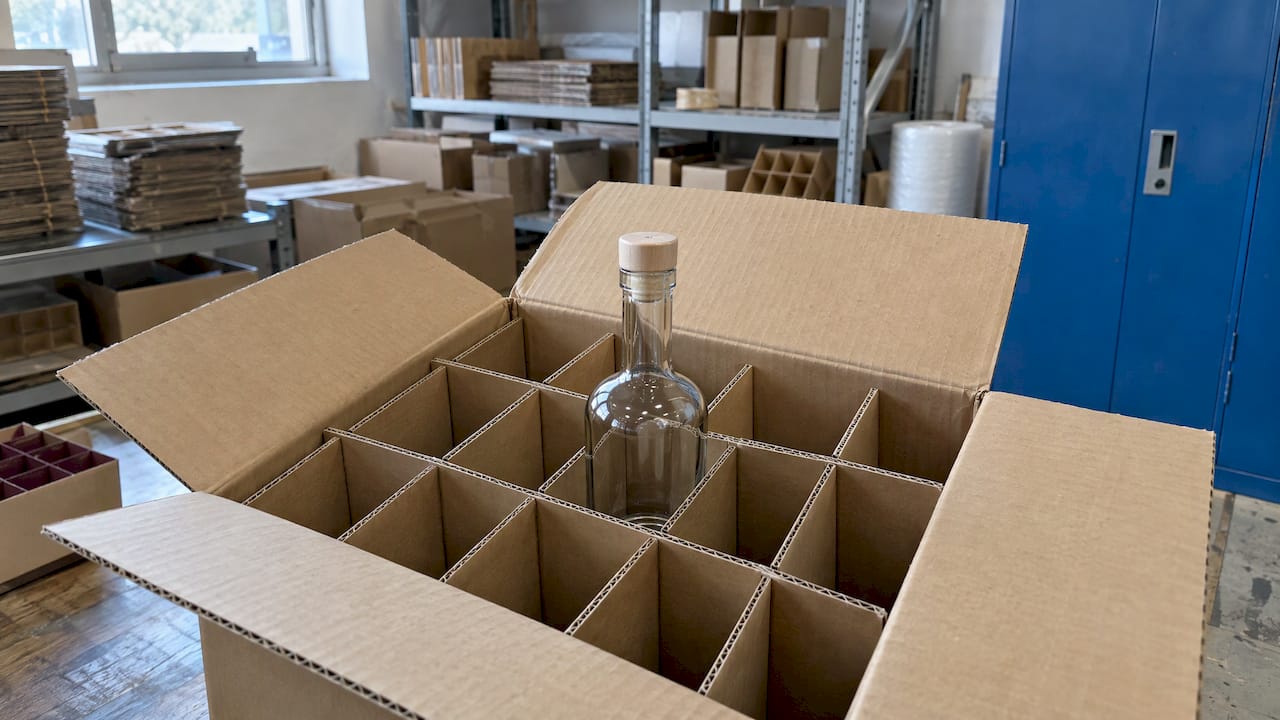
Protective bottle packaging has to do three jobs at once: stop glass from breaking, keep liquid in if it does, and arrive with the label and carton still looking like a premium product. For a beauty, wine, spirits or pharmaceutical brand, the best result comes from designing the carton, the insert and the label as one system around your specific bottle, then validating it with a drop test before you commit to a run. That is how we approach it at Yuan Packaging, where we manufacture rigid boxes, corrugated boxes and inserts, carrier bags and pressure-sensitive labels for bottled products.
TL;DR
- Glass fails from impact, bottle-to-bottle contact, vibration, compression and moisture. Packaging must control movement first and cushion second.
- Cell dividers, molded pulp or corrugated inserts, and a box-within-a-box structure outperform loose wrap such as a single layer of bubble wrap.
- Cushioning does not stop leaks. Add a sealed inner layer and absorbent material sized to the bottle's volume.
- Labels and printed cartons scuff in transit, so specify the label material and finish as part of the protective system.
- Fix the specification with a drop test on your actual bottle, shipped the way your customers will receive it.
Table of Contents
- What protective bottle packaging has to withstand
- Movement control: the principle behind every good structure
- Choosing the structure: five formats compared
- Match the insert to the bottle, not to a catalog
- Leakage is a separate problem
- The label is part of the protection
- Validate with a drop test before you order at scale
- Choosing by shipping route
- Recyclable and reusable choices
- A specification checklist for your next brief
- Our approach to protective bottle packaging
- Packaging built around your bottle
- FAQ
- Sources
What protective bottle packaging has to withstand
A bottle's journey is longer and rougher than most brand teams picture. A testing laboratory's list for food and beverage packaging covers impact or shock from manual and mechanical handling, vibration that scuffs labels, temperature and humidity extremes, top-load compression from stacking, pressure differences above 5,000 feet, and loss of cap torque. Each one maps to a design decision.
- Impact: a dropped carton or a bump on a conveyor. This is the threat cushioning is built for.
- Vibration: hours of truck or sortation movement that makes bottles rub against each other, the box walls and their own labels.
- Compression: pallets and parcels stacked on top of your carton. The outer board has to carry the load, not the glass.
- Humidity and temperature: swings that weaken board and stress closures.
- Leakage: a different failure from breakage, and one that cushioning alone does not fix.
One point from carrier guidance is worth building into every brief. DPD's packaging instructions say fragile goods like glass need a box that lines the bottom, top, sides and spaces between objects, so that friction, knocking and movement are prevented. The key idea is eliminating movement, not just adding padding.
Movement control: the principle behind every good structure
When bottles shift inside a carton, they hit each other and the walls. Separate every bottle from its neighbors and from the outer wall, and most breakage routes disappear. GOFO's packaging guide says bottles must be fully separated by dividers, individual cells or cushioning so they cannot move, collide or press against the outer box, and that glass should not rely on separation alone but also be protected against impact. It also calls for stronger corrugated board on multi-bottle shipments.
That gives you a simple two-layer model:
- Hold: a divider or cell that fixes each bottle in position.
- Absorb: a cushioning material or structure that takes the energy of a drop.
A structure that only does the second job lets bottles slide. A structure that only does the first transmits shocks straight into the glass.
Choosing the structure: five formats compared
| Format | Best for | What it does well | Watch for |
|---|---|---|---|
| Corrugated cell dividers | Multi-bottle cases, 6 or 12 per carton | Keeps every bottle apart, flat-packs before use | Needs correct cell size for the bottle diameter |
| Molded pulp or die-cut inserts | Single bottles and premium sets | Cradles the bottle's shape, fibre-based | Fit depends on bottle geometry |
| Box-within-a-box | High-value or fragile bottles | Inner box held inside a double-walled outer carton | More material and more pack-out time |
| Rigid shoulder-neck box | Gift and luxury presentation | Holds the bottle at the neck, premium unboxing | Usually shipped inside an outer carton |
| Carrier bag with bottle support | Retail hand-carry | Convenient and branded | Not a shipping solution on its own |
The box-within-a-box method is a good example of a spec you can copy. GOFO's guidance describes an inner box with moulded foam or bubble wrap inside a double-walled outer box with about 6 cm of clearance on all sides, plus corner or U-profile protectors on edges. It also warns against using a single layer of bubble wrap as the only protection for fragile glass.
Separators matter too. Packlink's bottle guidance asks for bottles packed individually, with separators at least 5 cm from the box borders, empty spaces filled and the box sealed with strong paper tape. It treats bubble wrap and newspaper as inappropriate packaging. Carriers set their own rules, so check the terms of the one you ship with.
For most brands, the practical route is a corrugated divider or insert inside a shipper, or a rigid shoulder-neck box inside a corrugated outer. You can see the structures we make on our corrugated inserts and dividers page and our shoulder-neck rigid boxes page. Our guide to box insert options walks through five insert types and the damage and waste each one is meant to cut.
Match the insert to the bottle, not to a catalog
A generic cutout is a compromise. Bottles differ in height, shoulder shape, neck length and weight, and each changes how the glass behaves in a drop. A tall, narrow wine or spirits bottle carries its weight high, so it sways more than a squat jar in the same cutout. The cushioning should therefore hold the shoulder and neck zone, not only the base.
When you brief an insert, supply:
- A bottle drawing or physical sample, including diameter tolerance. Glass is not made to the millimeter, so cells need room for the range.
- Fill volume and closure type (cork, screw cap, stopper, pump).
- Number of bottles per carton and the target carton dimensions.
- Shipping method: parcel, pallet, or a mix.
- Whether the carton also has to look good on a shelf or in an unboxing.
The last point decides whether you need a shipper only or a presentation box as well. Many of our wine, spirits and beauty clients need both, which is why we make the retail-facing box and the corrugated outer in one program. Our wine and spirits packaging guide covers how labels, boxes and carriers fit together.
Leakage is a separate problem
A bottle can survive the trip and still arrive wet. Wine-logistics research explains that temperature changes, vibration and humidity each stress corks, gaskets and screw caps, and that cardboard loses bending stiffness as relative humidity rises past 70%. Insulation liners are one way to limit temperature swings on long journeys.
For containment, GOFO's guidance asks that each liquid container be sealed individually and placed in a leak-proof inner bag or equivalent secondary containment, with absorbent material inside the box. Build this into your spec as its own line item:
- Check the closure is secure and the seal is intact before packing.
- Place each bottle in a sealed inner bag or sleeve.
- Add absorbent material sized to the bottle's liquid volume, with some margin, and more for multi-bottle cartons where two bottles could break together.
- Choose outer board that resists humidity for your route.
This matters for pharmaceutical and cosmetic liquids too. A leaking serum or tincture ruins the printed carton, the leaflet and the labels along with the product.
The label is part of the protection
Most guides on this topic stop at the box. For a brand, the label is the first thing the customer sees, and vibration inside a carton is exactly what scuffs it. A packaging test lab lists vibration-induced label scuffing among the hazards a beverage package must be designed for.
That changes how you specify labels for bottles that ship:
- Dividers that do not rub the label panel. Cells and inserts should hold the bottle at the glass, not drag across a foil-stamped or embossed area.
- A finish chosen for abrasion. Soft-touch lamination, foil stamping, embossing and spot UV all give different surface behavior. Decide with the shipping route in mind, and test the finished label in the final carton.
- Label material and adhesive matched to the glass and the conditions. Condensation, cold chain or humidity change what holds. Our pressure-sensitive label specification guide covers materials and adhesives.
- Neck and shoulder labels placed with the insert in mind. The neck is where a shoulder-neck box or cell holds the bottle, so a neck label needs to sit clear of the contact points. Our neck label design guide helps with placement.
For wine and spirits, our wine labels are made as pressure-sensitive labels, and the wine label guide lists required information, materials and printing options. If you need textured stocks, see our guide to textured paper labels.
Validate with a drop test before you order at scale
A structure that looks right on paper can still fail in a drop. Treat a test as part of the specification, not an afterthought. Run it on the finished pack: real bottle, real fill, real label, real carton.
A useful test plan varies three things: drop height, bottle orientation (base-down and side-on, for example) and the cushioning option. Compare results, not opinions. Look at the glass, the closure, the label and the carton after each drop. Record where failures start, because the pattern tells you whether to change the cell, the board or the fill.

Our article on drop test packaging covers standards, heights and pass criteria in more detail. Agree the pass criteria with your packaging maker before samples are made, so everyone is judging the same outcome.
Choosing by shipping route
The same bottle needs different protection depending on how it travels.
Parcel and e-commerce. Automated sortation means bottles get dropped, tipped and compressed. Use individual cells, an inner sleeve or bag with absorbent, and a sturdy mailer or shipper. Our e-commerce mailers are built for this kind of journey.

Pallet and trade shipments. Compression strength matters most. Stronger board and good pallet loading protect the glass from stacking loads. Retail-ready formats can help here too: see our retail-ready corrugated packs.
Retail and gifting. The bottle leaves the shelf in a hand. A rigid box protects at the point of sale, and a bottle carrier bag completes the experience. Our bottle and gift set carrier bags are designed for that moment.
Long-distance export. Long transits mean more handling, more climate change and more time in humidity. Specify moisture-resistant board, containment for liquids and a drop test that reflects the route.
Recyclable and reusable choices
Fibre-based structures such as corrugated dividers and molded pulp inserts fit most brands' sustainability goals, and customers increasingly expect them. Recyclability is more than a claim. ALDI's international recyclability guidelines define it as packaging that can be collected separately, sorted into dedicated streams, processed with proven recycling methods and turned into material that replaces primary raw material.
In Europe, regulation is moving the same way. The EU Packaging and Packaging Waste Regulation came into force on 11 February 2025 and requires all packaging placed on the European market to be recyclable by 2030, graded A, B and C. If you sell into the EU, ask your supplier to specify mono-material, easily separable components.
For glass itself, the same design-for-recycling guidance notes that glass can be melted down an unlimited number of times, that standard transparent, green or brown colors are preferred, and that fully colour-coated containers can interfere with sorting. Decoration by engraving or wet-strength paper labels is preferred. That is useful when you choose label stock for a bottle you want to be recyclable. We can supply packaging with options such as FSC certification when your brief requires it.
A specification checklist for your next brief
Use this when you request a quote:
- Bottle drawing or sample, with glass tolerance
- Fill volume, closure type and liquid (still, sparkling, spirit, oil, serum)
- Bottles per carton and target carton size
- Shipping route, humidity and temperature exposure
- Required drop height and pass criteria
- Containment requirement: inner bag, sleeve, absorbent
- Label material, finish and placement relative to contact points
- Sustainability needs: FSC, recyclability, mono-material
- Retail presentation needs: rigid box, carrier bag, shelf-ready pack
Our approach to protective bottle packaging
We see protective packaging as part of the brand experience, not a cost you add at the end. A bottle that arrives intact, with a crisp label and a box that opens well, tells the customer you cared about every detail.
That is why we think the bottle, the label, the insert and the carton should be specified together. When one supplier produces the labels, the rigid boxes, the corrugated outers and the carrier bags, the fit between them is designed in, not patched afterward. It is the atelier approach we apply to every project, with expert guidance from concept to finished product.
Our advice is to bring your bottle early. Share the glass, the closure, the route and the finish you want on the label, and let the structure be built around them. Then test it.
Anthony
Packaging built around your bottle
We are a custom packaging manufacturer in Huai'an, China, with over 25 years of experience and more than 100 million units delivered to more than 5,000 brands. Our range covers corrugated and e-commerce boxes, rigid gift boxes, carrier bags and pressure-sensitive labels for cosmetics, wine, spirits, pharmaceuticals and gourmet food. Send us your bottle and your requirements through the Yuan Packaging site and we will work through the right structure with you.
FAQ
What is the best protective packaging for glass bottles?
The most dependable approach separates each bottle in its own cell or insert, cushions it, and places the whole assembly inside strong corrugated board. For fragile or high-value glass, a box-within-a-box with clearance on all sides adds another layer. Single wraps of bubble film alone are not enough.
How do I stop bottles from leaking in transit?
Seal each bottle in an inner bag or sleeve and add absorbent material inside the carton. Check the closure before packing, and choose board that holds up in humid conditions. Cushioning prevents breakage, but containment is what protects the rest of the shipment if a bottle does fail.
Is a case of wine 6 or 12 bottles?
Both are standard. Wine is commonly sold and shipped in cases of 6 or 12, and the choice changes carton size, weight and divider layout. Tell your packaging maker the count early, since stronger board is needed as the load grows.
Can I protect the label as well as the glass?
Yes. Specify dividers that hold the bottle without rubbing the label panel, and pick a label material and finish suited to the route. Test the finished pack so you can see any scuffing before full production.
Sources
- Food & Beverage Packaging Testing, Westpak
- Packaging instructions, DPD (2023)
- Packaging Guide, GOFO (July 2026)
- Sending bottles with Packlink, Packlink Help Center
- Preventing bottle leaks, Hillebrand Gori
- ALDI International Recyclability Guidelines
- For Recycling: design guidance and PPWR 2025 to 2035, World Packaging