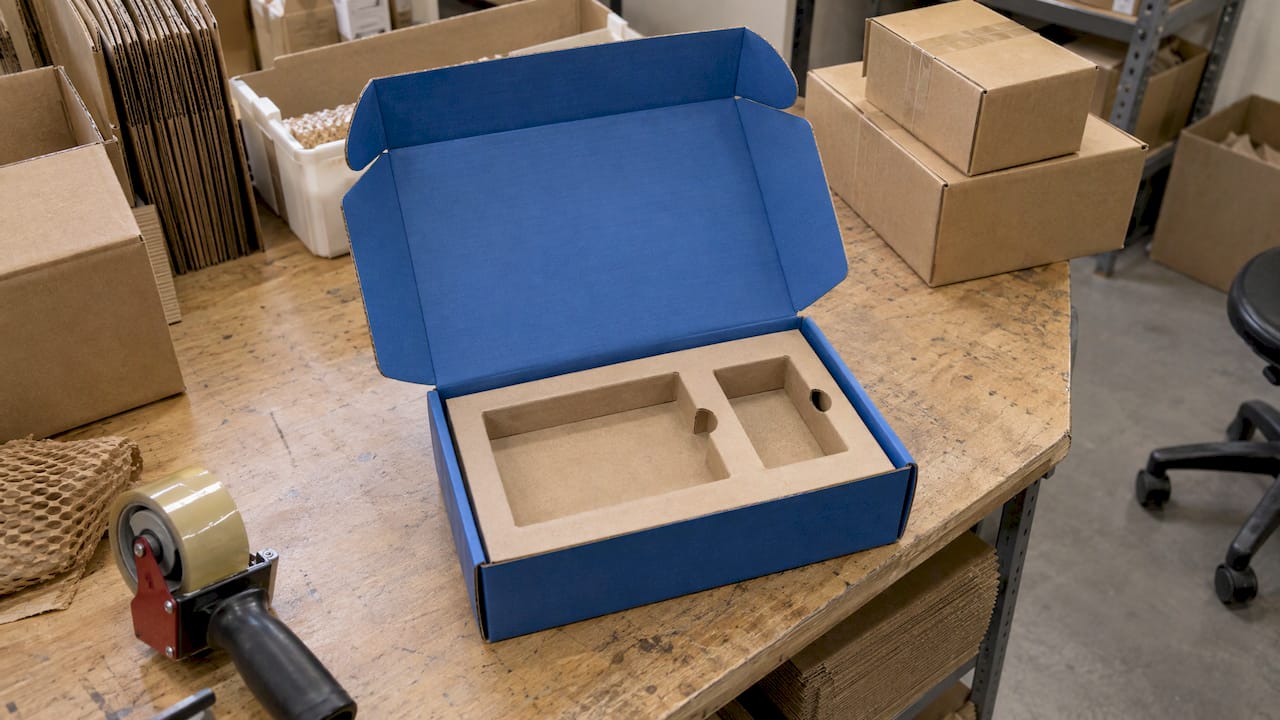
Good subscription box packaging does three jobs at once: it gets the contents to the door intact, it makes the monthly opening feel like a branded moment, and it can be reordered at the same quality every cycle. The strongest route is to specify the structure, print and finish together with one manufacturer, so the box that is tested for shipping is the same box that is designed for unboxing. At Yuan Packaging we make corrugated and e-commerce boxes and rigid gift boxes to your specification, with guidance from concept to finished product.
This guide walks through the decisions in the order you will face them: what the box has to do, how to choose size and structure, how to protect the contents, which finishes earn their cost, and what drives price, minimums and lead time.
TL;DR
- Subscription packaging is a repeat touchpoint, so design for the fifth delivery as well as the first.
- Choose the structure by how the box travels: a corrugated mailer for parcel networks, a rigid box for a gift or collector-grade tier.
- Set the shipping test level from product value, acceptable damage rate, volume and shipping environment, then size the inserts to it.
- Spend on finishes where the customer's hands and eyes land first: the lid, the inside reveal and the seal.
- Unit cost depends on size, board, print coverage, finishes and quantity, so send a full specification with your request for quote.
Table of Contents
- What subscription packaging does beyond holding products
- Choose the structure by how the box travels
- Inserts and dividers: where protection and presentation meet
- Protecting the contents in transit
- Print, finishes and labels that make the reveal
- Materials and sustainability claims
- Cost, minimums and lead time
- Plan the launch backward from the ship date
- Promo: your subscription box, made to specification
- Our perspective
- FAQ
- Sources
What subscription packaging does beyond holding products
A one-off order is opened once. A subscription box is opened every month, which changes the brief. Britt Martin, cofounder of Food Period, put it this way: packaging is the first physical touchpoint with a new customer and the continued touchpoint with a subscriber, and such touchpoints are rare in a digital world.
There is evidence that the moment pays back. A 2025 AfterShip study, as reported by D2C Times, found that customers who called their unboxing memorable repurchased at a 22% higher rate within 90 days than those who called it fine. It also found that 41% of those customers shared the unboxing on social media without being asked.
So the box has three roles:
- Protection. The contents arrive in the condition you promised.
- Presentation. The reveal sets the tone for the brand. GrowthSpoke describes the unboxing as the physical form of a subscription brand's promise, and notes that details such as straight stickers and uncrumpled tissue are what customers notice.
- Repeatability. The same box, at the same quality, month after month, across every production run.
That third role is why the manufacturer matters. A box that looks right in one sample but drifts in color or fit across runs weakens the ritual you are building.
Choose the structure by how the box travels
Start with the shipping route, not the artwork. Three structures cover most subscription programs.
| Structure | Best for | What it gives you |
|---|---|---|
| Corrugated mailer | Parcel shipping, monthly boxes, mixed contents | Strength in transit, printed inside and out, efficient flat storage |
| Rigid box (drawer, book-style, shoulder-neck) | Premium tiers, gift subscriptions, beauty and spirits | Collector-grade feel, a reusable box the customer keeps |
| Folding carton in an outer shipper | Individually packed items inside a larger shipper | Branded unit packs with a protective outer case |
Corrugated mailers for the monthly shipment
If the box rides through parcel networks, a corrugated mailer is the working choice. Our e-commerce mailers are made for exactly this route, and regular slotted cases suit larger or heavier shipments packed on a line. Our guide to e-commerce box design covers structure, print and protection in more depth.
Rigid boxes for the premium tier

When the box is part of the product, as with a quarterly collector edition, a beauty discovery set or a wine club gift, a rigid construction changes how the contents are received. Drawer boxes create a slow, staged reveal. Book-style hinged boxes open like a cover and present the contents as a collection. Shoulder-neck boxes give a lid-lifting moment suited to fragrance and spirits. For the packing, ship a rigid box inside a corrugated shipper so the finished surface arrives untouched.
Sizing the box
Measure the packed contents, not the product list. Add the thickness of the insert walls and any tissue or paper fill, then confirm the flat dimensions fit the parcel size band you plan to ship in. Two rules save money later:
- Keep the footprint stable. If next month's product is a different shape, a stable outer size lets you change only the insert.
- Leave room for the reveal. An overstuffed box opens badly and an underfilled box rattles. Design the insert so the hero item is seen first.
Inserts and dividers: where protection and presentation meet
Inserts do the quiet work. They hold each item in a fixed position, stop movement that causes scuffs, and set the order in which the customer discovers the contents. Our corrugated inserts and dividers are cut to the product set, so a bottle, a jar and a card each sit in their own place.
When specifying an insert:
- List every item with its dimensions and weight, including the heaviest and the most fragile.
- Decide the reveal order: which item the customer sees when the lid opens.
- Plan for variation. If contents rotate monthly, choose a divider layout that can flex, or a modular insert you swap.
- Prototype with real products, not dummies, and shake the box.
Protecting the contents in transit
The right level of protection depends on what is inside and how far it travels. The standard reference for evaluating a packed shipment is ASTM D4169, which simulates the transit hazards of vibration, shock, compression and moisture. The same source notes that testing intensity should reflect product value, acceptable damage levels, shipping volume and shipping environment.
Turn that into four questions for your program:
- Value. What does a damaged box cost you in the product, the replacement shipment and the cancelled subscription?
- Acceptable damage. Set the target before you design, not after the first complaints.
- Volume. A program shipping thousands of boxes a month meets rough handling statistically, even if each single box is only rarely hit.
- Environment. Humid climates, long routes and several handoffs raise the demands on board grade and inserts.
A practical sequence: build the prototype, pack it with the actual contents, run a transit simulation appropriate to your parcel route, then adjust the board, insert or fill and repeat before you approve the production run. Share the result with us at the quote stage so board grade, flute and insert design are set to it from the start.
Print, finishes and labels that make the reveal
Finishes are where a subscription box becomes recognizable. Use them with a plan, because every finish adds a step to production. Our production range covers foil stamping, embossing, spot UV and soft-touch lamination.
| Finish | Effect | Where it works best |
|---|---|---|
| Foil stamping | Metallic highlight on logo or pattern | Lid, brand mark, edition numbers |
| Embossing | Raised relief you can feel | Logo on rigid lids, subscription tier marks |
| Spot UV | Gloss contrast against a matte ground | Pattern or product name on a soft-touch surface |
| Soft-touch lamination | Velvety, matte hand feel | Full outer surface of premium boxes |
Print the inside
The outside identifies the brand to the courier. The inside is the part the customer opens on camera. Printing the inner lid with a message, a pattern or the month's theme gives you a reveal at a modest additional cost compared with adding more components. This is also what makes a box shareable: GrowthSpoke argues that a box that is not ready for Instagram or TikTok leaves free organic reach on the table.
Labels as the flexible layer
A printed box can stay constant while labels change each cycle. A pressure-sensitive label can carry the month's edition, a batch number or an allergen panel, and a premium textured paper stock adds a tactile cue to bottles, jars and tins. For wine and spirits clubs, our wine labels follow the same approach: one label system, rotating artwork. For high-value contents, anti-counterfeit labels can protect the brand.

Seals and extras
A branded seal sticker, a ribbon pull or a card slot costs little and tells the customer the box is to be opened with care.
Materials and sustainability claims
Subscription boxes ship in volume, so material choices show up in your environmental footprint and, increasingly, your regulatory exposure. We can supply paper-based packaging with certifications such as FSC where your specification calls for it.
A few principles apply whichever market you ship to:
- Right-size the pack. In the UK, packaging rules require the minimum adequate weight and volume for safety, hygiene and consumer acceptance, and it must be designed to permit reuse or recovery, including recycling. Smaller boxes also ship for less.
- Think about components. Under UK recyclability guidance, parts that separate easily by hand are assessed separately, while parts that can only be split by tools or machinery are assessed together. A mailer with a glued-in insert and a mailer with a loose paper insert are not the same case.
- Keep records. The same UK guidance asks obligated producers to keep their assessment records for seven years.
- Check the rules where you sell. The UK examples above are the UK's rules, not universal ones. For U.S. shipments, see our packaging EPR compliance plan, and for chemical restrictions in materials and inks, REACH versus RoHS.
When you make an environmental statement on the box, tie it to a specific, documented material and certificate, and keep that paperwork on file.
Cost, minimums and lead time
There is no honest single price for custom subscription packaging, because the price is the sum of choices. These factors move it most:
- Size and board. A larger flat sheet and a heavier board cost more per unit.
- Print coverage. Inside and outside print, and the number of colors, add to setup and run cost.
- Finishes. Each of foil, embossing, spot UV and soft-touch lamination is an added process.
- Inserts. Custom-cut dividers are an extra component with their own tooling.
- Quantity. Setup costs spread over more units, so unit cost falls as the run grows.
- Number of versions. Several artwork variants reduce the benefit of a single large run.
We do not publish a price list, because each project is specified and quoted individually through a request for quote. Lead time follows the same logic: a plain printed mailer moves through production differently from a rigid box with several finishes, and sampling is an added step you should plan for.
What to include in your request for quote
- Box type and internal dimensions, or the list of contents with their sizes.
- Board or paper preferences, and any certification such as FSC.
- Artwork status and the areas to print, inside and outside.
- Finishes wanted.
- Insert needs, with the items they hold.
- Quantity for the first run and the expected annual volume.
- Destination markets and shipping route.
- Your target delivery window, counted back from your first ship date.
With that list, a quote is accurate the first time rather than revised three times.
Plan the launch backward from the ship date
A subscription launch has a fixed date: the first box has to land when you promised. Work backward from it.
- Ship date. Fix it, then add buffer for transit from the factory to your fulfillment site.
- Production. Allow for the run itself and the quality checks on the finished goods.
- Sampling and approval. Reserve time for at least one physical sample and a transit test.
- Artwork and dielines. Finalize the layout on the factory's dieline before final art.
- Specification. Settle structure, board, finishes and inserts at the start, because changes late in the process are the usual source of delay.
For seasonal editions, such as holiday and gifting boxes, treat the first quarter of the year as the time to specify, not the autumn.
Promo: your subscription box, made to specification
If you are ready to move from concept to production, we can build the box as one system: the corrugated mailer or rigid box, the cut inserts, the printed finishes and the labels that change each cycle. With more than 25 years of experience and 100 million units delivered to over 5,000 brands, our work is aimed at consistent quality across repeat runs.
Send your specification through our corrugated and e-commerce box page for a mailer, or see our full product range to compare rigid boxes, cartons, bags and labels.
Our perspective
Brands often start a subscription program by choosing the artwork and leave the structure for later. We would reverse that. The box is a repeat ritual, and a ritual depends on things working the same way every time: the lid lifts cleanly, the insert holds each item, the finish feels the same in month twelve as in month one.
That is why we treat the box, the insert and the label as one project. Atelier-level craftsmanship and precision production matter most when the order is large and has to be repeated. A soft-touch surface, a foil mark and a carefully cut divider are small details, but together they make a small ceremony of an ordinary delivery.
Our advice: decide the shipping route first, choose the finishes second, and bring us the full specification early. Expert guidance from concept to finished product exists so that the choices you make on day one still hold on the day the thousandth box ships.
Anthony
FAQ
What is the best box type for a subscription service?
For parcel shipping, a printed corrugated mailer is the usual working choice because it combines strength with printable surfaces inside and out. For a premium or gift tier, a rigid drawer or book-style box gives a collector-grade reveal, packed inside a corrugated shipper. Choose by the route the box travels and the experience you want to create.
How do I make a subscription box feel premium without a huge cost?
Concentrate the finish budget on a few touchpoints: one foil or embossed brand mark on the lid, a printed inner lid, and a branded seal. Keep the outer footprint stable and rotate labels or inserts instead of reprinting the whole box. This gives each delivery a fresh look while the main box stays a single repeat order.
How do I know the box will protect the contents?
Pack a prototype with the real contents and test it against your shipping route. ASTM D4169 is the standard that simulates vibration, shock, compression and moisture, and the intensity is set by product value, acceptable damage, volume and environment. Share the outcome with us so the board and insert are specified to it.
What should I send for a quote on custom subscription boxes?
Send the box type, internal dimensions or product sizes, material and certification needs, artwork status, finishes, inserts, first-run quantity and annual volume, destination markets and target delivery window. A complete specification lets the quote reflect your real requirements, including the sampling step.
Can I change the contents each month without reordering the box?
Yes, if you design for it. Keep the outer size constant, use a flexible insert layout or a swappable insert, and put the changing information on labels or a printed card. The box stays a stable repeat order while each shipment still feels new.
Sources
- 7 Subscription Box Trends You Need to Know About, GrowthSpoke
- ASTM D4169, Smithers
- Composition and use of packaging, London Borough of Bromley
- Recyclability assessment methodology: supplementary guidance, GOV.UK