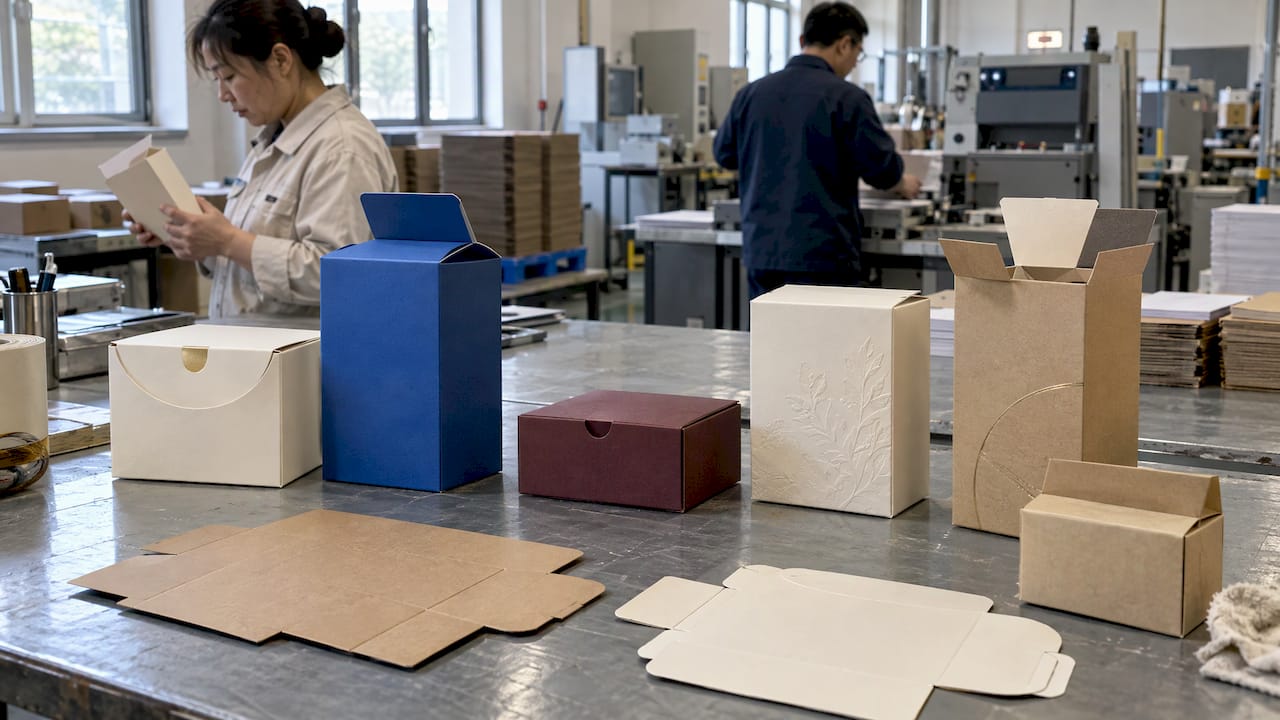
Folding carton packaging is printed paperboard that is cut, creased and shipped flat, then folded into a box at the point of filling. For luxury beauty, spirits, pharmaceutical and gourmet brands, the right carton comes from four decisions made in order: the structure, the board, the print and finish, and the regulatory copy. We make custom folding cartons for these categories, and this guide walks through each decision the way we would brief it with your team.
TL;DR
- A folding carton is flat-packed paperboard, printed, die-cut and creased, then folded and glued or locked into shape. It stores and ships flat, which keeps freight and warehouse costs down.
- Choose the style first (tuck end, window, reverse tuck, and so on), then the board. Board grade, thickness and construction decide protection and how well print and finishes look.
- Smooth bright board suits detailed print and foil. Stiffer layered board suits heavier or larger products.
- Pharmaceutical cartons carry mandatory copy and tamper-evidence rules that differ by market, so lock them into the dieline before artwork starts.
- Send your RFQ with product dimensions and weight, board preference, finish list, quantities and destination markets.
Table of Contents
- What a folding carton is and how it is made
- Choosing a carton style
- Folding carton materials and board types
- Printing and finishes that make a carton read as luxury
- What each category should specify
- Sustainability and what is changing in the market
- What drives folding carton cost
- From brief to finished carton: a practical checklist
- Our approach to folding cartons
- Start your carton project with us
- FAQ
- Sources
What a folding carton is and how it is made
A folding carton starts as a flat sheet of cartonboard. Pro Carton's folding carton module describes cartonboard as a material that can be printed, cut, creased and erected into many shapes by folding, gluing and interlocking. That combination is why the format is so common in retail: one material carries your brand artwork, protects the product and arrives at your filling line as a stack of flat blanks.
The production sequence is simple to describe and unforgiving in detail:
- Print the artwork on the sheet or web.
- Finish the surface: foil, embossing, spot UV, soft-touch lamination.
- Die-cut and crease the shape, including the fold lines.
- Fold and glue side seams, or leave the blank flat for your packing team to erect.
The dieline, the flat technical drawing of cuts and creases, ties these steps together. A finish placed too close to a crease can crack when the carton folds, which is why artwork and structure should be reviewed together. Our guide to folding carton design, dielines and specs covers the drawing in more depth.
Choosing a carton style
Style decides how the box opens, how it sits on a shelf and how much protection it gives. Pro Carton's module lists a wide range of possible structures: double-thickness or cavity walls, hinged lids, windows, handles, pourers, internal platforms, tapered panels, leak-proof or sift-proof corners and non-rectangular shapes. In practice, most luxury projects start from a few families.
| Style | Best for | What to know |
|---|---|---|
| Tuck-end carton | Serums, creams, perfume, supplements, chocolates | The workhorse. Closes with tucked flaps, ships flat, suits fast filling lines. |
| Window carton | Gourmet food, cosmetics where color or texture sells | A die-cut opening shows the product. Plan the window position against the fold lines. |
| Reverse tuck | Retail products hung or stacked on shelves | Flaps open in opposite directions, which changes how the front panel reads. |
| Sleeve or tray with insert | Gift sets, spirits miniatures | An insert holds the product in place and adds protection. |
When a product needs more than a flat panel can offer, such as a heavy bottle or a gift set, consider whether a folding carton with an insert is enough or whether a rigid box fits better. We make both, so the decision can follow the product rather than the supplier's range.
Folding carton materials and board types
Board choice shapes how the carton feels in the hand, how sharp the print looks and how well it protects. Pro Carton's module notes that protection depends on the product and on how it is packed, distributed and used, and that board grade, grammage (weight per square meter), thickness, closures and double- or cavity-wall construction all affect performance.
Two boards dominate premium work:
- SBS (solid bleached sulfate): a smooth, bright white surface. A 2025 technical comparison of SBS and FBB says SBS suits detailed print and finishing.
- FBB (folding boxboard): a layered construction that the same comparison says can deliver higher stiffness at a given grammage, useful for larger or heavier packs.
Recycled and kraft boards are the other common choices, often paired with natural-look brands and sustainability programs. If you need a certified fiber source such as FSC, state it in the RFQ. We can meet specific requirements such as FSC certification.
Barriers and coatings
Some products need more from the board than good looks. Pro Carton's module points out that barriers or laminations may be needed for heat, water, moisture or grease resistance, or for product release, especially where the product touches or sits close to the board. That matters for chocolate, oily balms, candles and anything chilled. Tell your supplier what the carton will touch and under which conditions it will be stored, and the right board and coating follow from that.

Printing and finishes that make a carton read as luxury
Plain printed cartons communicate information. Finished cartons communicate value. The options we produce include foil stamping, embossing, spot UV and soft-touch lamination, and each does a different job:
- Foil stamping: metallic effect for logos and key lines. Pro Carton's module describes metallic effects achieved through printing, foil lamination or hot and cold foil. Our foil stamping guide explains how to prepare artwork for it, and metallic inks vs foil helps you choose between the two.
- Embossing: the same module describes surface texture from embossing. A raised monogram or pattern gives a carton a tactile identity that survives in photos and on shelf.
- Spot UV: a gloss varnish on selected areas, strongest against a matte or soft-touch ground.
- Soft-touch lamination: a velvety matte surface that reads as premium the moment it is picked up.
You can see the full range on our finishes page. A useful discipline: pick one hero finish and one supporting finish. Foil on the logo, embossing on a pattern and spot UV on an icon together can compete rather than build.
Pro Tip: Ask for finish samples on the same board you will order. The same foil can look different on a smooth SBS sheet and on a textured kraft sheet.
What each category should specify
Luxury beauty
Shelf presence and the unboxing moment lead. Specify a smooth white board, soft-touch lamination and one or two metallic or embossed details. Make sure the carton fits the primary container tightly enough that it does not rattle, and think about whether an insert is needed for glass.
Spirits and wine
Cartons for bottles and gift sets need strength as well as style, because the product is heavy. Consider stiffer board or a carton with a supporting insert, and coordinate the carton with the bottle label so the whole pack tells one story. Our guides to wine and spirits packaging and premium spirits label printing show how label, carton and carrier bag work together, and our wine labels are produced to match.
Gourmet food
Seasonal gifting means artwork changes each year while the structure stays the same. Keep one dieline and change the print, finishes and window to refresh the line. Check grease and moisture exposure early, as above, and plan production well ahead of your peak season.
Pharmaceuticals
Here the carton is a regulated document as much as a package. The details depend on where the medicine is sold:
- United States, over-the-counter drugs: under 21 CFR 211.132, most OTC products for retail sale that the public can reach while on the shelf must use tamper-evident packaging with indicators or barriers that show visible evidence of tampering. Retail packages generally must prominently identify the tamper-evident feature. Dermatological, dentifrice, insulin and lozenge products are excepted.
- European Union, human medicines: Directive 2001/83/EC, Article 54 requires specified information on the outer packaging, including the medicine name, active substances, route, expiry, storage, warnings, authorization holder and batch number. Under Article 63, the text generally has to appear in the official language or languages of the member state where it is marketed, and identical text in several languages is allowed.
Because the carton must hold all of this legibly, structure and copy have to be planned together. Our guide to pharmaceutical carton requirements covers Braille, FMD and leaflets. For final regulatory wording, your regulatory affairs team or the relevant authority has the last word.
Sustainability and what is changing in the market
Paperboard has a strong sustainability case: renewable wood fiber, recyclability and circularity. PostPress's March 2026 industry report also notes that barrier and coating innovations have to perform without compromising recyclability or compostability, and that plants are consolidating several older machines into integrated roll-to-carton systems to cut handoffs and downtime.
If you sell into the EU, packaging rules are tightening. According to European Commission guidance in EUR-Lex, the Packaging and Packaging Waste Regulation (EU) 2025/40 entered into force on February 11, 2025 and generally applies from August 12, 2026. The same guidance places the recyclability requirement for packaging on the EU market from that date, with harmonized design-for-recycling criteria from January 1, 2030, or 24 months after the relevant delegated act if that is later. In practice, choose coatings and laminations with recycling in mind. We summarize what this means for printers in our PPWR briefing.

What drives folding carton cost
There is no single price for a custom carton, because the quote follows the specification. The factors that move it most:
- Quantity. Tooling and setup are spread across the run, so larger runs lower the unit cost.
- Board. Grade, grammage and any coating or barrier.
- Finishes. Each added process adds a step. A single well-placed foil is often more effective than several effects.
- Structure. Windows, inserts and complex dielines need more tooling and handling.
- Artwork complexity. Number of colors and special inks.
To reduce RFQ rounds, send the same information to every supplier you ask: external and internal dimensions, product weight, board preference, finishes, quantities and destination markets. If you are comparing overseas options, our list of folding carton manufacturers in China explains what to look for.
From brief to finished carton: a practical checklist
- Define the product, its weight and how it ships.
- Pick the style and request a dieline.
- Choose the board and any barrier or certification, such as FSC.
- Choose one hero finish and a supporting finish.
- Add regulatory copy and codes to the dieline before artwork begins.
- Review a sample and check fit with the actual product.
- Confirm quantities and seasonal timing.
Our approach to folding cartons
We run a specialized packaging manufacturing company in Huai'an, China, with more than 25 years of experience, 100 million units delivered and over 5,000 brands served. Our folding cartons sit alongside labels, rigid boxes and carrier bags, which is where our approach to packaging as one system comes from.
We think of a carton as a small ceremony: the first thing a customer touches, and often the only part of your brand they hold before the product itself.
That is why we treat structure, board and finish as one conversation. A smooth SBS surface with foil on the logo and a soft-touch ground is a different object from the same artwork on a plain coated sheet, and the difference shows on a shelf.
Our guidance runs from concept to finished product, and we work to specific requirements, including FSC certification, so that a launch or a seasonal run arrives with the carton you specified. Bring us the dieline, or just the product, and we will help you shape it.
Anthony
Start your carton project with us
If you are ready to specify, we make folding cartons for beauty, wine and spirits, pharmaceutical and gourmet food brands, with finishes including foil stamping, embossing, spot UV and soft-touch lamination. Send us your product details and target quantities through our custom folding cartons page and we will respond with a quote built on your specification.
If your launch also needs labels, boxes or bags, the same team can produce them together, so finishes and colors match across the pack. Start with our quote form.
FAQ
What is the difference between folding cartons and rigid boxes?
A folding carton is made from paperboard and ships flat, then is folded into shape at filling. A rigid box is built from thick board wrapped in paper and arrives already assembled. Cartons suit higher volumes and faster filling, while rigid boxes suit gift and collector formats. We make both.
Which board is best for custom printed folding cartons?
It depends on the product. SBS gives a smooth, bright surface that suits detailed print and finishing, while FBB's layered construction offers more stiffness at the same weight. Recycled and kraft boards suit natural-look brands. Tell us the product weight, finishes and any FSC requirement, and we will recommend a board.
Can folding cartons be used for pharmaceuticals?
Yes. Pharmaceutical cartons must carry required information and, in the US, most OTC products for retail sale need tamper-evident packaging under 21 CFR 211.132. In the EU, Directive 2001/83/EC sets the information and language rules. Build these into the dieline before artwork begins.
What should I include in a folding carton RFQ?
Include dimensions, product weight, board preference, finishes, quantities, destination markets and any certification such as FSC. Add a dieline if you have one. Complete briefs reduce back-and-forth and make quotes comparable.
Sources
- Pro Carton: Folding Cartons module
- 21 CFR 211.132, tamper-evident packaging requirements
- Directive 2001/83/EC on EUR-Lex
- European Commission PPWR guidance on EUR-Lex
- PostPress: The State of Folding Cartons Today and What's Ahead