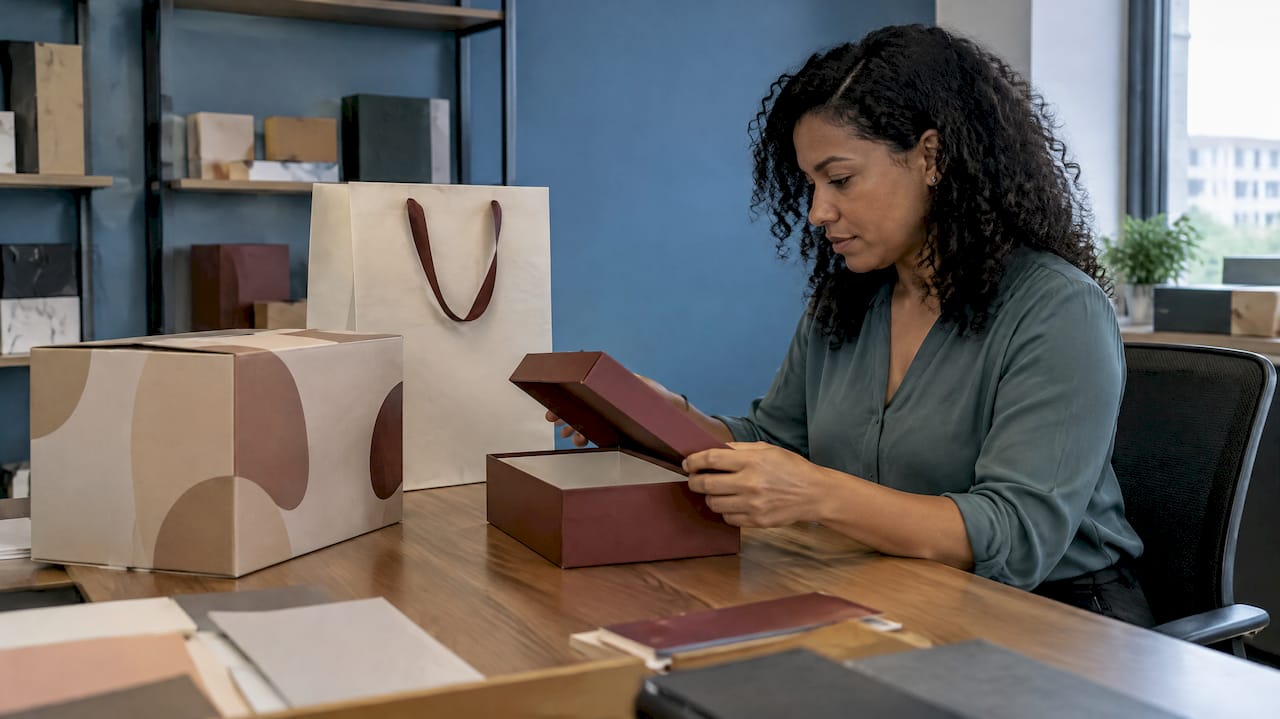
Custom printed packaging is any box, label, bag or carton made to your dimensions and printed with your artwork, so the pack carries your brand from the shelf to the unboxing. For premium brands the result depends less on the print itself than on how well structure, substrate, finish and compliance are decided together before a single sheet goes on press. At Yuan Packaging, a custom manufacturer in Huai'an, China, we make pressure-sensitive labels, rigid gift boxes, carrier bags and folding cartons for beauty, wine, spirits, pharmaceutical and gourmet food brands, and this guide follows the way those projects are specified.
TL;DR
- Decide the format first (label, folding carton, rigid box, bag or corrugated mailer), then the substrate, then the finish. The finish has to suit the material, not the other way round.
- Print method follows run size: digital for short or variable runs, offset for the best quality and lowest unit cost at scale, flexo for high-volume labels and flexible packs.
- Prepare artwork on a proper dieline with bleed, spot colors and finishes on separate layers. Most delays start here.
- Wine, spirits, pharma and cosmetics carry label rules that vary by market. Settle the copy and any approvals before you commit to production.
- Ask for finishes to be priced per unit before you commit, and keep them restrained.
Table of Contents
- What custom printed packaging covers
- Start with the job the pack has to do
- Choosing a format by industry
- Print methods: match the process to the run
- Finishes: where premium is made or lost
- Preparing artwork the right way
- Compliance: check the copy before you print
- Sustainable choices that stand up to scrutiny
- How an order typically runs
- Our perspective
- Plan your project with Yuan Packaging
- FAQ
- Sources
What custom printed packaging covers
The phrase covers more than a printed box. In practice you are choosing among five families, and most premium launches combine two or three of them:
| Format | Typical role | Premium use |
|---|---|---|
| Pressure-sensitive labels | Identity on a bottle, jar, tube or vial | Wine, spirits, cosmetics, pharma |
| Folding cartons | Retail unit pack, flat-shipped | Skincare, fragrance, supplements, gourmet food |
| Rigid gift boxes | Presentation and gifting | Collector editions, sets, candles |
| Paper carrier bags | Point-of-sale and gifting | Boutiques, seasonal campaigns |
| Corrugated and e-commerce boxes | Shipping and retail-ready packs | Direct-to-consumer delivery |
A label is not a sticker. Labels are specified by face material, adhesive, finish and the surface they must stick to, which is why we treat them as an engineering decision; our guide to labels versus stickers explains the difference in buying terms.
Custom branded packaging, packaging with a logo and printed packaging all describe the same thing. What changes from project to project is how much of the pack is printed, how it is finished and how it must behave in transit.
Start with the job the pack has to do
Packaging has two jobs. Appearance covers size, shape and printing. Function covers protecting the product and making manufacturing, packing and use efficient. The Pro Carton folding carton module frames carton design in exactly those two halves. Luxury work is hard because both are demanding at once.
A 2025 trade report on premium packaging describes the same tension: high-end aesthetics and a memorable unboxing have to coexist with e-commerce logistics and durability, and the case studies it cites solved that through close collaboration and careful material choices (Packaging Insights, December 2025).
So before you brief a manufacturer, write down:
- The channel. Shelf, gifting, travel retail, e-commerce or clinical supply. A box that sits on a shelf can be delicate; one shipped to homes cannot.
- The product's weight, fragility and fill. A glass bottle needs a different structure than a lipstick.
- The SKU map. How many variants, sizes and languages share one structure.
- The markets. Where it will be sold decides the mandatory copy and any material rules.
- The budget per unit. Include finishes, inserts and any special tooling.
Choosing a format by industry
Beauty and cosmetics
Skincare and fragrance usually live in folding cartons at retail, with a rigid box for sets and launches. Our tuck-end cartons suit light, regularly replenished lines, while window cartons let the color of the product show through a die-cut opening. Cosmetic labels on jars and tubes need adhesives and face stocks that cope with oils and humidity, so state the container material and the formula type in your brief.
Wine and spirits
The label is the product's first signature. Premium wine and spirits labels typically combine textured paper, foil and embossing, and must survive ice buckets and condensation. Our guide to premium spirits label printing walks through those choices. For gifting, shoulder-neck rigid boxes and bottle and gift set carrier bags complete the presentation. Where grey-market diversion or counterfeits are a concern, anti-counterfeit labels add a layer of authentication.
Pharmaceuticals
Here the pack is a compliance document as much as a brand surface. Copy, warnings, barcodes and legibility come first, and a printed finish must never compromise readability. Folding cartons and labels are the usual formats, and the artwork has to be locked to approved text before it reaches prepress.
Gourmet food and seasonal ranges
Seasonal launches have fixed windows, so the format should let you change artwork without changing structure. A single carton or rigid box structure with new printed sleeves, labels or bags across the year keeps lead times predictable. Ribbon handle paper bags and rigid candle boxes show how the same brand system extends across formats.
Print methods: match the process to the run
The printing process follows the quantity and the product. According to Made Good Designs' packaging design guide (June 2026), digital suits short or variable runs, offset lithography gives the best quality and lowest per-unit cost at scale, and flexo suits flexible packaging and labels at high volume.
In practical terms:
- Digital works for pilot launches, regional variants and limited editions where artwork changes often.
- Offset fits cartons and rigid-box wraps where color accuracy and a low unit price matter at volume. It needs plates, so artwork should be final before it runs.
- Flexo is the standard for pressure-sensitive label rolls in volume.
If a design uses a brand color that must match across a label, a carton and a bag, specify it as a spot color on every item and ask for a printed color reference to approve.
Finishes: where premium is made or lost
Finishing is what turns a functional pack into a desirable one. The usual toolkit is foil stamping, embossing and debossing, spot UV and soft-touch lamination, which we cover in our finishes overview. Two rules keep them working:

Match the finish to the substrate. Made Good Designs notes that soft-touch laminate over kraft fights the natural look and that spot UV needs coated stock to register cleanly (source). Foil is the most forgiving on smooth, dense boards and texture-free label stocks. Our guides to foil stamping and to metallic inks versus foil help you choose between a true metallic shine and a printed approximation.
Use restraint. The same guide observes that foil, embossing and spot UV signal quality when used sparingly, and look try-hard when piled on. One hero effect per pack, placed where the hand and eye land first, is a safer approach than four.
Finishes also have to travel well with the pack's structure. A gift set that pairs a premium foldable gift box with a printed sleeve can look cohesive if the finishing language is shared.
Always ask for finishes to be priced per unit at your intended volume before you approve a design. A foil panel that looks modest on screen can add real cost across a large run.
Preparing artwork the right way
The artwork stage is where most schedules slip, so it is worth doing methodically. Our artwork preparation guide goes deeper; the core steps are:
- Get the dieline. The dieline is the flat blueprint of every cut, crease, fold and glue tab, and the most important technical file in the project (Made Good Designs). Build your design on the manufacturer's dieline, not a generic template.
- Set up color. Supply CMYK plus any spot colors, and keep the dieline on its own non-printing layer.
- Add bleed. Extend backgrounds beyond the trim edge so a small cutting shift never shows a white sliver.
- Separate the finishes. Foil, embossing and spot varnish each need their own layer, so the maker knows exactly where they go.
- Check the images and codes. Use high-resolution linked images, and vector barcodes and QR codes.
- Approve a proof. Review a white mock-up for fit and a printed proof for color before production.
A white sample, an unprinted version of the structure, is often the cheapest insurance you can buy: it reveals fit, closure and feel before ink is involved.
Compliance: check the copy before you print
Rules differ by product and by market, so decide where you will sell before finalizing artwork.
Wine and spirits in the US. Distilled spirits and wines with 7% to 24% alcohol by volume sold across state lines need a certificate of label approval (COLA) from the Alcohol and Tobacco Tax and Trade Bureau. Products sold only within the state where they are bottled may qualify for an exemption certificate instead (TTB label approval basics). Get approval of the label artwork before ordering a large run, because a change after printing means a reprint.
Cosmetics, food and pharmaceuticals. Mandatory statements, ingredient lists, warnings and barcodes depend on the product category and the destination market. Confirm the final text with your regulatory contact, then lock it in the artwork.
Selling into the EU. The Packaging and Packaging Waste Regulation, Regulation (EU) 2025/40, entered into force on 11 February 2025 and generally applies from 12 August 2026, with obligations phased in until 2040. It covers recyclability, recycled content, substances such as PFAS and heavy metals, and harmonized labeling, and it applies to food, cosmetic and pharmaceutical packaging (Tentamus). We summarize what it means for printed packaging in our PPWR briefing.

Sustainable choices that stand up to scrutiny
Sustainability is now part of the premium brief. The practical way to do it well is to specify materials you can verify. Options include FSC or PEFC certified boards, recycled board, vegetable-based inks and water-based coatings, with minimal ink coverage and restrained foils. USM Designer also recommends linking or QR-coding to a sustainability page rather than putting unverifiable claims on the pack (USM Designer, 2025).
Finishes are part of this conversation too. Trade coverage reports that advances in lamination mean some film laminates are now considered curbside recyclable (Packaging Impressions, 2023). We can work to specific requirements such as FSC certification, so state your certification and end-of-life goals in the first brief.
How an order typically runs
Brands commission custom packaging per order, often through a request for quote. To get a precise quote and avoid rounds of clarification, send:
- The format and internal dimensions of the product.
- Quantity per SKU, and the number of SKUs.
- Material and certification preferences.
- Finishes, with the areas they apply to.
- Destination markets and any approvals needed.
- Your launch date, so the schedule can be worked back from it.
From there the sequence is structure and dieline, white sample, artwork, proof, production and quality checks. The earlier the structure is fixed, the fewer surprises in the late stages.
Our perspective
Premium packaging is a small ceremony. The customer touches the pack before they touch the product, so every decision about substrate, edge, finish and label placement is part of the brand's first sentence.
With over 25 years of experience and 100 million units delivered to more than 5,000 brands, we have learned that the best results come from deciding structure, material and finish together, not in sequence. A foil that suits one board can fail on another; a label that looks perfect flat has to wrap a curved bottle.
That is why we work like an atelier: expert guidance from concept to finished product, precision in production, and sustainable options such as FSC-certified materials where your brief calls for them. When labels, cartons, rigid boxes and bags come from one maker, your brand reads as one voice across the whole range.
Anthony
Plan your project with Yuan Packaging
If you are specifying packaging for a beauty, wine, spirits, pharmaceutical or gourmet food range, we make pressure-sensitive labels, rigid gift boxes, carrier bags and folding cartons with finishes including foil stamping, embossing, spot UV and soft-touch lamination. Tell us the format, quantity and finish you have in mind through our quote form and we will take the brief from there.
FAQ
What is the difference between custom printed packaging and stock packaging with a logo?
Custom printed packaging is built to your dimensions, material and artwork, with its own dieline and tooling. Stock packaging is a standard size with your mark added. For premium products where fit, feel and finish carry the brand, a custom structure is the usual choice.
Which print method should I choose?
Let quantity and design guide you. Digital suits short and variable runs, offset gives the best quality and lowest unit cost at scale, and flexo suits high-volume labels (Made Good Designs). Tell your manufacturer the volume per SKU and they can recommend the best fit.
Can I use the same finish on labels and boxes?
Yes, and it helps the range look unified, but check each substrate. Foil, embossing and spot UV behave differently on label stock, coated board and kraft, so confirm the finish on each material before approving the design.
Do my labels need approval before printing?
For wine and spirits sold across US state lines, yes: a COLA from TTB is required for covered products (TTB). Cosmetics, food and pharmaceutical labels have their own mandatory text, so finalize it before artwork goes to prepress.
What should I send to get an accurate quote?
Send the format, dimensions, quantities per SKU, material and certification needs, finishes, destination markets and launch date. The more complete the brief, the fewer revisions between request and proof.
Sources
- Premium luxury packaging: Aligning brand experience, e-commerce and sustainability (Packaging Insights)
- Folding Cartons module (Pro Carton)
- The Packaging Design Process: A Complete Guide (Made Good Designs)
- TTB Label Approval Basics
- Creative Design Packaging: 2025 Guide (USM Designer)
- Operational Guide: Finishing and Embellishing Labels and Packaging (Packaging Impressions)