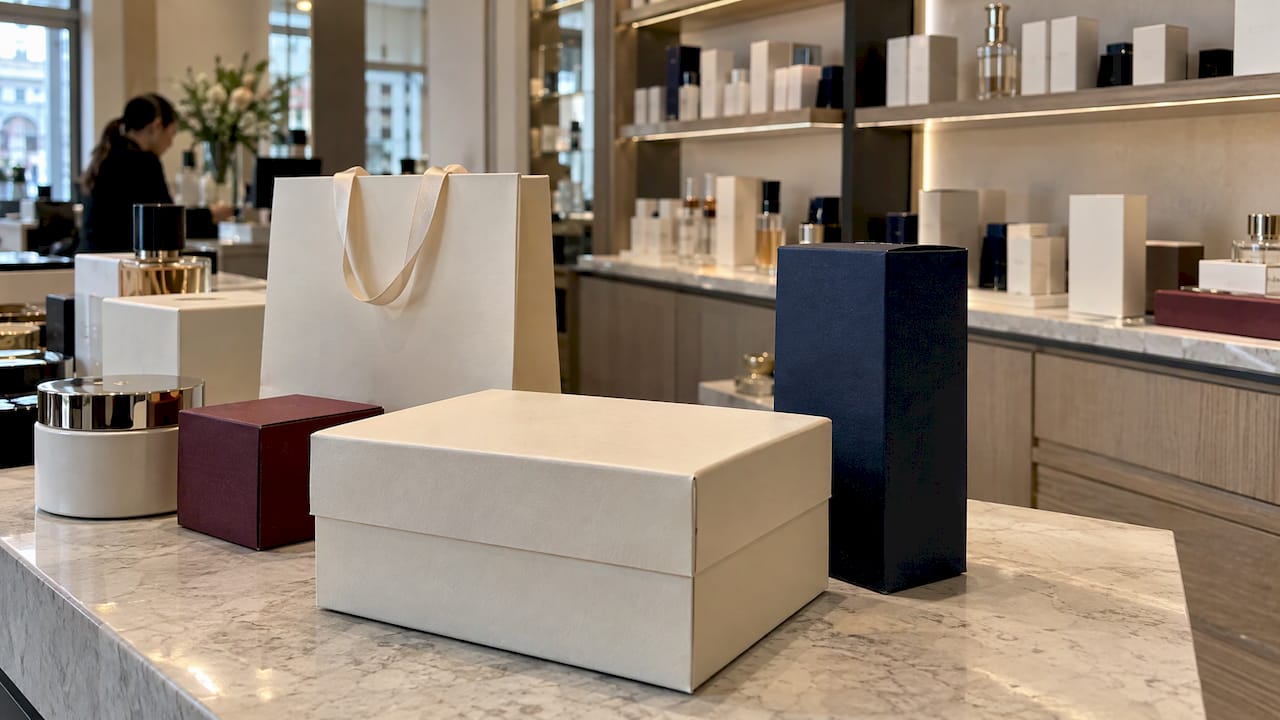
Luxury retail packaging is the box, bag, carton and label system that makes a premium product look and feel worth its price at the shelf and in the hand. The best systems pair a structure that suits the product (a rigid box, a folding carton, a carrier bag) with restrained, well-executed finishing and a label that meets the rules of the market where you sell. This guide shows you how to choose each part, what to specify, and how a bespoke order runs from brief to delivery.
TL;DR
- Pick the structure first (rigid box, folding carton, carrier bag or label), then choose finishes that support the brand rather than decorate it.
- Research suggests that space and texture influence perceived luxury, so one or two well-chosen finishes often beat a pile of effects.
- Labels carry legal content. Plan the artwork around the required information for your product and market before you design.
- If you sell in the EU, new packaging rules target unnecessary layers, so design for the product rather than for bulk.
- Send a manufacturer a complete brief (product dimensions, volumes, finishes, deadlines) to get an accurate quote and a smooth seasonal launch.
Table of Contents
- What makes retail packaging feel luxurious
- Choosing the right format for your product
- Finishes and materials: what each one does
- Designing luxury labels that comply
- From brief to shelf: how a custom order runs
- Our perspective
- Work with Yuan on your next packaging project
- FAQ
- Sources
What makes retail packaging feel luxurious
Luxury is a set of signals that add up: weight, structure, surface, restraint and precision. Buyers read these within seconds, often before they read a word.
Two pieces of research are worth knowing. A 2024 study of 833 participants in Japan found that larger whitespace on a package raised perceived luxury and product quality. The same study found the effect could disappear when high-end fonts or visual textures were added. The practical lesson: when you use a rich finish, give it room, and do not stack every signal on one panel.
A second finding concerns touch and opening. Bentley University reported in 2026 that raised textures made chocolate seem more indulgent, and that more intricate opening mechanisms produced higher perceived quality and willingness to pay. It also found scent could raise perceived luxury but reduce satisfaction when it overwhelmed the experience. That study covered chocolate, so treat it as a direction for testing in your own category, not a guarantee.
For a brand manager, this translates into a short checklist:
- Structure: a lid that lifts with a slight resistance, a drawer that glides, a shoulder-neck that seats the lid slowly.
- Surface: texture you can feel, such as embossing, soft-touch lamination or a textured paper stock.
- Restraint: generous negative space and one clear focal point.
- Consistency: the box, bag, carton and label should look like one family.
Think of the unboxing as a small ceremony: a narrative moment with a beginning (the bag), a middle (the box) and an end (the product and its label).
Choosing the right format for your product
The right format depends on what you sell, how it is shipped, and where the customer first meets it. Here is how the main formats compare.
| Format | Best for | Strength | Watch for |
|---|---|---|---|
| Rigid gift boxes | Skincare sets, fragrance, candles, gift sets, premium spirits | Structure and perceived value | Higher unit cost and bulk in storage and freight |
| Folding cartons | Single cosmetics, pharmaceutical items, retail units | Efficient to ship flat, strong print surface | Needs a carefully drawn dieline |
| Paper carrier bags | In-store carry-out, gifting, boutique retail | Brand visibility outside the store | Handle and gusset choice affect load capacity |
| Pressure-sensitive labels | Bottles, jars, tubes, cans | Direct brand carrier and regulatory space | Material and adhesive must suit the container |
| Corrugated and e-commerce boxes | Direct-to-consumer shipments | Protection in transit | Printed interior can extend the brand moment |
Rigid boxes: the signature of luxury
A rigid box is made from thick board wrapped in printed paper, which gives it the weight buyers associate with premium goods. Common structures include the top-and-base box, the book-style hinged box, the drawer box and the shoulder-neck box. There are also category-specific designs such as rigid candle boxes. For fragrance, inserts and sizing matter as much as the finish, which our fragrance box design guide covers.
Folding cartons: precision at volume
Folding cartons suit products sold in larger quantities, including cosmetics and pharmaceuticals. A tuck-end carton is the classic option, and a window carton lets the product show through. Our guide to folding carton design explains styles, dielines and specs.
Carrier bags: the brand walking out the door
A bag extends your packaging beyond the store. A ribbon handle paper bag feels gift-ready, and a bottle and gift set carrier is built for wine, spirits and set products. If you want a reusable option, consider non-woven carrier bags.
Matching format to sector
- Beauty and fragrance: rigid boxes or cartons with soft-touch and foil, plus an inner insert.
- Wine and spirits: a shoulder-neck or drawer box, a carrier bag and a textured label. See our wine and spirits packaging guide.
- Pharmaceutical: folding cartons and labels where clarity of information comes first.
- Gourmet food: seasonal rigid boxes and cartons built around the gifting calendar, as described on our food and beverage packaging page.
You can browse more sectors on our industries page.
Finishes and materials: what each one does
Finishing is where a plain printed box becomes something collectible. Each option changes how the package looks, feels and photographs, so choose by effect rather than by novelty. You can see the full range on our finishes page.
| Finish | What it adds | Best used for |
|---|---|---|
| Foil stamping | Metallic shine on logos and key lines | Brand marks, product names |
| Embossing | Raised relief you can feel | Logos, patterns, seals |
| Debossing | Pressed-in, quiet detail | Understated, tactile marks |
| Spot UV | Glossy contrast on a matte surface | Highlights on a logo or pattern |
| Soft-touch lamination | Velvety, matte surface | Full panels on boxes and cartons |
| Textured paper | Natural grain and depth | Labels and wrapped boxes |
Our article on embossing versus debossing explains the difference and what each costs. For labels, textured paper stocks give a premium handfeel and should be chosen for how they perform on press and on the bottle.
Pro tip: edit your finishes
Given the research above on whitespace and texture, a good rule is one hero finish and one supporting finish per panel. A foil logo on a soft-touch box with plenty of open space often reads as more premium than five effects competing. Ask for a physical sample or prototype before approving a large run so you can judge the finishes in your hands, under store lighting.

Materials and sustainability
Material choices carry both feel and footprint. Options include FSC-certified board and paper, which we can specify on request, and lighter structures that protect without excess. Our piece on why leading brands are rethinking packaging sustainability goes deeper.
Regulation is also moving. In the European Union, the Packaging and Packaging Waste Regulation (PPWR) does not ban luxury packaging, but it challenges features such as double walls, false bottoms and unnecessary layers. The same coverage notes that marketing and consumer acceptance alone should not justify extra packaging weight and volume. If you sell in the EU, plan for this now. If you sell only in the US, the principle still helps: a right-sized structure usually ships better and wastes less.

Designing luxury labels that comply
A label is the smallest piece of luxury packaging and the one with the most rules. Build the artwork around the required content first, then add finish.
Cosmetic labels
In the United States, the FDA says the principal display panel must state the product name, identify its nature or use, and carry an accurate statement of net quantity of contents. The same page explains that requirements such as ingredient labeling and net quantity apply to the outer container label. Check the FDA page for the full list and for how your product is classified, and confirm requirements for any other country where you sell.
Wine and spirits labels
Alcohol labels are regulated at the national level, and requirements differ by market and product type. In the US, the Alcohol and Tobacco Tax and Trade Bureau (TTB) oversees them, so confirm the mandatory statements and label approval process with TTB before you finalize artwork. Design the layout so the mandatory text has a clear, legible home, then place decorative elements around it. Our wine labels page covers what we produce, and our premium spirits label printing guide explains material and finishing decisions. For a wider view of boxes, bags and labels working together, see our wine packaging manufacturing page.
Pharmaceutical labels
Pharmaceutical labels are shaped by regulators and by your quality system. Treat legibility and accuracy as the design brief, and have your regulatory team approve content before artwork goes to production. Where counterfeiting is a concern, anti-counterfeit labels add a layer of authentication.
Choosing label materials
Pressure-sensitive labels depend on the face stock, the adhesive and the surface they will sit on. Wet bottles, cold storage, curved jars and oily creams all change the requirement. Our pressure-sensitive label specification guide walks through materials and adhesives so you can write a precise spec.
From brief to shelf: how a custom order runs
A bespoke packaging project follows a predictable path. Knowing the steps helps you plan around a launch.
- Write the brief. Include the product, its dimensions and weight, the sector, the quantity range, target finishes, material needs (such as FSC) and your launch date.
- Request a quote (RFQ). The more complete the brief, the more accurate the quote. Missing dimensions or finish details are the most common reasons quotes change.
- Develop structure and artwork. The manufacturer prepares a dieline for your structure. You supply artwork or work from the dieline with your designer.
- Prototype and sample. Approve structure, color and finish on a physical sample before committing to the full run.
- Produce and inspect. Production runs follow approved samples, with quality checks at key stages.
- Ship and receive. Plan freight, customs and warehouse space. Rigid boxes take more room than flat-packed cartons.
Planning for seasonal launches
Seasonal gifting windows are fixed, while production and freight are not. Work backward from your in-store date:
- Allow time for sampling and at least one revision round.
- Add freight time, especially for overseas shipping.
- Build in a buffer for artwork or compliance changes.
- Decide early whether you want a repeat run, since reorders are simpler when specs are locked.
Lead times depend on structure, finish and quantity. Ask for a schedule against your launch date when you send your RFQ.
Our perspective
We make luxury packaging every day, and the pattern is consistent: the boxes that feel most expensive are rarely the most decorated.
They are the ones where structure, material and finish were decided together, with the label and the bag in mind from the start. That is how we work at Yuan. We bring atelier-like craftsmanship and high-precision production to each project, and we guide you from concept to finished product.
Our view is that a premium package should be designed for the product it holds, with finishes chosen to carry the brand and with sustainable material options, including FSC certification where you need it, treated as part of the specification and not as an afterthought.
If you give us a clear brief, we can help you decide where a finish earns its place and where open space will do more work.
Anthony
Work with Yuan on your next packaging project
We are a custom packaging manufacturer based in Huai'an, China, producing rigid gift boxes, folding cartons, carrier bags and pressure-sensitive labels for beauty, wine and spirits, pharmaceutical and gourmet food brands. Send us your brief and we will help you match structure, finish and materials to your product and your launch calendar.
Start on our custom packaging homepage, or go straight to rigid gift boxes if a box is your first priority. If you are still comparing options, our guide to the best luxury packaging manufacturers explains what to look for, and our piece on gift box design trends shows where premium retail is heading.
FAQ
What is luxury retail packaging?
It is the set of boxes, bags, cartons and labels used to present premium products in stores and to customers. It combines a well-built structure, quality materials and refined finishes such as foil stamping, embossing and soft-touch lamination. The goal is to make the product look and feel as valuable as its price suggests.
Which finishes matter most for a premium look?
Foil stamping, embossing and soft-touch lamination are the most common choices because they change how a package looks and feels. Research on whitespace suggests that space around them matters too. Choose one hero finish and one supporting finish, then review a physical sample.
Do I need to worry about packaging regulations?
Yes, mainly for labels and for specific markets. In the US, cosmetics labels follow FDA rules and alcohol labels fall under TTB oversight. In the EU, PPWR is changing expectations around packaging weight, volume and recyclability. Confirm requirements with the relevant regulator for each country where you sell.
What should I include when requesting a quote?
Give your product dimensions and weight, the packaging format, quantity range, desired finishes, material requirements such as FSC, destination country and the date you need the goods in store. A complete brief allows a more accurate quote and helps avoid revisions later.
Can one manufacturer supply the box, bag and label together?
Yes. We produce rigid boxes, folding cartons, carrier bags and pressure-sensitive labels, which helps you keep color, finish and material consistent across the whole package. Share the full set in one RFQ so the pieces are planned together.
Sources
- Study on package whitespace and perceived luxury (J-STAGE, 2024)
- Bentley University: how packaging influences chocolate choices
- Packaging Gateway: how PPWR is redefining premium for luxury packaging
- FDA: Summary of Cosmetics Labeling Requirements