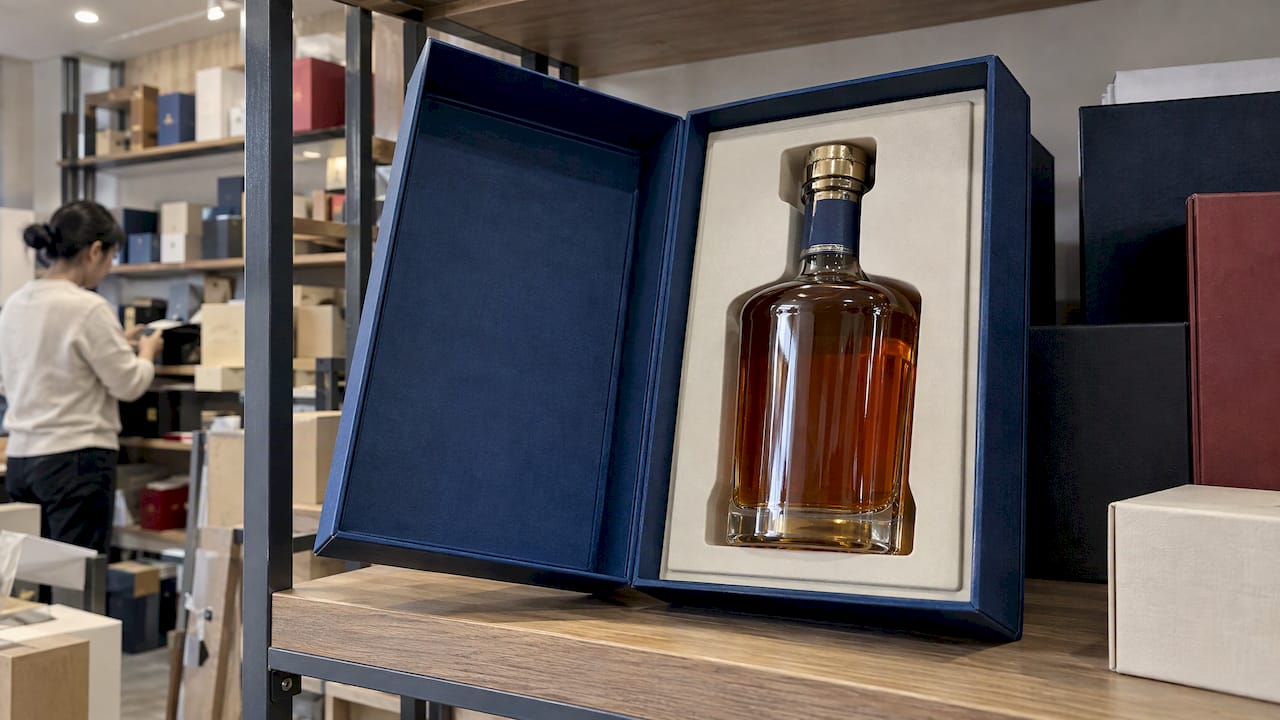
A spirits gift box does three jobs at once: it protects a heavy glass bottle, it signals the price tier before anyone reads the label, and it makes the bottle easy to give. The brands that get all three right start from the structure and the board, then choose finishes and labels to match. We make custom rigid boxes, folding cartons, carrier bags and pressure-sensitive labels for wine and spirits brands, and this guide walks through the decisions in the order we would take them with you.
TL;DR
- Choose the structure first (rigid shoulder-neck, drawer, book-style or windowed folding carton), because it sets cost, protection and unboxing in one move.
- Premium boxed spirits typically use heavy two-sided folding box board, and finishes such as foil, embossing and spot varnish need to be tested on that exact board.
- Gift ranges are often hand-packed, which frees up shape and finish, but the box must survive repeated removal and replacement of the bottle.
- The label, the box and the carrier bag should be specified together so the print, colors and finishes read as one system.
- In the US, premium packaging has its own regulatory angle: brief your compliance adviser before you finalize a retailer offer.
Table of Contents
- What a spirits gift box actually is
- Box styles and structures for liquor bottles
- Boards, windows and inserts
- Finishes that raise the perceived value
- Designing for gifting, retail and shipping
- The label belongs in the same brief
- Balancing premium look, practicality and sustainability
- US compliance: brief it before you finalize the offer
- A step-by-step brief for your gift box
- Plan your spirits gift boxes with Yuan
- FAQ
- Sources
What a spirits gift box actually is
A spirits gift box is secondary packaging: it holds a bottle that already has its closure and label, and it is built for presentation and giving rather than for the bottling line. It can hold one bottle, a bottle with glasses, or a bottle with mixers and miniatures.
The US trade also treats this as a distinct category. Regulators describe value-added packages as gift packages of alcoholic liquor received from a manufacturer or wholesaler, including special packaging such as holiday boxes and gifts that combine alcohol with nonalcoholic items. The TTB, the federal alcohol regulator, has also issued guidance on premium gift packaging such as distinctive decanters and wooden or tin boxes. We come back to why that matters for your sales terms in the compliance section below.
For a brand manager, the practical meaning is simple. The gift box is where you have the most design freedom and the most visible return, so it deserves its own specification, not a leftover line on the bottle brief.
Box styles and structures for liquor bottles
Most premium spirits gift packaging falls into a handful of structures. Each solves a different problem.
| Structure | How it works | Best suited to |
|---|---|---|
| Shoulder-neck rigid box | A rigid base and a lid that sits over a raised neck, giving a refined reveal | Flagship and limited-edition bottles |
| Drawer box | A sleeve with a slide-out tray | Gift sets with glasses or accessories |
| Book-style hinged box | A hinged lid that opens like a book | Collector editions and presentation sets |
| Window carton | A folding carton with a die-cut opening that shows the bottle | Seasonal runs and retail shelf impact |
| Tuck-end carton | A folding carton with tucked closures at both ends | Core range gifting at larger volumes |
Rigid boxes are built from a thick board wrapped in printed paper, so they hold their shape and feel substantial in the hand. Folding cartons are printed and die-cut from paperboard and ship flat, which suits larger runs. Our rigid gift box range and folding carton range cover both routes, so you can compare them against the same bottle rather than commit to one before you see the options.
Pro Tip: Decide whether the bottle is shown or revealed. A window changes your whole print strategy because the glass, the liquid color and the label become part of the box design.
Boards, windows and inserts
The board is the part nobody photographs and everybody feels. Packaging Scotland reports that premium boxed spirits tend to use 700μm two-sided folding box board, and that ink rub, foil, transit and bottling-line tests are part of verifying that the board performs with the chosen print, folding, gluing and finishes. If you are specifying a folding carton, ask for those tests to be run on your artwork, not on a generic sample.
Windows deserve the same care. Packaging Digest describes E. & J. Gallo's spirits gift cartons as using .024 SBS board with heavy-gauge PVC or acetate film forming full-panel windows in die-cut openings. The film is sometimes scored and folded to wrap around two panels, so the bottle can be seen from more than one side. The XO brandy carton in the same report used a single die-cut oval window in a dark, classic-style package. Both approaches work: a full window is open and retail-friendly, a small oval is restrained and traditional.

Packaging Scotland also points to craft details that signal status. A flap cut to fit neatly around the bottle neck, or a flap folded in on itself so there is no raw edge, tells the buyer the package was made with care. These are small structural decisions, and they cost little compared with the impression they create.
Inserts: where protection and presentation meet
The insert holds the bottle still, controls how it rises out of the box and frames it visually. When you brief an insert, settle these points:
- Bottle dimensions with tolerance. Glass varies from batch to batch, so supply the real bottle and the drawing.
- Neck and shoulder support. The bottle should not rock when the box is tilted.
- Pull or lift mechanism. Gift boxes are opened, closed and reopened, so the removal path matters.
- Extras. Glasses, miniatures or cards change the cavity layout and the box depth.
We develop these structures with you from concept to finished product, and a physical bottle sent early removes most surprises later.
Finishes that raise the perceived value
Finishes are how a box earns its price tier. Packaging Scotland notes that premium spirits cartons usually combine foiling, embossing, debossing and spot varnishing. Our own finishes range includes foil stamping, embossing, spot UV and soft-touch lamination.
A useful way to choose is to give each finish one job:
- Foil stamping for the brand mark or a single heritage detail. Use it on the element the eye should find first.
- Embossing or debossing for texture you can feel, such as a crest, a distillery emblem or a pattern.
- Spot UV to add contrast, for example a gloss mark on a matte field.
- Soft-touch lamination for the velvet feel of the whole surface, which suits dark, deep colors.
Stacking all four on one panel rarely looks luxurious. Two or three deliberate finishes, placed where a hand or an eye lands, read as confident. Because finishes behave differently on different boards and papers, we recommend approving them together on the real material.
Designing for gifting, retail and shipping
Where the box will live changes how you build it.
Gifting. Packaging Scotland observes that limited-edition and gifting ranges are often hand-packed, which gives greater flexibility in box shape, form and finishes because the packaging does not have to survive a production line. The same source adds that the board, print, gluing and finishes must still withstand repeated removal and replacement of the bottle. A rigid structure is a natural answer here.
Retail shelf. A shelf gives you seconds. Strong contrast, a clear window or one bold finish is what carries across a store. The shape trends are worth watching too: SevenFifty Daily's 2022 forecast said standard 750 ml wine gift boxes seemed to be fading while 750 ml gift tins stayed popular, and that producers were looking at oval or pyramid shapes. The same piece lists logo cocktail glass sets, non-alcoholic mixers and mini bottles among popular value-added extras, and advent calendars and limited-edition bottlings among holiday draws. Treat these as prompts for your own range, not as rules.
Shipping. If bottles travel to consumers, the gift box usually needs an outer shipper. Our corrugated and e-commerce boxes are made for that role, and the gift box inside stays pristine. For in-store gifting, a bottle and gift set carrier bag completes the experience at the till.

For wider reading on trends, our journal covers gift box design trends shaping premium retail in 2026, and the wine and spirits packaging guide connects labels, boxes and carriers.
The label belongs in the same brief
A beautiful box around a mismatched label breaks the illusion. The label is the first thing a buyer reads when the lid comes off, so its paper, ink and finishing should speak the same language as the box: the same foil tone, the same emboss logic, the same color values.
We produce pressure-sensitive labels for wine and spirits, and you can see the range on our wine and spirits labels page. For a deeper look at materials, adhesives and finishes, read our guide to label printing for premium spirits. If counterfeiting is a concern for your higher-priced bottlings, we also make anti-counterfeit labels.
Commissioning labels, boxes and bags together means one set of colour references across every piece and one conversation about timing, which matters when a seasonal launch has a fixed shelf date.
Balancing premium look, practicality and sustainability
Luxury and sustainability are no longer opposites, and the board is where they meet. Packaging Scotland argues that specification should never compromise on substrate weight, performance or sustainability even when board supply chains are under pressure. In practice, that means asking three questions before you approve a sample:
- Does the board weight carry the bottle without flexing at the lid or the shoulders?
- Do the finishes you want work on this material, or do they need a different surface?
- Is the material certified to the standard your retail partners expect?
On the last point, we can work to requirements such as FSC certification, and sustainable material options are part of our range.
A practical rule: put the premium effort where the consumer touches and sees, and keep the hidden structure efficient. A pristine lid with a well-judged insert beats an overbuilt box with a crowded surface.
US compliance: brief it before you finalize the offer
If you sell into the United States, the packaging decision has a commercial side. The TTB's Industry Circular 12-02 states that requiring a retailer to buy a minimum quantity of standard-pack product in order to obtain the same product in a premium package is an unlawful tie-in sale under the Federal Alcohol Administration Act. The circular names distinctive decanters and wooden or tin boxes among premium gift packaging.
In plain terms: design the gift box as you like, but have your compliance adviser or attorney review how you offer it to retailers and distributors. Individual states also have their own rules on what a licensed store may sell alongside alcohol, as the Connecticut guidance on value-added packages shows. Packaging that holds alcohol with other items, such as glasses or mixers, is the area where state rules are most likely to matter, so confirm the details for each state you sell in.
A step-by-step brief for your gift box
Here is the sequence we suggest when you commission a spirits gift box.
- Define the role. Is this a flagship, a seasonal release, a retailer exclusive or an e-commerce gift? The answer drives structure and budget.
- Send the real bottle. Share the bottle, its dimensions and its closure details so inserts and cavity sizes are right the first time.
- Choose the structure. Use the table above, and request two options if you are torn between rigid and folding carton.
- Set the board and the finish plan. Name the finishes and where each sits, then confirm they suit the chosen material.
- Align the label. Match foil, texture and colour to the box, and confirm label materials for the bottle surface.
- Plan the outer layers. Add a shipper, a carrier bag or both, depending on your route to the buyer.
- Approve a sample. Open, close and lift the bottle out many times before you sign off.
- Fix your timeline. Work backward from your shelf or gifting date, and leave room for sampling.
This is the route we take brands through: concept, structure, materials, finishes and production, with one team behind every layer.
Our view: a gift box is a small ceremony
We have spent more than 25 years making packaging for beauty, wine, spirits and lifestyle brands, and more than 100 million units have left our factory in Huai'an for over 5,000 brands. What stays constant is this: the moment someone lifts a lid is a narrative moment, and the box should tell the same story as the liquid.
That is why we work like an atelier. We treat the structure, the board, the finish and the label as one piece of craft, not four purchases. A foil stamp that is a fraction off, a window that does not frame the bottle, an insert that lets the glass rock: each is small, and together they decide whether the bottle feels collector-grade.
Our advice is to give us the bottle early, name the feeling you want in the buyer's hands, and let us show you what the structure and finishes can do. Precision at the sample stage is what makes the full run feel effortless.
Anthony
Plan your spirits gift boxes with Yuan
We are a custom packaging manufacturer in Huai'an, China, producing luxury rigid gift boxes, labels, carrier bags and folding cartons for wine, spirits, beauty and lifestyle brands. Our range includes foil stamping, embossing, spot UV and soft-touch lamination, with sustainable materials and FSC certification available on request.
If you have a bottle, a launch date and a vision for the unboxing, tell us about your project and we will guide you from concept to finished product.
FAQ
What is the best box style for a premium spirits gift?
For flagship and limited-edition bottles, a rigid shoulder-neck, drawer or book-style box gives the most substantial feel. For seasonal runs where shelf impact and volume matter, a windowed folding carton is a strong option. The right choice depends on the bottle, the buyer and the budget.
What board is used for premium spirits cartons?
Packaging Scotland reports that premium boxed spirits tend to use 700μm two-sided folding box board. Rigid boxes use a thicker wrapped board for greater structure. Whichever you choose, test the board with your print and finishes.
Can a gift box include glasses or mixers?
Yes, and extras such as logo glasses, mixers and miniatures are popular value-added items, according to SevenFifty Daily's forecast. They change the insert layout and box depth, so plan them at the briefing stage. In the US, check state rules on packages that combine alcohol with other items.
Should the label match the gift box?
Yes. The label is read first when the lid opens, so foil tone, texture and color should align with the box. Specifying them together keeps the whole presentation consistent.
Sources
- Industry Circular 12-02, TTB
- What Items Can I Sell at a Package Store, Connecticut Department of Consumer Protection
- Achieving stand-out in a crowded spirits market, Packaging Scotland
- Windowed gift-packs lift spirits, Packaging Digest
- The Retail Forecast for Wine and Spirits Gift Packaging, SevenFifty Daily